Redox‐dependent binding and conformational equilibria govern the fluorescence decay of NAD(P)H in living cells
Thomas S. Blacker, Nimit Mistry, Nicoletta Plotegher, Elizabeth R. Westbrook, Michael D. E. Sewell, John Carroll, Gyorgy Szabadkai, Angus J. Bain, Michael R. Duchen

TL;DR
This study explains how enzyme binding and redox states affect the fluorescence decay of NAD(P)H in living cells, improving its use as a metabolic reporter.
Contribution
The study identifies how redox states control NAD(P)H binding configurations, influencing fluorescence decay in live cells.
Findings
Time-resolved anisotropy imaging reveals multiple enzyme binding configurations of NAD(P)H with varied fluorescence lifetimes.
Redox states of NAD and NADP pools govern the equilibrium of these binding configurations.
These findings provide a foundation for accurate interpretation of NAD(P)H FLIM in metabolic studies.
Abstract
When probed in living systems using fluorescence lifetime imaging microscopy (FLIM), the emission from reduced nicotinamide adenine dinucleotide (NADH) and its phosphorylated form NADPH have shown promise as sensitive intrinsic reporters of metabolism. However, an incomplete understanding of the biochemical processes controlling their fluorescence decay makes it difficult to draw unambiguous conclusions. Here, we utilised time‐resolved fluorescence anisotropy imaging to identify multiple enzyme binding configurations associated with lifetimes both longer and shorter than unbound NAD(P)H. FLIM, combined with mathematical and computational modelling, revealed that the redox states of the NAD and NADP pools control the steady‐state equilibrium of binding configurations, which in turn determines the observed fluorescence decay. This knowledge will be foundational to developing the accurate…
Genes, proteins, chemicals, diseases, species, mutations and cell lines named across the full text — each resolved to its canonical identifier and authoritative record.
Click any figure to enlarge with its caption.
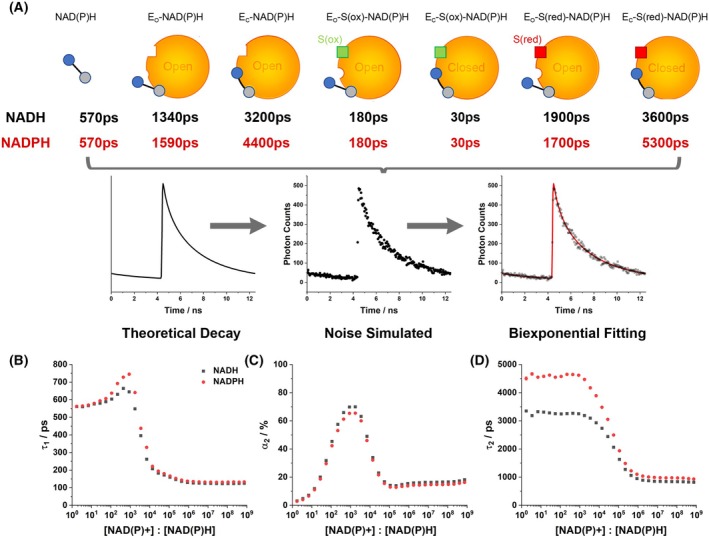 Figure 1
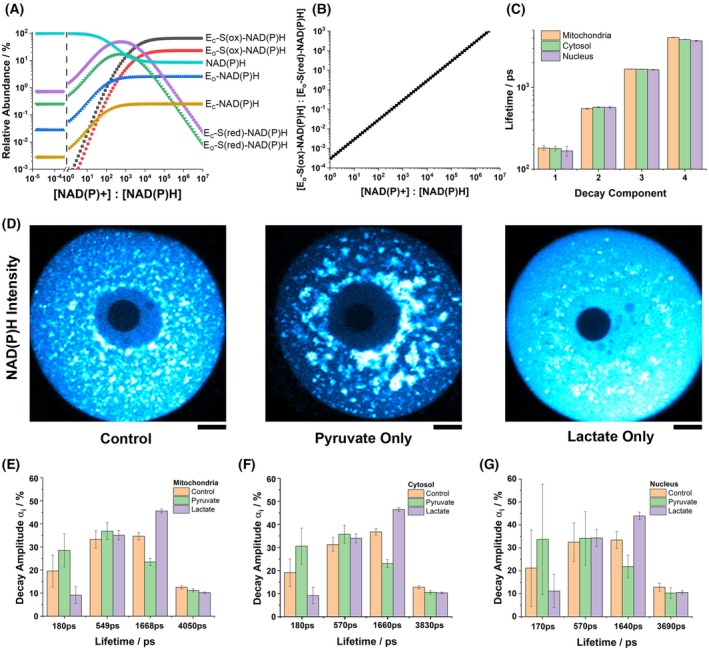 Figure 2
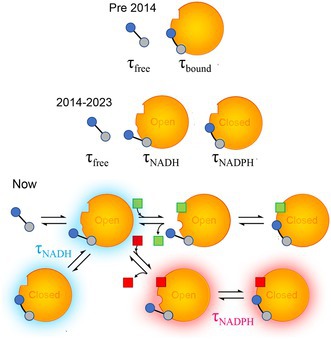 Figure 3
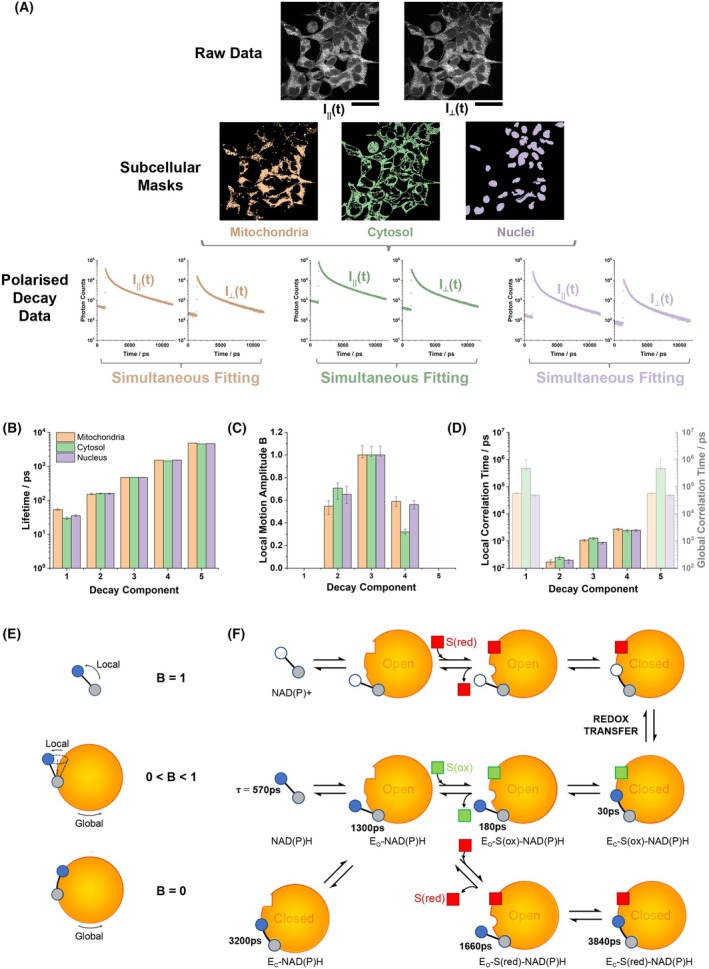 Figure 4
Peer Reviews
No public reviews on file for this paper yet. If you reviewed it on a platform where reviews are public (OpenReview, ICLR, NeurIPS, ICML), you can paste yours below so the community can read it here.
Videos
No videos yet. Explain this paper in a talk, walkthrough, or lecture? Add one.
Taxonomy
TopicsAdvanced Fluorescence Microscopy Techniques · Advanced Electron Microscopy Techniques and Applications · Cell Image Analysis Techniques