PET imaging of mitochondrial complex-I in the adenine-induced tubulointerstitial nephropathy mouse model using [18F]BCPP-BF
Kenneth Dahl, Peter Johnström, Miklós Toth, Vasco C. Sousa, Charlotte Ericsson, Maria Strömstedt, Tord Inghardt, Miguel A. Cortés González, Anna Reznichenko, Aurelija Jucaite, Zsolt Cselényi, Robert Unwin, Hiroyuki Ohba, Christer Halldin, Benjamin Challis, Hideo Tsukada

TL;DR
This study explores using [18F]BCPP-BF PET imaging to track mitochondrial dysfunction in a mouse model of kidney disease.
Contribution
The study demonstrates the potential of [18F]BCPP-BF as a non-invasive imaging biomarker for monitoring mitochondrial complex-I in kidney disease.
Findings
[18F]BCPP-BF binding in mouse kidneys decreased by 59–61% after two weeks of adenine treatment.
In vitro autoradiography confirmed a 65.6% reduction in [18F]BCPP-BF specific binding in adenine-fed mice.
The results suggest [18F]BCPP-BF could serve as an imaging biomarker for chronic kidney disease progression.
Abstract
Chronic kidney disease (CKD) poses a significant global health burden with limited effective treatments for its prevention, progression, and associated complications. Mitochondrial dysfunction is recognized as a pivotal factor in the development of kidney diseases, with mitochondrial complex-I (MC-I) playing a crucial role in assessing overall mitochondrial function. Recent advancements in selective MC-I positron emission tomography (PET) radioligands now allow for non-invasive visualization and quantification of renal mitochondrial status in vivo. The aim of the present study was to evaluate the utility of [18F]BCPP-BF in the adenine induced tubulointerstitial nephropathy model. Binding of the MC-I targeted PET radioligand, [18F]BCPP-BF, showed a gradual decline in the kidneys of mice on an adenine-rich diet. [18F]BCPP-BF binding decreased by 59–61% compared to baseline after two…
Genes, proteins, chemicals, diseases, species, mutations and cell lines named across the full text — each resolved to its canonical identifier and authoritative record.
Click any figure to enlarge with its caption.
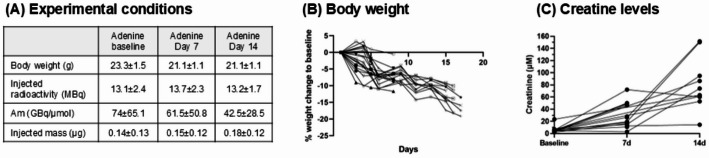 Figure 1
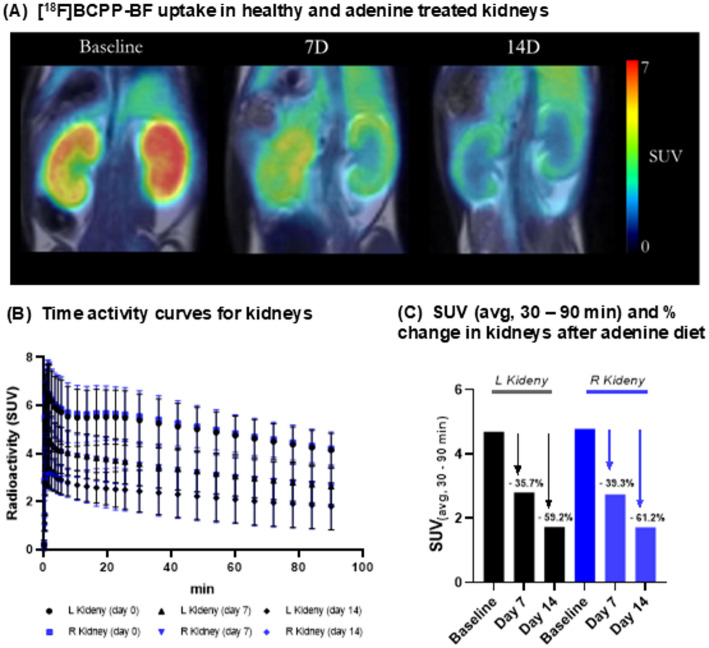 Figure 2
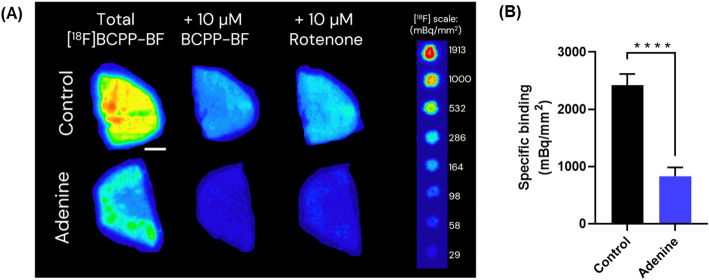 Figure 3
 Figure 4
Peer Reviews
No public reviews on file for this paper yet. If you reviewed it on a platform where reviews are public (OpenReview, ICLR, NeurIPS, ICML), you can paste yours below so the community can read it here.
Videos
No videos yet. Explain this paper in a talk, walkthrough, or lecture? Add one.
Taxonomy
TopicsMitochondrial Function and Pathology · Metabolism and Genetic Disorders · Ion Transport and Channel Regulation