Full P4 to P3− Reduction with a Redox‐Active Metal Crown Complex
Johannes Maurer, Marcel A. Schmidt, Michael Nägel, Christian Färber, Jens Langer, Sjoerd Harder

TL;DR
A new method uses a metal crown complex to fully reduce P4 to P3− at room temperature, enabling the stable formation and reactivity of the P3− anion.
Contribution
The paper introduces a selective room-temperature reduction of P4 to P3− using a redox-active metal crown complex, enabling the isolation of a unique phosphido anion.
Findings
The P4 reduction to P3− is exothermic and results in a stable s-block metal complex.
The P3− anion is stabilized by a two-armed pincer-like ligand with highly fluxional ion exchange.
The P3− anion exhibits reactivity as a base, nucleophile, and reducing agent.
Abstract
Traditional bulk syntheses of phosphorus compounds start with P4 to PCl3 oxidation but more sustainable methods cleave P─P bonds reductively. This generally results in larger polyphosphide Zintl anions: Pm nˉ. We report a relatively selective full reduction of P4 at room temperature to give a unique hydrocarbon‐soluble s‐block metal complex of the P3ˉ anion. Key to this chemistry is a recently reported redox‐active metal crown complex: (BDI*)MgNa3N″2 (VI); N″ = N(SiMe3)2 and BDI* = HC[(tBu)C═N‐DIPeP]2, DIPeP = 2,6‐CHEt2‐phenyl. The reduction of P4 according to 2 VI + 0.25 P4 → (BDI*)MgNa5N″3P (1) + 0.5 [(BDI*)Mg]2 + 0.33 (NaN″)3 is calculated to be exothermic (ΔH = −40.5 kcal mol−1). The crystal structure of 1 shows a strongly bound (BDI*)MgP2ˉ anion with two chelating [Na‐N″‐Na+] and [Na‐N″‐Na‐N″‐Na+] arms of unequal length. Although these arms are highly fluxional and rapidly exchange…
Genes, proteins, chemicals, diseases, species, mutations and cell lines named across the full text — each resolved to its canonical identifier and authoritative record.
Click any figure to enlarge with its caption.
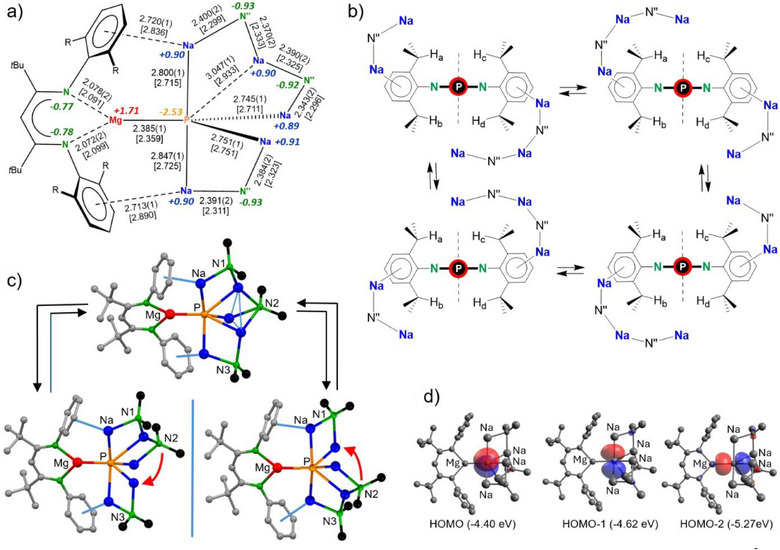 Figure 1
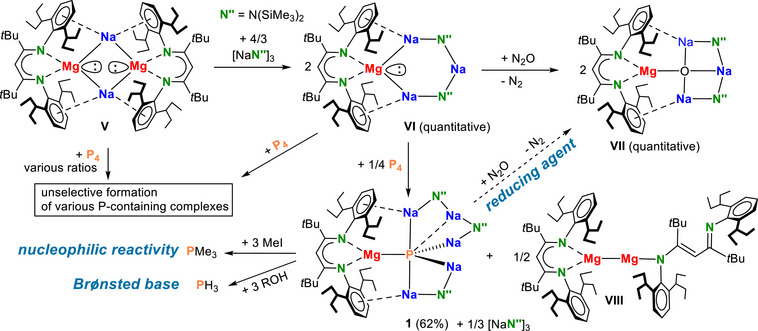 Figure 2
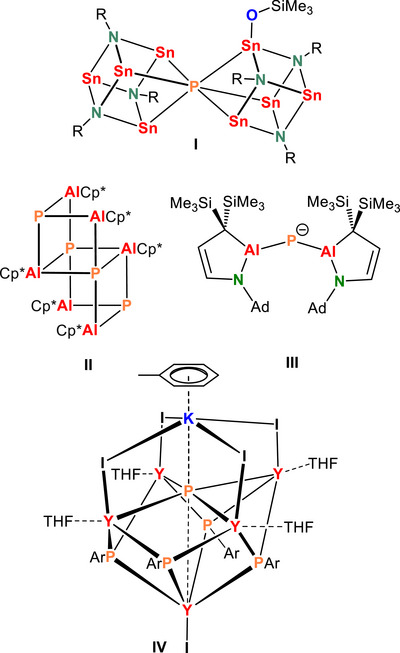 Figure 3
 Figure 4
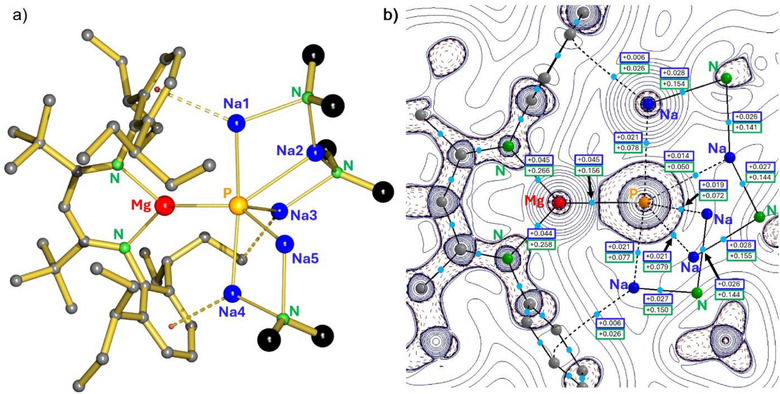 Figure 5
Peer Reviews
No public reviews on file for this paper yet. If you reviewed it on a platform where reviews are public (OpenReview, ICLR, NeurIPS, ICML), you can paste yours below so the community can read it here.
Videos
No videos yet. Explain this paper in a talk, walkthrough, or lecture? Add one.
Taxonomy
TopicsSynthesis and characterization of novel inorganic/organometallic compounds · Coordination Chemistry and Organometallics · Organometallic Complex Synthesis and Catalysis