Relationships among discrimination, cognitive-affective pain amplifiers, and identification with Native American culture: results from the Oklahoma Study of Native American Pain Risk
Brandon W. Jones, Hayden M. Ventresca, Taylor V. Brown, Parker A. Kell, Kayla N. Trevino, Joanna O. Shadlow, Jamie L. Rhudy

TL;DR
The study explores how discrimination and cultural identification affect pain-related anxiety and catastrophizing in Native Americans.
Contribution
It reveals that stronger cultural identification correlates with increased pain catastrophizing due to higher discrimination exposure.
Findings
Higher identification with Native American culture strengthens the link between discrimination and pain catastrophizing.
Discrimination is associated with increased pain-related anxiety, but cultural identification does not moderate this effect.
Those with stronger cultural identification reported experiencing more discrimination.
Abstract
Native Americans (NAs) experience higher rates of chronic pain than other U.S. ethnic/racial groups. This may be partly caused by stress from interpersonal discrimination, which promotes pain-related catastrophizing and anxiety, cognitive-emotional processes that amplify pain. Greater identification with NA culture has been shown to buffer against negative health outcomes for NA communities, therefore the present study examined whether greater identification with NA culture buffers against the harmful effects of discrimination on pain-related anxiety and catastrophizing. Participants were 153 healthy, chronic pain-free NAs enrolled in the Oklahoma Study of Native American Pain Risk (OK-SNAP). Identification with NA culture was assessed by the Native American Acculturation Scale (NAAS), which was reversed scored so that higher scores=greater identification. Interpersonal discrimination…
Genes, proteins, chemicals, diseases, species, mutations and cell lines named across the full text — each resolved to its canonical identifier and authoritative record.
Click any figure to enlarge with its caption.
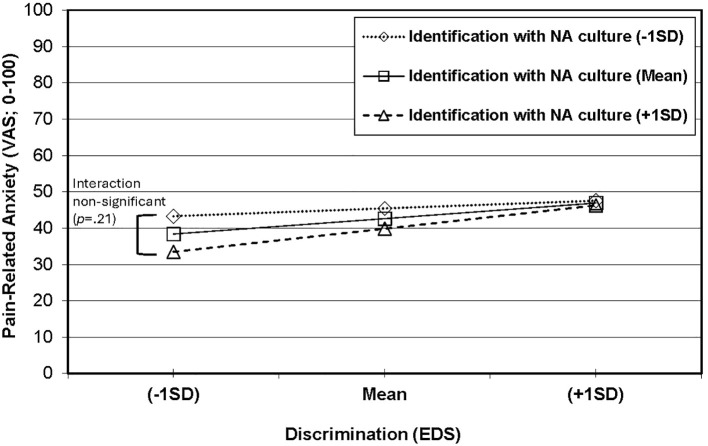 Figure 1
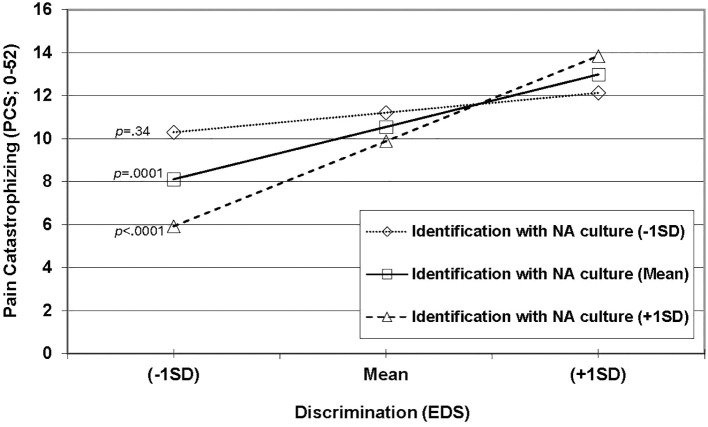 Figure 2
Peer Reviews
No public reviews on file for this paper yet. If you reviewed it on a platform where reviews are public (OpenReview, ICLR, NeurIPS, ICML), you can paste yours below so the community can read it here.
Videos
No videos yet. Explain this paper in a talk, walkthrough, or lecture? Add one.
Taxonomy
TopicsMusculoskeletal pain and rehabilitation · Cultural Competency in Health Care · Healthcare professionals’ stress and burnout