Comparative effects of low-load blood flow restriction training and high-load resistance training on physical performance in college 800-m runners: a randomized control trial
Jianhua Yu, Jingyan Yu, Lei Zhao, Yi Yang

TL;DR
This study compares high-load resistance training and low-load blood flow restriction training in college 800-m runners, finding both improve performance, with high-load training offering slightly better gains in muscular power.
Contribution
The novel contribution is demonstrating that low-load BFR training can be an effective alternative to high-load resistance training for collegiate 800-m runners.
Findings
Both HL-RT and BFR training improved muscular strength, power, endurance, and running performance.
HL-RT showed greater improvements in V1 load compared to BFR training.
No significant differences were found between the groups for most performance measures.
Abstract
High-load resistance training (HLRT) is commonly used to enhance performance in 800-m runners but may not always be suitable. Low-load blood flow restriction (BFR) training offers similar benefits to HLRT while reducing these issues. This study aimed to compare the effects of traditional HL-RT and low-load BFR training on muscular strength, power, endurance, and running performance of collegiate 800-m runners over an 8-week training program. A total of 22 participants were randomly divided into HL-RT group (n = 11) and BFR group (n = 11). Physical performance was assessed at three time points: baseline, mid-intervention, and post-intervention. The tests included the 20-m sprint test (T20m), countermovement jump test (CMJ), smith machine full-squat test (to assess V1 load), plantar flexion rate of force development test (PF-RFD), 200-m test (T200m), and 800-m test (T800m). Significant…
Genes, proteins, chemicals, diseases, species, mutations and cell lines named across the full text — each resolved to its canonical identifier and authoritative record.
Click any figure to enlarge with its caption.
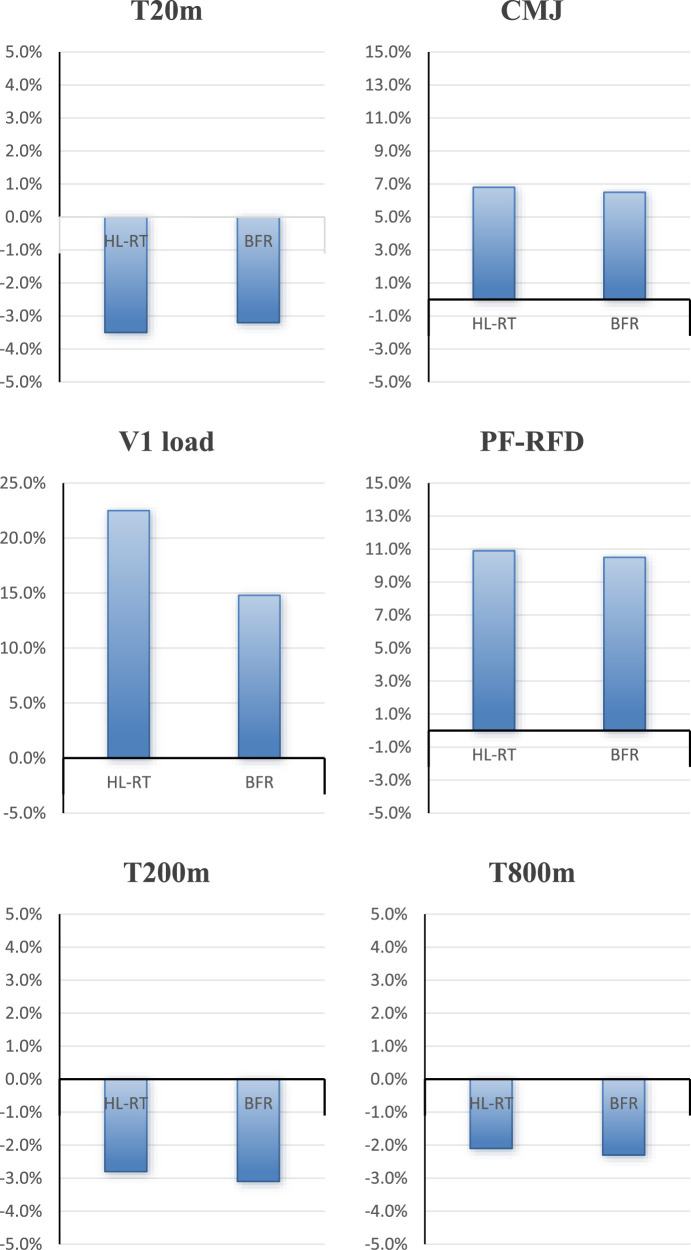 Figure 1
Peer Reviews
No public reviews on file for this paper yet. If you reviewed it on a platform where reviews are public (OpenReview, ICLR, NeurIPS, ICML), you can paste yours below so the community can read it here.
Videos
No videos yet. Explain this paper in a talk, walkthrough, or lecture? Add one.
Taxonomy
TopicsCardiovascular and exercise physiology · Sports Performance and Training · Cardiovascular Effects of Exercise