Identifying Subgroups At-Risk for Noncommunicable Diseases in Cambodia: A Latent Class Analysis of Behavioral and Metabolic Risk Factor Patterns
Cassandra Comey, Kanya Anindya, Ailiana Santosa, Paul Kowal, Srean Chhim, Heng Sopheab, Nawi Ng

TL;DR
This study identifies subgroups in Cambodia with high risk for noncommunicable diseases based on behavioral and metabolic factors.
Contribution
The novel use of latent class analysis reveals distinct risk profiles for noncommunicable diseases in Cambodia.
Findings
Three risk classes were identified: alcohol users with lower metabolic risk, substance users with unhealthy behaviors, and alcohol users with higher metabolic risk.
Men, older adults, and less-educated individuals are more likely to belong to higher-risk classes.
The findings suggest targeted public health strategies are needed for specific demographic groups.
Abstract
Cambodia is experiencing a demographic shift likely to increase the burden of noncommunicable diseases (NCDs). Identifying patterns of risk factors among adults can contribute to efforts to effectively target and prevent these chronic diseases. This study aims to examine latent classes of population risk based on behavioral and metabolic risk factors for NCDs in Cambodia. Data from 5275 respondents aged 18 and older from the 2023 Cambodian World Health Survey Plus were used for analysis. Latent class analysis identified distinct classes of individuals with similar behavioral and metabolic risk factors. Indicator variables included tobacco and alcohol use, fruit and vegetable diet, physical activity, body mass index, blood pressure, blood glucose, and total cholesterol and triglyceride levels. Multinomial logistic regression was employed to predict latent class membership based on…
Genes, proteins, chemicals, diseases, species, mutations and cell lines named across the full text — each resolved to its canonical identifier and authoritative record.
Click any figure to enlarge with its caption.
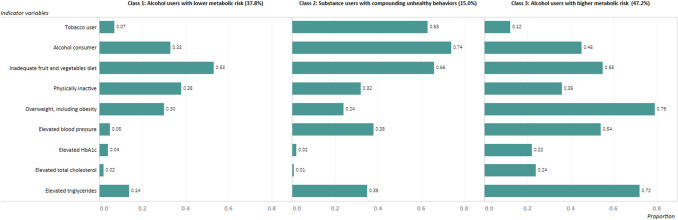 Figure 1
Peer Reviews
No public reviews on file for this paper yet. If you reviewed it on a platform where reviews are public (OpenReview, ICLR, NeurIPS, ICML), you can paste yours below so the community can read it here.
Videos
No videos yet. Explain this paper in a talk, walkthrough, or lecture? Add one.
Taxonomy
TopicsGlobal Public Health Policies and Epidemiology · Health Promotion and Cardiovascular Prevention · Obesity, Physical Activity, Diet