Pd‐Catalyzed Cross‐Coupling of Alkylbisboronic Esters
Philip P. Scott, Christopher E. Baird, Elizabeth A. Kraichely, Liam M. Radeke, Timothy J. Barker

TL;DR
This paper describes a new palladium-catalyzed reaction that couples alkylbisboronic esters with aryl bromides, with a focus on optimizing the linker length for better results.
Contribution
The study introduces a selective cross-coupling method using alkylbisboronic esters with optimal two-carbon linkers.
Findings
Aryl bromides are effective substrates in the Pd-catalyzed cross-coupling reaction.
A two-carbon linker in alkylbisboronic esters provides the best reaction efficiency.
Competition experiments help clarify the reaction mechanism.
Abstract
A Pd‐catalyzed cross‐coupling between alkylbisboronic esters and aryl bromides is described. A variety of aryl bromides are found to be competent substrates in the reaction. Different alkyl chain lengths of the alkylbisboronic esters are examined, and a two‐carbon linker is found to be of the optimal chain length. Several competition experiments are performed to better understand the mechanism of the reaction. A reaction that selectively couples only one of two identical boronic esters in an alkylbisboronic ester is described. Investigations into the chain length of the alkylbisboronic ester found that the 2‐carbon linker is the most effective substrate under the reaction conditions.© 2025 WILEY‐VCH GmbH
Genes, proteins, chemicals, diseases, species, mutations and cell lines named across the full text — each resolved to its canonical identifier and authoritative record.
Click any figure to enlarge with its caption.
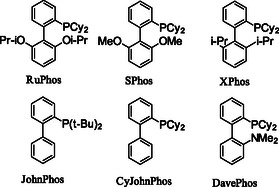 Figure 1
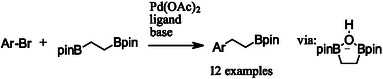 Figure 2
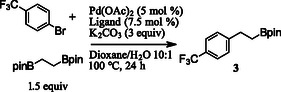 Figure 3
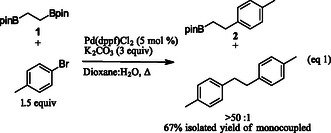 Figure 4
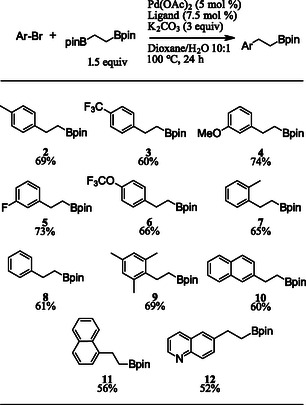 Figure 5
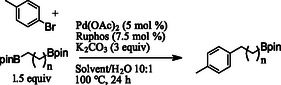 Figure 6
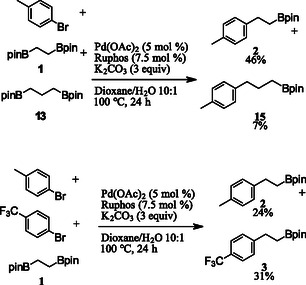 Figure 7
Peer Reviews
No public reviews on file for this paper yet. If you reviewed it on a platform where reviews are public (OpenReview, ICLR, NeurIPS, ICML), you can paste yours below so the community can read it here.
Videos
No videos yet. Explain this paper in a talk, walkthrough, or lecture? Add one.
Taxonomy
TopicsCatalytic Cross-Coupling Reactions · Catalytic C–H Functionalization Methods · Asymmetric Hydrogenation and Catalysis