Rice breeding against sheath blight is now feasible: a breakthrough discovery of SBRR1-mediated sheath blight resistance from natural rice germplasm
Qingqing Hou, Xuewei Chen

TL;DR
Scientists discovered a gene, SBRR1, that provides strong resistance to sheath blight in rice, offering a major breakthrough for breeding resistant rice varieties.
Contribution
The discovery of SBRR1-R, an elite resistance allele with a promoter insertion, enables high resistance to sheath blight without yield loss.
Findings
SBRR1 is the first major gene conferring natural sheath blight resistance in rice.
The SBRR1-R allele is found in indica rice and provides strong resistance with no yield penalty.
A defense module involving SBRR1-R offers insights into rice immunity and breeding potential.
Abstract
Sheath blight (ShB), caused by the necrotrophic fungus Rhizoctonia solani, is a globally destructive rice disease responsible for significant yield losses. However, the absence of characterized genes conferring high potential resistance to sheath blight within natural rice germplasm constrains resistance breeding. A recent study published in Nature Genetics uncovered the ShB resistance receptor-like kinase 1 (SBRR1) as a key gene associated with disease resistance. SBRR1-R, an elite resistance allele mainly presented in indica rice and distinguished by a 256-bp promoter insertion, confers strong resistance without obvious yield penalty. SBRR1 is the first gene with major effects underlying natural variation in sheath blight resistance, offering significant potential for rice breeding. Furthermore, the discovery of the “bHLH57—SBRR1-R—SIP1—Chit3/4” defense module provides fundamental…
Genes, proteins, chemicals, diseases, species, mutations and cell lines named across the full text — each resolved to its canonical identifier and authoritative record.
Click any figure to enlarge with its caption.
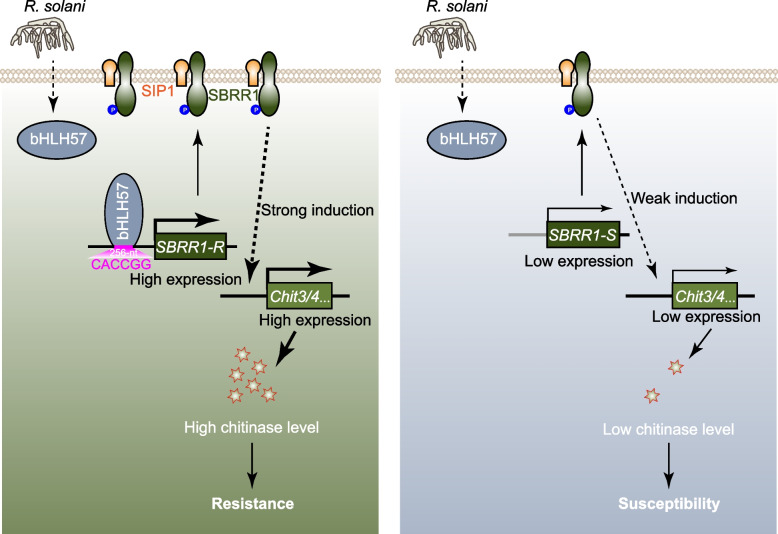 Figure 1
- —http://dx.doi.org/10.13039/501100001809National Natural Science Foundation of China
- —Special Fund for Leading Scientists in Basic Research of Sichuan Province
- —Major Program of National Natural Science Foundation of Sichuan Province
- —New Cornerstone Science Foundation through the XPLORER PRIZE and New Cornerstone Investigator Program
Peer Reviews
No public reviews on file for this paper yet. If you reviewed it on a platform where reviews are public (OpenReview, ICLR, NeurIPS, ICML), you can paste yours below so the community can read it here.
Videos
No videos yet. Explain this paper in a talk, walkthrough, or lecture? Add one.
Taxonomy
TopicsPlant Disease Resistance and Genetics · Plant-Microbe Interactions and Immunity · Plant Pathogenic Bacteria Studies
Main text
Rice sheath blight (ShB) caused by necrotrophic fungus Rhizoctonia solani poses one of the most severe threats to global rice production, with 10–50% yield losses annually (Wang et al. 2025). Modern agricultural practices, including deployment of semi-dwarf varieties, high planting density, and excessive nitrogen fertilization, have exacerbated ShB outbreaks by creating favorable conditions for pathogen proliferation (Singh et al. 2019). While current control predominantly relies on chemical fungicides with significant environmental costs, genetic resistance breeding remains the most sustainable solution (Molla et al. 2020; Wang et al. 2025). However, progress has been hindered by the polygenic inheritance of ShB resistance, absence of completely resistant germplasm and technical challenges in resistance phenotyping (Molla et al. 2020; Wang et al. 2023). Although over 60 quantitative trait loci (QTLs) have been identified, none have been successfully isolated through traditional map-based cloning (Molla et al. 2020; Wang et al. 2023). Recent advances in genomics, particularly genome-wide association study (GWAS), have successfully identified several genes associated with ShB resistance, including OsRSR1 and OsRLCK5 from natural rice varieties (Wang et al. 2021), as well as the ROD1 (SNP1^A^) natural allele which confers enhanced ShB resistance without growth penalty (Gao et al. 2021), but their practical breeding potential remains largely unexplored. In addition, the few genes conferring ShB resistance characterized through reverse genetics approaches often confer partial resistance at the cost of agronomic performance, limiting their breeding utility directly (Nizamani et al. 2025). Consequently, the absence of available ShB resistance genes in the current breeding program presents a major bottleneck for developing resistant rice cultivars (Li et al. 2020).
Compared to biotrophic/hemi-biotrophic pathogens, necrotrophic pathogens present a unique challenge to the host defense system, because they generally employ diverse virulence strategies including cell wall-degrading enzymes and phytotoxins, to directly kill host cells, which has led to poor understanding of host resistance to these pathogens relative to biotrophic/hemi-biotrophic pathogens (Mengiste et al. 2025; Xie et al. 2025). Although reverse genetics approaches have partially uncovered some resistance mechanisms associated with rice resistance to R. solani, critical knowledge gaps remain in understanding natural variations in ShB resistance, particularly in how rice perceives this necrotrophic pathogen and mounts effective defense (Cao et al. 2022; Nizamani et al. 2025).
Recently, a remarkable work by Feng et al. (2025) has successfully broken this critical bottleneck by discovering a novel ShB-resistant allele with high breeding potential derived from a natural germplasm. In this study, they identified SBRR1 (ShB resistance receptor-like kinase 1), which encodes a G-type lectin receptor-like protein kinase, as a key gene conferring ShB resistance via GWAS. Within the natural germplasm collection, SBRR1 exhibits two distinct haplotypes: the favorable haplotype SBRR1-R and the unfavorable haplotype SBRR1-S. SBRR1-R exhibits significantly stronger disease resistance and pathogen responsiveness than SBRR1-S, attributable to a 256-bp insertion in its promoter region. Furthermore, SBRR1-R has originated from common wild rice Oryza rufipogon I, the progenitor of indica rice, and shows preferential distribution in indica rice varieties from regions with high ShB pressure, suggesting its applicational potential in pathogen defense. Since most japonica rice varieties lack the SBRR1-R allele, to assess the breeding potential of SBRR1-R, they introduced SBRR1-R into two high-yield but ShB-susceptible japonica cultivars, Taigeng 394 (TG394) and Xudao 3 (XD3), via marker-assisted selection. Near isogenic lines TG394-SBRR1^R^ and XD3-SBRR1^R^ exhibit significantly enhanced ShB resistance while maintaining all major agronomic and yield traits. Notably, field trials found that SBRR1-R in TG394-SBRR1^R^ Line reduces yield loss by up to 9.54% compared to TG394 under severe disease pressure, demonstrating the significant breeding value of SBRR1-R.
Feng et al. then comprehensively decoded the multilayered defense network orchestrated by SBRR1-R (Fig. 1). Their investigation firstly uncovered that the 256-bp insertion in SBRR1-R promoter contains a functional CACCGG cis-element specifically recognized by transcription factor bHLH57, a feature absent in the unfavorable SBRR1-S allele, as validated via comprehensive in vitro (yeast one-hybrid and electrophoretic mobility shift assays) and in vivo (chromatin-immunoprecipitation-quantitative PCR) analyses. Subsequent dual-luciferase reporter assays and transgenic tests demonstrated that this interaction forms a pathogen-responsive molecular switch enabling bHLH57 to rapidly activate SBRR1-R, conclusively establishing bHLH57 as the master positive regulator of SBRR1-R.Fig.1A model for SBRR1-mediated ShB resistance**.** In SBRR1-R varieties, bHLH57 specifically binds to the ‘CACCGG’ motif of the SBRR1-R promoter, elevating SBRR1 expression. In the cytoplasm, SIP1 interacts with SBRR1 to facilitate effective accumulation of SBRR1 on the plasma membrane. SBRR1 phosphorylation is increased upon R. solani attack and is required for ShB resistance. Finally, rapidly elevated expression of chitinase genes accounts for the majority of SBRR1-mediated downstream defense against R. solani. In SBRR1-S varieties, due to lack of the ‘CACCGG’ motif in the promoter, bHLH57 cannot effectively activate SBRR1 expression, resulting in lower SBRR1 expression that leads to less accumulation of chitinases and, thus, disease susceptibility
At the protein level, this study demonstrated that SBRR1 kinase activity is indispensable for disease resistance, as evidenced by the complete loss of function in kinase-dead KiD transgenic lines. Phosphoproteomic analysis using liquid chromatography-tandem mass spectrometry (LC–MS/MS) revealed that R. solani infection strongly induces phosphorylation at TT682/683 residues within the activation loop of SBRR1 kinase domain, establishing phospho-regulation as a critical mechanism for SBRR1-mediated defense signaling. Yeast two-hybrid screening further identified SIP1 (SBRR1-interaction protein 1), an ankyrin-repeat domain-containing protein that facilitates SBRR1 in effective translocation to the plasma membrane. Disruption of this interaction, as seen in SIP1 knockout lines, leads to endoplasmic reticulum retention of SBRR1 and compromises disease resistance, confirming the critical role of proper membrane localization for immune receptor functionality.
Finally, the study definitively established that SBRR1-mediated downstream defense signals against R. solani operate through transcriptional activation of downstream chitinase genes Chit3 and Chit4, rigorously validated through transcriptomic analysis, enzymatic activity assays, and transgenic tests. Extensive studies have confirmed that chitinases exert antifungal activity by specifically hydrolyzing β-1,4-glycosidic bonds in chitin polymers to disrupt fungal cell wall integrity and inhibit pathogen growth (Nizamani et al. 2025).
In summary, this study identified SBRR1-R, a naturally existing elite allele conferring ShB resistance in rice germplasm with significant breeding potential, and established a molecular ShB defense module containing "bHLH57—SBRR1-R—SIP1—Chit3/4" (Fig. 1). The discovery represents a breakthrough in ShB resistance research, overcoming the persistent challenge of the critical shortage of available genes confer resistance to ShB with breeding potential. Notably, while SBRR1 exhibits kinase activity critical for ShB resistance, its phosphorylation mechanisms and direct substrates remain to be determined. Furthermore, although SIP1-dependent membrane localization is crucial for SBRR1 function, its ability to regulate nuclear Chit3/4 expression likely involves intermediate signaling components. Further investigation is needed to elucidate how SBRR1 triggers a membrane-to-nucleus signaling cascade to transmit defense signals.
Although over 20 genes associated with ShB resistance have been identified (Table S1), most were characterized via reverse genetics approaches, and their underlying defense mechanisms remain poorly understood. Moreover, the lack of natural resistance alleles with proven breeding potential has hindered ShB resistance breeding. The identification of SBRR1-R fills this gap, providing a foundation for further exploration of ShB resistance mechanisms and breeding strategies. The "bHLH57—SBRR1-R—SIP1—Chit3/4" module not only offers a framework for identifying novel interactors regulating SBRR1 kinase activity but also facilitates the exploration of SBRR1 homologs in related crops. Importantly, the demonstrated breeding value of SBRR1-R in japonica rice highlights its utility as an exemplary case of natural allele mining for resistance breeding.
Receptor-like kinases (RLKs) are central components of plant immunity, functioning in the perception of external signals and activation of downstream defense pathways (Fan et al. 2018). Several RLKs have been identified in resistance against necrotrophic fungal pathogens. The SBRR1-R-mediated defense module uncovers a previously unrecognized layer of regulation, where an RLK integrates transcriptional control (bHLH57) with chitinase activation (Chit3/4) to restrict pathogen invasion. These findings reveal a membrane-to-nucleus signaling cascade that expands our understanding of RLK-mediated necrotrophic resistance and plant immune responses.
Rice has accumulated abundant natural variations during evolution and domestication. These variations underlie agronomic traits and breeding resources. Notably, Japonica rice is more susceptible to ShB than indica (Jia et al. 2011). The SBRR1-R allele, predominantly found in indica varieties, has been successfully introgressed into ShB-susceptible japonica cultivars TG394 and XD3 through marker-assisted selection. The resulting near-isogenic Lines exhibit enhanced ShB resistance without yield penalty and suffered markedly reduced losses under severe disease pressure. These results demonstrate the potential of broadening ShB resistance across rice subspecies. For breeding applications, breeders can utilize the co-segregating 256-bp insertion marker for efficient selection, combining SBRR1-R with complementary resistance QTLs to enhance durability, and targeting SBRR1 in japonica to broaden resistance. With its proven efficacy and multiple deployment strategies, we affirm that ShB-resistant rice breeding is now practically feasible. SBRR1-R deployment in breeding programs promises to reduce reliance on chemical fungicides, enhance food security, and contribute to sustainable rice production.
Supplementary Information
Supplementary Material 1. Table S1. Main regulators of ShB resisitance in rice.
The reference list from the paper itself. Each links out to its DOI / PubMed record.
- 1Fan J, Bai P, Ning Y, Wang J, Shi X, Xiong Y, Zhang K, He F, Zhang C, Wang R et al (2018) The monocot-specific receptor-like kinase SDS 2 controls cell death and immunity in rice. Cell Host Microbe 23:498–510. 10.1016/j.chom.2018.03.00310.1016/j.chom.2018.03.003PMC 626793029576481 · doi ↗ · pubmed ↗
- 2Gao M, He Y, Yin X, Zhong X, Yan B, Wu Y, Chen J, Li X, Zhai K, Huang Y et al (2021) Ca 2+ sensor-mediated ROS scavenging suppresses rice immunity and is exploited by a fungal effector. Cell 184:5391–5404. 10.1016/j.cell.2021.09.00910.1016/j.cell.2021.09.00934597584 · doi ↗ · pubmed ↗
- 3Mengiste T, Liao C (2025) Contrasting Mechanisms of Defense Against Biotrophic and Necrotrophic Pathogens 20 Years Later: What Has Changed? Annu Rev Phytopathol 63:279-308. https://doi.org/10.1146/annurev-phyto-121823-03113910.1146/annurev-phyto-121823-03113940465653 · doi ↗ · pubmed ↗
- 4Wang A, Shu X, Jing X, Jiao C, Chen L, Zhang J, Ma L, Jiang Y, Yamamoto N, Li S et al (2021) Identification of rice (Oryza sativa L.) genes involved in sheath blight resistance via a genome-wide association study. Plant Biotechnol J 19:1553–1566. 10.1111/pbi.1356910.1111/pbi.13569 PMC 838460533600077 · doi ↗ · pubmed ↗
- 5Wang Y, Sun Q, Zhao J, Liu T, Du H, Shan W, Wu K, Xue X, Chen Z, Xie W et al (2023) Fine mapping and candidate gene analysis of q SB 12, a gene conferring major quantitative resistance to rice sheath blight. Theor Appl Genet 136:246. 10.1007/s 00122-023-04482-z 10.1007/s 00122-023-04482-z 37973669 · doi ↗ · pubmed ↗
- 6Xie W, Xue X, Wang Y, Zhang G, Zhao J, Zhang H, Wang G, Li L, Wang Y, Shan W et al (2025) Natural mutation in Stay-Green (Os SGR) confers enhanced resistance to rice sheath blight through elevating cytokinin content. Plant Biotechnol J 23:807–823. 10.1111/pbi.1454010.1111/pbi.14540 PMC 1186917539630094 · doi ↗ · pubmed ↗