From demyelination to neurodegeneration in multiple sclerosis: reassessing the role of visual evoked potential P100-N145 amplitudes: a missing piece of the puzzle?
Nurhan Kaya Tutar, Nilufer Kale

TL;DR
This study explores how changes in visual evoked potential amplitudes over time may predict disability progression in multiple sclerosis patients.
Contribution
The study identifies P100–N145 amplitude decline as a potential biomarker for disability worsening in relapsing–remitting MS.
Findings
Longitudinal decrease in P100–N145 amplitude was significantly associated with EDSS progression.
Baseline VEP parameters did not predict disability worsening over time.
P100–N145 amplitude changes showed a strong negative correlation with disability status changes.
Abstract
Multiple sclerosis (MS) is a chronic demyelinating disease with a heterogeneous clinical course, making long-term disability prediction challenging. Visual evoked potentials (VEPs), particularly amplitude-based parameters, may serve as sensitive biomarkers of neurodegeneration and functional decline undetected by conventional clinical measures. To assess the relationship between longitudinal changes in P100–N145 amplitude and concurrent Expanded Disability Status Scale (EDSS) changes in relapsing–remitting MS (RRMS) and the relative utility of baseline and longitudinal VEP parameters in representing disability status. In this retrospective cohort study, 45 MS patients (90 eyes) with available VEP and EDSS data were followed for a median period of 48 months. The primary endpoints were (1) change in EDSS score over time and (2) EDSS progression, defined as any increase in EDSS score…
Genes, proteins, chemicals, diseases, species, mutations and cell lines named across the full text — each resolved to its canonical identifier and authoritative record.
Click any figure to enlarge with its caption.
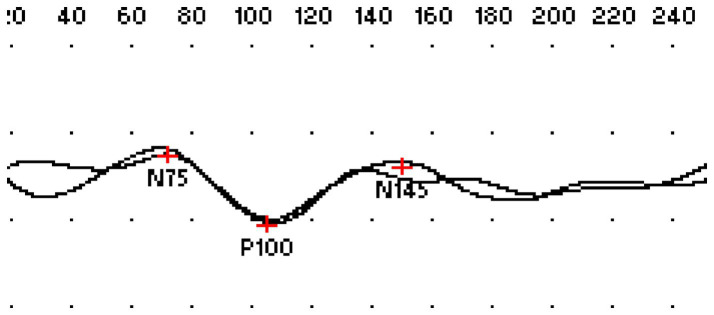 Figure 1
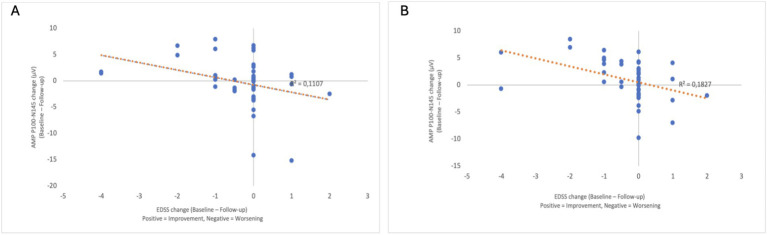 Figure 2
Peer Reviews
No public reviews on file for this paper yet. If you reviewed it on a platform where reviews are public (OpenReview, ICLR, NeurIPS, ICML), you can paste yours below so the community can read it here.
Videos
No videos yet. Explain this paper in a talk, walkthrough, or lecture? Add one.
Taxonomy
TopicsMultiple Sclerosis Research Studies · Glaucoma and retinal disorders · Vestibular and auditory disorders