Preferences for gene therapy in Duchenne muscular dystrophy: insights from patient and caregiver interviews and attribute development
Thomas Desmet, Lauren Van Haesendonck, Sophie Vermeire, Eline van Overbeeke, Steven Simoens, Isabelle Huys

TL;DR
This study explores what DMD patients and caregivers value in gene therapy, identifying key treatment characteristics to guide future research and decision-making.
Contribution
The study develops six patient-centered attributes for evaluating gene therapy in DMD, informed by patient and caregiver input.
Findings
Patients and caregivers prioritize treatment effects on muscle and heart function and independence.
Caregivers of younger children show a strong willingness to consider gene therapy in clinical trials.
Six key attributes were developed, including therapy type and risk of life-threatening side effects.
Abstract
Duchenne muscular dystrophy (DMD) is an X-linked degenerative muscle disease with no curative treatment available to date. The current long-term use of corticosteroids is associated with severe adverse effects. With the progress of promising gene therapy for DMD, this research aims to identify the key characteristics that matter most to patients, develop attributes for a subsequent quantitative preference study, ultimately aimed to inform future market access and clinical decision-making on gene therapy. A literature review was conducted, followed by semi-structured interviews with DMD patients and caregivers to explore their preferences regarding DMD treatment benefits and side effects and gene therapy as a promising treatment option. A ranking exercise helped reveal the most important treatment characteristics, forming the basis for the first step of a structured, four-step attribute…
Genes, proteins, chemicals, diseases, species, mutations and cell lines named across the full text — each resolved to its canonical identifier and authoritative record.
Click any figure to enlarge with its caption.
 Figure 1
 Figure 2
 Figure 3
 Figure 4
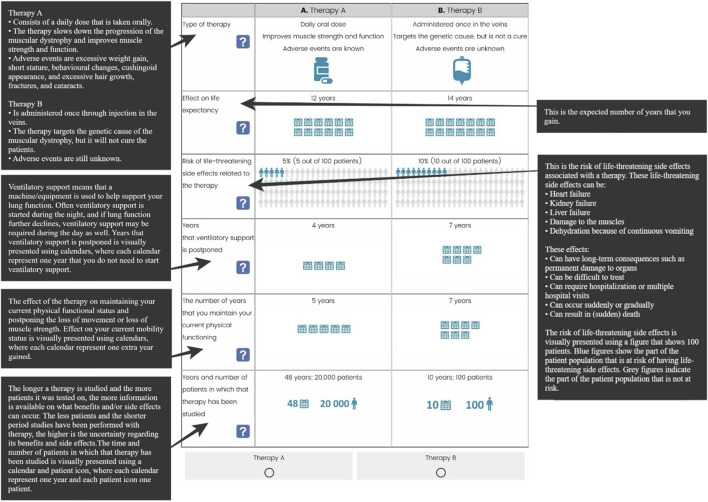 Figure 5
Peer Reviews
No public reviews on file for this paper yet. If you reviewed it on a platform where reviews are public (OpenReview, ICLR, NeurIPS, ICML), you can paste yours below so the community can read it here.
Videos
No videos yet. Explain this paper in a talk, walkthrough, or lecture? Add one.
Taxonomy
TopicsMuscle Physiology and Disorders · Virus-based gene therapy research · Autism Spectrum Disorder Research