Postictal punctate hippocampal diffusion restriction: the chicken or the egg?
Jan Heckelmann, Yvonne Weber, Manuel Dafotakis, Stefan Wolking

TL;DR
This paper presents cases of unusual MRI findings after seizures that mimic stroke but resolve over time, suggesting a new postictal phenomenon in the hippocampus.
Contribution
The paper introduces punctate hippocampal diffusion restriction as a novel postictal imaging phenomenon distinct from stroke.
Findings
Four cases showed reversible punctate hippocampal DWI lesions after seizures, mimicking ischemia but resolving on follow-up MRI.
None of the patients had classical stroke or TGA symptoms, and follow-up MRIs ruled out ischemic stroke.
Video-EEG monitoring revealed epilepsy or unprovoked seizures, suggesting the MRI findings are postictal rather than ischemic.
Abstract
Magnet resonance imaging (MRI) is the imaging gold standard for the evaluation of suspected epileptic seizures but also indispensable for detecting cerebral ischemia, using diffusion-weighted imaging (DWI) sequences. DWI restrictions can also occur following an epileptic seizure, thus mimicking cerebral ischemia. Postictal DWI lesions typically cross vascular territories and are confined to the cortex. Here, we present four illustrative cases with the unusual finding of reversible punctate postictal hippocampal DWI lesions, reminiscent of transient global amnesia (TGA). Case 1 was identified during video-EEG examination. We consecutively screened our database for similar cases, identifying three additional cases (3 male/1 female, age range 53–78 years). The initial MRI was performed within 5 days, a follow-up MRI within 4.5 months. All patients received video-EEG-monitoring. All cases…
Genes, proteins, chemicals, diseases, species, mutations and cell lines named across the full text — each resolved to its canonical identifier and authoritative record.
Click any figure to enlarge with its caption.
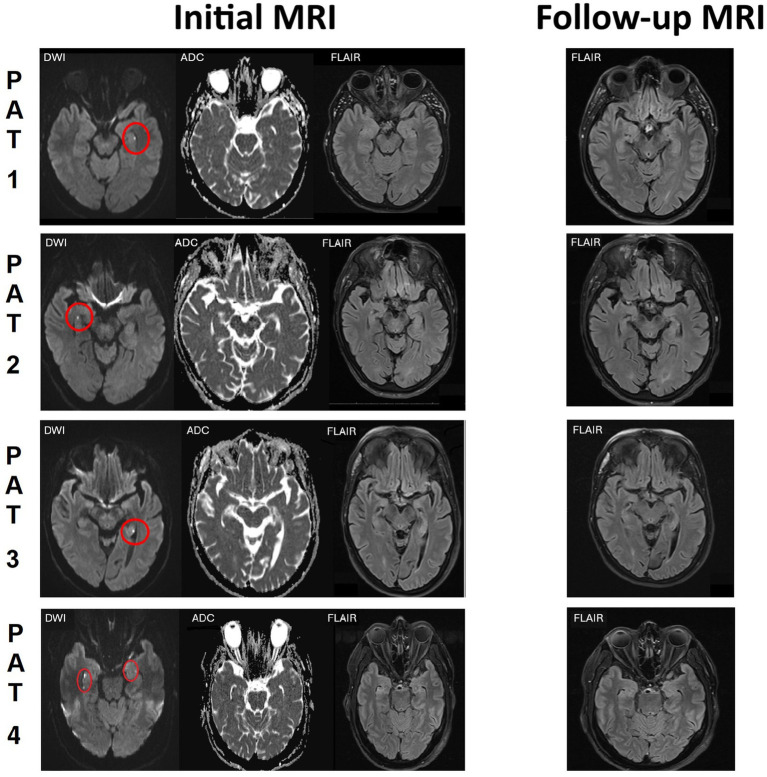 Figure 1
Peer Reviews
No public reviews on file for this paper yet. If you reviewed it on a platform where reviews are public (OpenReview, ICLR, NeurIPS, ICML), you can paste yours below so the community can read it here.
Videos
No videos yet. Explain this paper in a talk, walkthrough, or lecture? Add one.
Taxonomy
TopicsEpilepsy research and treatment · Infectious Encephalopathies and Encephalitis · Neuroscience and Neuropharmacology Research