The 6-item specific object anthropomorphism scale: a new questionnaire for children and adults
Jonathan David, Mikaela Stowe, Nathan Caruana, Melissa M. Norberg

TL;DR
This paper introduces a new 6-item questionnaire to measure anthropomorphism in both children and adults, making it easier to understand and use.
Contribution
The paper presents the Specific Object Anthropomorphism Scale (SOAS), a novel and accessible tool for measuring anthropomorphism.
Findings
The SOAS showed a one-factor structure and good reliability in adults.
The scale was confirmed to be unidimensional and highly understandable for children aged 5–12.
The SOAS demonstrated convergent and divergent validity in adult participants.
Abstract
The attribution of human characteristics, emotions, or behaviors to nonhuman entities or objects is known as anthropomorphism. Research on anthropomorphism has been limited by abstract measures that may be difficult for both children and adults to understand. To address this issue, we developed and tested the reliability and validity of the Specific Object Anthropomorphism Scale (SOAS) across three studies involving child and adult participants. The SOAS consists of six items that ask respondents to rate the extent to which a specific object possesses anthropomorphic qualities using simple, concrete statements. Study 1 found that the measure fit a one-factor solution in adults (aged 17–72, M = 32.3). In Study 2, we confirmed the unidimensional structure in adults (aged 18–73, M = 32.2) and demonstrated excellent test-retest reliability, convergent validity, and divergent validity. Study…
Genes, proteins, chemicals, diseases, species, mutations and cell lines named across the full text — each resolved to its canonical identifier and authoritative record.
Click any figure to enlarge with its caption.
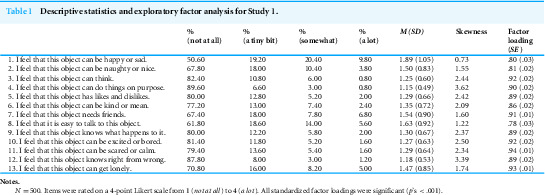 Figure 1
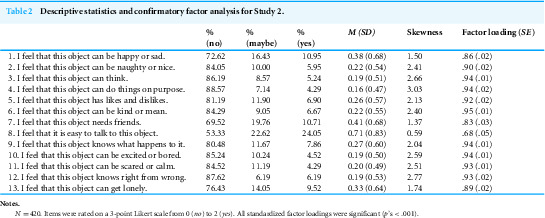 Figure 2
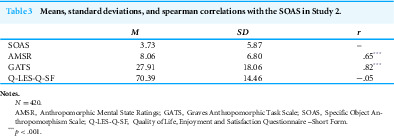 Figure 3
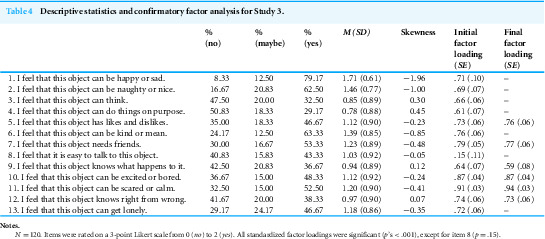 Figure 4
Peer Reviews
No public reviews on file for this paper yet. If you reviewed it on a platform where reviews are public (OpenReview, ICLR, NeurIPS, ICML), you can paste yours below so the community can read it here.
Videos
No videos yet. Explain this paper in a talk, walkthrough, or lecture? Add one.
Taxonomy
TopicsPsychology of Moral and Emotional Judgment · Behavioral Health and Interventions · Action Observation and Synchronization