“The Safety Check”: A simple and reproducible intraoperative test to support surgeons in training during ALT flap harvesting
Íñigo Aragón-Niño, Hailong Ma, Yue He

TL;DR
This paper introduces a simple intraoperative test called 'The Safety Check' to help trainee surgeons during ALT flap harvesting, improving confidence and efficiency.
Contribution
The novel contribution is a reproducible intraoperative technique to support trainees in identifying compromised perforators during ALT flap surgery.
Findings
The Safety Check improved trainee confidence and early identification of compromised perforators.
The method increased surgical efficiency without significantly prolonging the procedure.
It served as an educational tool for active learning and intraoperative discussions.
Abstract
The anterolateral thigh (ALT) flap is widely used in reconstructive surgery due to its versatility and favorable donor site characteristics. However, its harvest remains technically challenging, primarily due to the anatomical variability of the perforators. Experienced surgeons make intraoperative decisions based on anatomical knowledge, tactile feedback, and visual cues, but these skills may be underdeveloped in surgeons in training, increasing the risk of complications. To address this issue, we present “The Safety Check,” a simple and reproducible intraoperative test designed to assist trainees in decision-making during ALT flap harvest. This method is based on the visual assessment of arterial pulsatility along the course of perforators and the pedicle, formalizing a step that is often intuitive for experienced surgeons. The technique was applied in 52 cases over a 6-month period,…
Genes, proteins, chemicals, diseases, species, mutations and cell lines named across the full text — each resolved to its canonical identifier and authoritative record.
Click any figure to enlarge with its caption.
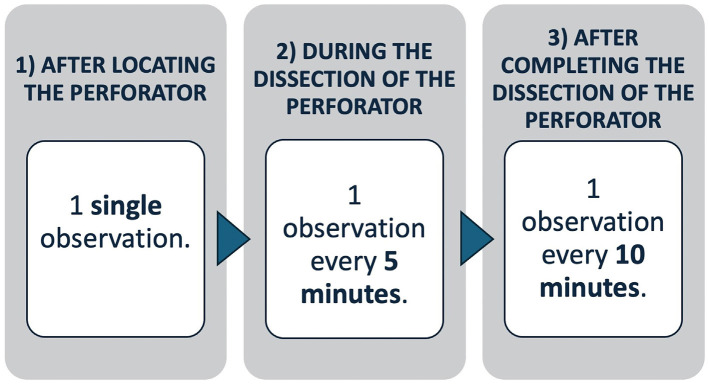 Figure 1
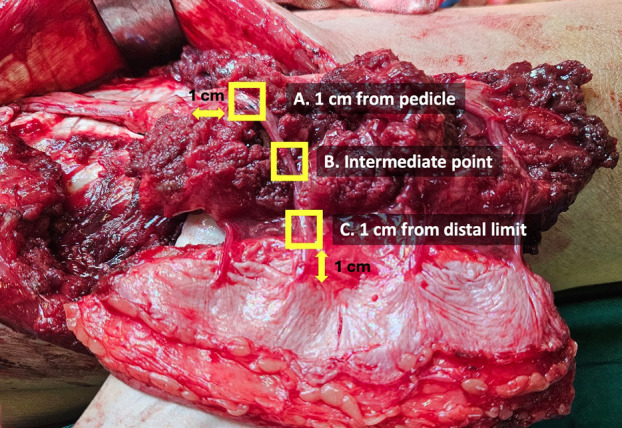 Figure 2
Peer Reviews
No public reviews on file for this paper yet. If you reviewed it on a platform where reviews are public (OpenReview, ICLR, NeurIPS, ICML), you can paste yours below so the community can read it here.
Videos
No videos yet. Explain this paper in a talk, walkthrough, or lecture? Add one.
Taxonomy
TopicsCardiac, Anesthesia and Surgical Outcomes · Surgical Simulation and Training
Introduction
The anterolateral thigh (ALT) flap is a highly versatile reconstructive option in microsurgery, valued for its long pedicle, minimal donor site morbidity, and adaptability. However, the harvest of ALT flaps remains one of the most technically demanding procedures, primarily due to the considerable anatomical variability of the perforators (1,2). For experienced microsurgeons, decisions during flap harvest are guided by a combination of detailed anatomical knowledge, tactile feedback, and visual cues. However, these skills are not always well developed in surgeons in training or those with limited experience in perforator flap surgery. This gap in experience may result in longer operative times, increased risk of vascular compromise, and even flap failure (3,4).
To address these challenges, we introduce “The Safety Check,” a simple and reproducible intraoperative test designed to assist surgeons in training during ALT flap harvests. This method formalizes the visual assessment of arterial pulsatility, a step that experienced surgeons often perform intuitively, making it accessible and reliable for those in training. The goal is to support real-time decision-making, enhance safety, and improve the learning curve during ALT flap harvests.
Case Report
A total of 52 ALT flap harvests were included in this protocol over a 6-month period for the reconstruction of head and neck oncological cases. All procedures were conducted by maxillofacial surgeons in the early years of their reconstructive surgery training, under the supervision of experienced microsurgeons. A total of 181 perforators were explored during these procedures and ‘’The Safety Check’’ protocol was systematically applied in each case.
The method involves monitoring perforators by visually assessing the arterial wall pulse at different points along each perforator and the pedicle. Observation can be performed with the naked eye or, preferably, using surgical loupes to improve precision.
The protocol consisted of three phases (Fig. 1):
Figure 1. Schematic representation of the process.
Phase 1: Initial Observation: Performed after identifying perforators and before starting dissection. One observation per perforator is made to establish a baseline.
Phase 2: During Dissection: Monitoring is repeated every 5 minutes to detect early signs of perforator compromise during dissection and manipulation.
Phase 3: After Dissection Until Flap Elevation: Once the perforators are fully dissected, monitoring continues every 10 minutes until the flap is ready for pedicle division or inset.
Each perforator was assessed at three anatomical locations: 1 cm from the distal end of the perforator, 1 cm from the junction with the main pedicle, and an optional intermediate point (Fig. 2). Each observation should last at least 5 seconds or until at least two consecutive pulses are detected at the same point. This assessment should be performed on all perforators of the flap, starting from the distal to the proximal perforators.
Figure 2. Observation reference points on the flap.
Its implementation resulted in the following observed benefits:
Confidence and Learning: Surgeons in training reported increased confidence and a better understanding of anatomical landmarks and vascular structures during the dissection process.
Identification of Compromised Perforators: The protocol facilitated the early identification of compromised perforators, especially during subtle trauma in the dissection phase, reducing the risk of unnoticed vascular compromise.
Teaching Tool: The method was successfully incorporated into the teaching process, promoting active learning and enhancing intraoperative discussions about anatomical variations and surgical techniques.
Discussion
‘’The Safety Check’’ protocol has shown considerable promise in improving the safety and efficiency of ALT flap harvesting, particularly in a training environment. Its structured, visual assessment approach provided surgeons in training with a clear and reproducible method to monitor perforator health throughout the dissection process. This was particularly beneficial in reducing uncertainty when faced with subtle intraoperative challenges, such as poor visibility of perforators or the risk of vascular compromise.
One of the key benefits observed was the enhancement of intraoperative confidence. Surgeons in training felt more in control, as the method provided them with concrete evidence of vascular viability, which may have otherwise been difficult to assess without extensive experience. In addition, the protocol’s simplicity and minimal impact on operative time allowed it to be seamlessly integrated into the surgical workflow.
While this study did not collect quantitative data, the consistency and positive feedback from both junior and senior surgeons suggest that “The Safety Check” can be an invaluable educational tool. The feedback from senior surgeons indicated that the method promoted more productive intraoperative discussions, reinforcing the importance of real-time decision-making and anatomical knowledge.
The Safety Check is not intended to replace experienced judgment but rather to complement traditional training methods. By offering a structured, repeaTable approach to monitoring arterial pulsatility, it provides a foundation for surgeons in training to develop their intraoperative decision-making skills in a high-risk, technically demanding procedure. Additionally, the adaptability of the method makes it applicable to other perforator-based flaps, potentially broadening its utility beyond the ALT flap.
The reference list from the paper itself. Each links out to its DOI / PubMed record.
- 1Gholami M Shaban B Hejazi A Sazegar G Soufizadeh R Anatomical Variations of Anterolateral Thigh Flap: A Fresh Cadaver Dissection Study World J Plast Surg 202110(3)18243491266310.29252/wjps.10.3.18PMC 8662690 · doi ↗ · pubmed ↗
- 2Smith RK Wykes J Martin DT Niles N Perforator variability in the anterolateral thigh free flap: a systematic review Surg Radiol Anat 201739(7)7797892813879410.1007/s 00276-016-1802-y · doi ↗ · pubmed ↗
- 3Saad N Mc Gill M Karamitros G Cromack D Wang H Fisher S Surface to Perforator Index: Assessing the Importance of the Number of Perforators in Successful Harvesting of the Anterolateral Thigh Flap J Reconstr Microsurg 202440(5)3923973806138910.1055/s-0043-1776734 · doi ↗ · pubmed ↗
- 4Deskoulidi PI Benetatos KM Maltzaris NA Diamantopoulos PK Basagiannis ED Kotrotsiou MD The Anterolateral Thigh Perforator Flap in an Innovative Microsurgery Training Method Plast Reconstr Surg Glob Open 20186(11)e 19743088178810.1097/GOX.0000000000001974 PMC 6414106 · doi ↗ · pubmed ↗