Three new species of the genus Cicurina Menge, 1871 from Chongqing, China (Araneae, Cicurinidae)

Abstract
Genes, proteins, chemicals, diseases, species, mutations and cell lines named across the full text — each resolved to its canonical identifier and authoritative record.
Click any figure to enlarge with its caption.
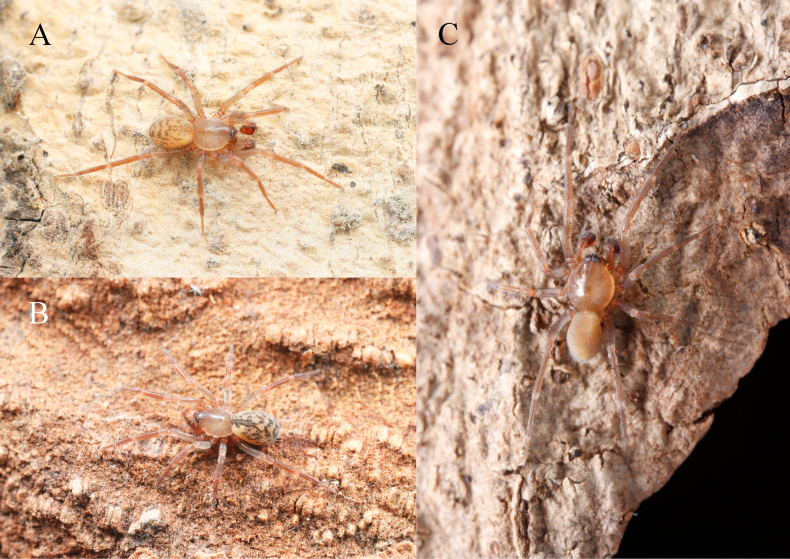 Figure 1
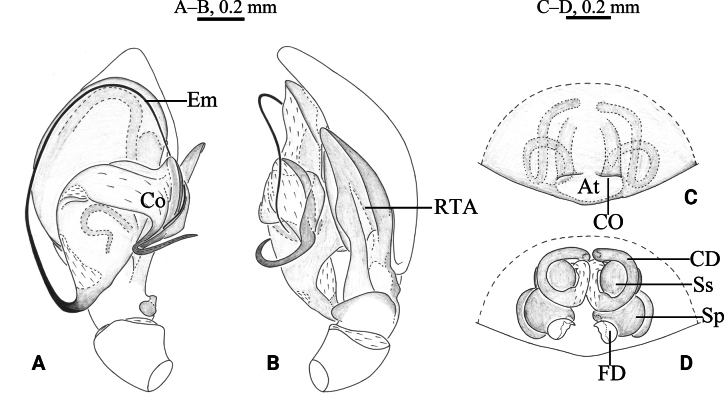 Figure 2
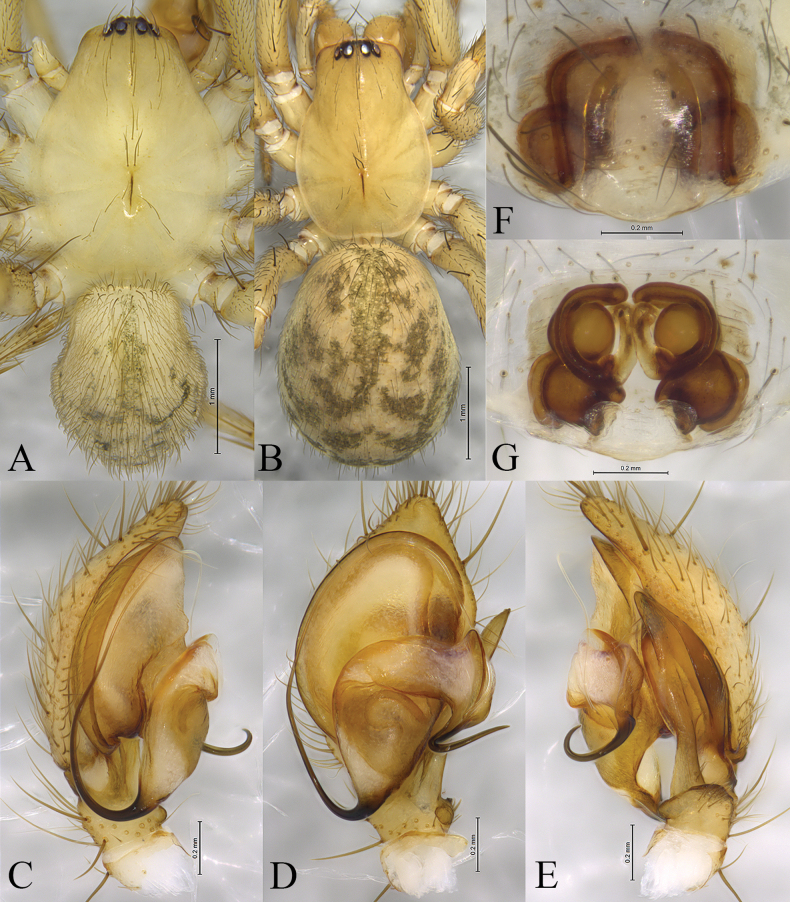 Figure 3
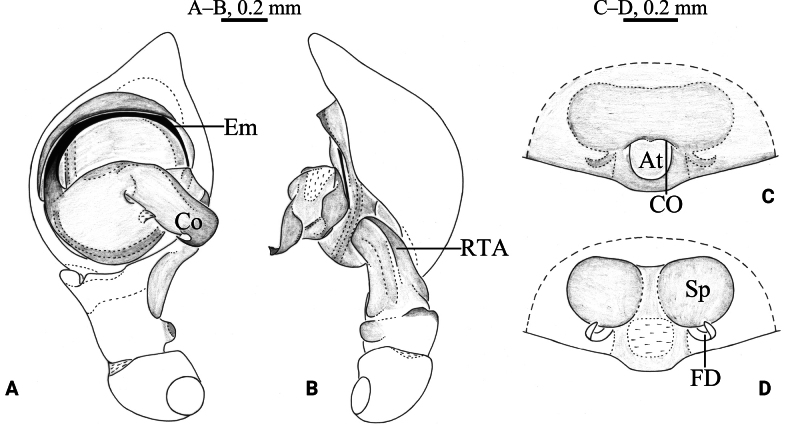 Figure 4
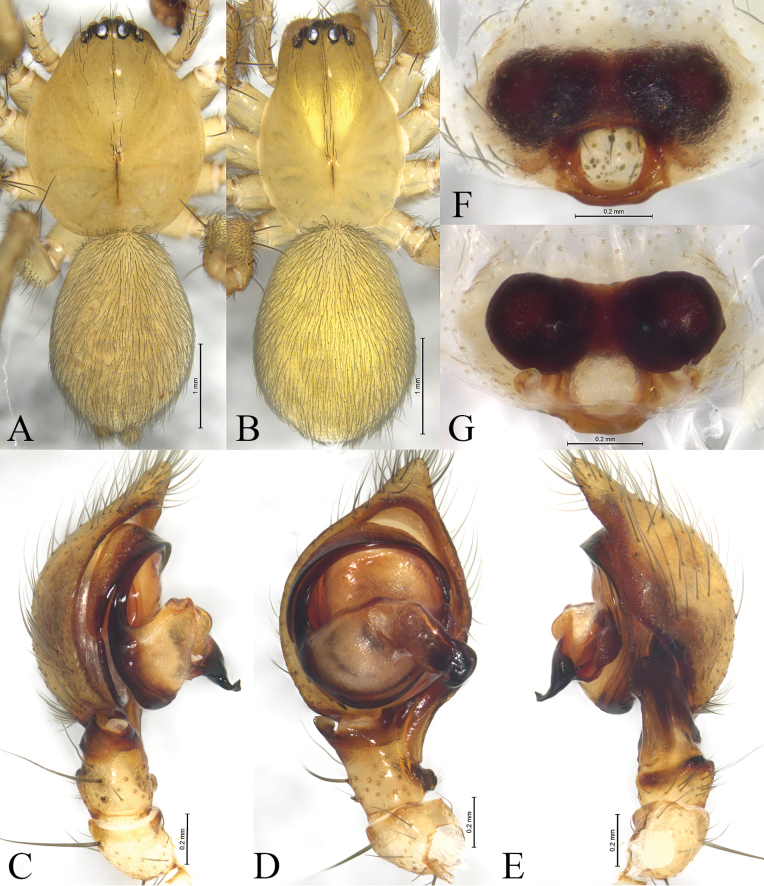 Figure 5
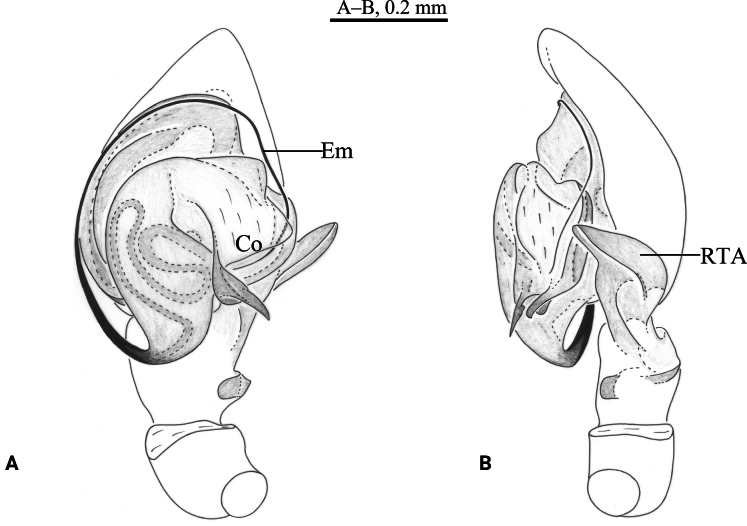 Figure 6
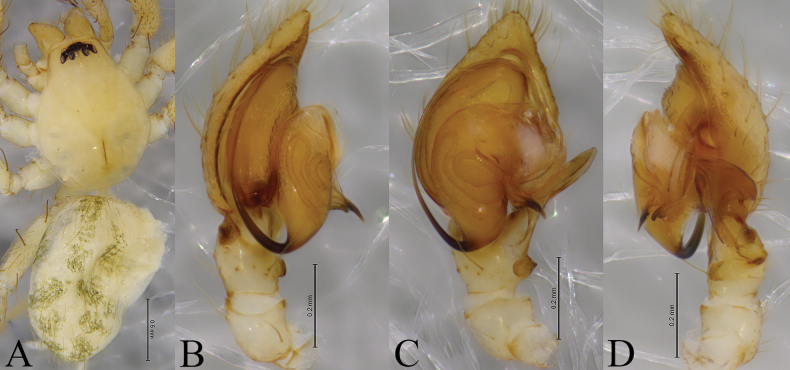 Figure 7
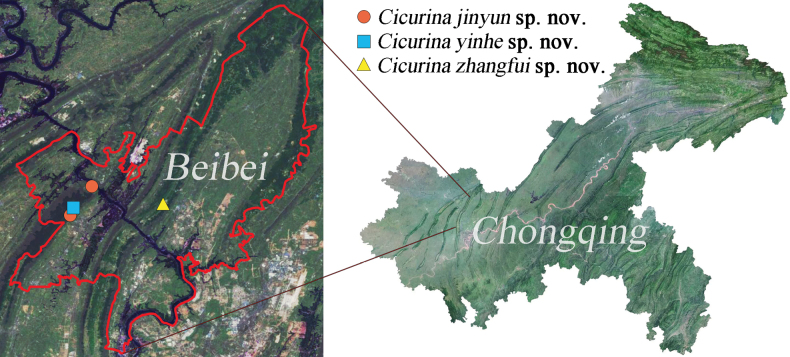 Figure 8
Peer Reviews
No public reviews on file for this paper yet. If you reviewed it on a platform where reviews are public (OpenReview, ICLR, NeurIPS, ICML), you can paste yours below so the community can read it here.
Videos
No videos yet. Explain this paper in a talk, walkthrough, or lecture? Add one.
Taxonomy
TopicsSpider Taxonomy and Behavior Studies · Lepidoptera: Biology and Taxonomy · Genomics and Phylogenetic Studies
Introduction
The spider genus Cicurina Menge, 1871 has a complex taxonomic history, having been moved from Agelenidae to Dictynidae (Lehtinen, 1967), then to Hahniidae (Wheeler et al. 2017), before finally being placed in its own designated family, Cicurinidae (Gorneau et al. 2023). It comprises 86% (154 out of 179) of the species in the entire family, predominantly distributed across the Holarctic region, of which 114 species are distributed in North America (WSC 2025).
Cicurina spiders, characterized by their small size and secretive behavior, are typically found in leaf litter, under stones, and in caves, where they construct intricate small funnel webs that function as both shelters and hunting grounds (Gertsch 1992; Wang et al. 2019; Liao et al. 2022). Recent studies suggest that its diversity has been significantly underestimated, particularly in China where 31 species (10 in Chongqing Mun., 8 in Guizhou Prov., 5 in Hunan Prov., 3 in Guangdong Prov., 2 in Anhui Prov., 2 in Hubei Prov., 1 in Zhejiang Prov.) have been recorded (Chen 1986; Wang and Xu 1989; Song and Kim 1991; Wang 1994; Peng et al. 1996; Yin et al. 2012; Li and Wang 2017; Wang et al. 2019; Liao et al. 2022; Wang et al. 2024; Wang and Zhang 2025; WSC 2025). Based on our field experience, we speculate that numerous unknown Cicurina species likely exist in southern China, particularly in southwestern mountain areas.
In this paper, we describe and illustrate three new Cicurina species from Chongqing Municipality, China, with living specimen photos of two species. This work represents the third contribution to the study of Cicurina spiders in Chongqing, following Wang et al. (2024) and Wang and Zhang (2025).
Material and methods
All specimens were preserved in 75% ethanol and examined, illustrated, photographed and measured using a Leica M205A stereomicroscope equipped with a drawing tube, a Leica DFC450 camera and LAS software (ver. 4.6). Male palps and epigynes were examined and illustrated after they were dissected. Epigynes were cleared by immersing them in pancreatin (Álvarez-Padilla and Hormiga 2007). Eye sizes were measured as the maximum dorsal diameter. Leg measurements are shown as: total length (femur, patella and tibia, metatarsus, tarsus). All measurements are in millimetres. Specimens examined here are deposited in the spider collection at the School of Life Sciences, Southwest University, Chongqing, China (SWUC).
Abbreviations used in the text: ALE, anterior lateral eye; AME, anterior median eye; MOA, median ocular area; PLE, posterior lateral eye; PME, posterior median eye.
Taxonomy
Family Cicurinidae Kishida, 1955 (洞叶蛛科)
Genus Cicurina Menge, 1871
洞叶蛛属
Cicurina
jinyun
sp. nov.
Taxon classificationAnimaliaAraneaeCicurinidae
31418523-1FF8-59A8-9D34-023320E55732
https://zoobank.org/62DA73D2-1E3B-48ED-B31D-62822F2F265E
Type material.
Holotype • male (SWUC-T-CI-13-01), China, Chongqing, Beibei, Jinyun Mountain National Nature Reserve, Baiyun Temple, 29°49'39"N, 106°22'59"E, elev. 641 m, 18 September 2016, L.Y. Wang leg. Paratypes: • 6 males and 7 females (SWUC-T-CI-13-02–14), Jinyun Mountain National Nature Reserve, Beiwenquan, 29°51'32"N, 106°24'41"E, elev. 229 m, 30 December 2024, L.Y. Wang, M. Irfan, Y.N. Mu, X.Y. Zhang and E.X. Liu leg.
Etymology.
The specific name refers to the type locality.
Diagnosis.
The male of this new species is similar to that of C.yuelushanensis Wang, Zhou & Peng, 2019 (Wang et al. 2019: figs 7A, 8C–E) in having the strong retrolateral tibial apophysis, and the slender and filiform embolus, but differs by the longer and curved conductor end (Figs 2A, B, 3C–E) (vs. knife-like in C.yuelushanensis). The female is similar to that of C.tetragongylodes Liao, Yin, He & Xu, 2022 (Liao et al. 2022: 485, figs 6A–E, 7A, B) in having the posteriorly located epigynal atrium, the ball-shaped spermathecae and secondary spermathecae, but differs by the unconnected anterior edge of atrium (Figs 2C, 3F) (vs. closely connected in C.tetragongylodes) and the secondary spermathecae encircled by copulatory ducts (Figs 2D, 3G) (vs. all spermathecae surrounded by copulatory ducts in C.tetragongylodes).
Photos of living specimens. A. Cicurinajinyun sp. nov., paratype male; B. Cicurinajinyun sp. nov., paratype female; C. Cicurinayinhe sp. nov., paratype male. Photographed by Qian-Le Lu.
Cicurinajinyun sp. nov. holotype male (A, B) and paratype female (C, D). A. Left male palp, ventral view; B. Same, retrolateral view; C. Epigyne, ventral view; D. Vulva, dorsal view. Abbreviation: At = atrium; CD = copulatory duct; CO = copulatory opening; Co = conductor; Em = embolus; FD = fertilization duct; RTA = retrolateral tibial apophysis; Sp = spermathecae; Ss = secondary spermathecae.
Cicurinajinyun sp. nov. holotype male (A, C–E) and paratype female (B, F, G). A. Male habitus, dorsal view; B. Female habitus, dorsal view; C. Left male palp, prolateral view; D. Same, ventral view; E. Same, retrolateral view; F. Epigyne, ventral view; G. Vulva, dorsal view.
Description.
Male holotype (Fig. 3A) total length 4.03. Prosoma 2.36 long, 1.72 wide; opisthosoma 1.73 long, 1.38 wide. Carapace pyriform, pale yellow, with several rows of setae. Eye sizes and interdistances: AME 0.03, ALE 0.11, PME 0.09, PLE, 0.12; AME–AME 0.04, AME–ALE 0.03, PME–PME 0.10, PME–PLE 0.05, ALE–PLE 0.04. MOA 0.24 long, anterior width 0.09, posterior width 0.27. Clypeus height 0.20. Chelicerae with three promarginal and nine retromarginal teeth. Leg measurements: I 6.30 (1.71, 2.24, 1.37, 0.98); II 5.46 (1.55, 1.81, 1.17, 0.93); III 4.93 (1.43, 1.57, 1.16, 0.77); IV 6.54 (1.74, 2.34, 1.53, 0.93). Leg formula: 4123. Opisthosoma oval, pale yellow and hairy, with faint patterns.
Palp (Figs 2A, B, 3C–E). Retrolateral tibial apophysis long and strong. Base of retrolateral tibial apophysis with two small apophyses, extending ventrally and dorsally. Embolus strong, originating at approximately 6-o’clock position, with the anterior part extending inside in the long groove of the conductor. Conductor strong, with J-shaped end.
One of female paratypes (SWUC-T-CI-13-02, Fig. 3B) total length 4.66. Prosoma 2.17 long, 1.50 wide; opisthosoma 2.43 long, 1.99 wide. Carapace pyriform, pale yellow, with several rows of setae. Eye sizes and interdistances: AME 0.06, ALE 0.13, PME 0.09, PLE, 0.13; AME–AME 0.01, AME–ALE 0.02, PME–PME 0.09, PME–PLE 0.05, ALE–PLE 0.02. MOA 0.24 long, anterior width 0.13, posterior width 0.30. Clypeus height 0.12. Chelicerae with two promarginal and nine retromarginal teeth. Leg measurements: I 5.29 (1.57, 1.94, 1.07, 0.71); II 4.43 (1.36, 1.49, 0.93, 0.65); III 4.28 (1.23, 1.45, 0.98, 0.62); IV 5.75 (1.68, 1.96, 1.38, 0.73). Leg formula: 4123. Opisthosoma oval, pale yellow and hairy, with distinct patterns.
Epigyne (Figs 2C, D, 3F, G). Atrium large and wide. Copulatory openings located anterior to atrium. Copulatory ducts long and spiral. Spermathecae and secondary spermathecae ball-shaped. Fertilization ducts short.
Variation.
Males (N = 7) total length 4.10–4.20; females (N = 7) total length 3.68–4.66.
Distribution.
Known only from the type locality, Chongqing, China (Fig. 8).
Cicurina
yinhe
sp. nov.
Taxon classificationAnimaliaAraneaeCicurinidae
39861B57-7EF3-5698-BE37-C9C486CC03B5
https://zoobank.org/6A31F5FE-87D7-447F-A03B-AA57CA90D6E4
Figs 1C , 4A–G , 5A–G , 8 银河洞叶蛛
Type material.
Holotype • male (SWUC-T-CI-14-01), China, Chongqing, Beibei, Shuitu Town, Wuji Valley, Yinhe Cave, 29°50'4"N, 106°29'51"E, elev. 550 m, 23 November 2021, L.Y. Wang and T.Y. Ren leg. Paratypes: • 9 males and 3 females (SWUC-T-CI-14-02–13), with same data as for holotype.
Etymology.
The specific name refers to the type locality.
Diagnosis.
This new species is similar to C.lichuanensis Wang, Zhou & Peng, 2019 (Wang et al. 2019: figs 5A–D, 6A–G) in having the similar shaped retrolateral tibial apophysis, the long and strong embolus, the posteriorly located epigynal atrium, and the ball-shaped spermathecae, but differs by the wider and slightly curved retrolateral tibial apophysis (Figs 4B, 5E) (vs. wide and more curved in C.lichuanensis), the sharp conductor end (Figs 4A, B, 5C–E) (vs. blunt in C.lichuanensis), and the wide epigynal atrium (Figs 4C, D, 5F, G) (vs. wider in C.lichuanensis).
Cicurinayinhe sp. nov. holotype male (A, B) and paratype female (C, D). A. Left male palp, ventral view; B. Same, retrolateral view; C. Epigyne, ventral view; D. Vulva, dorsal view. Abbreviation: At = atrium; CO = copulatory opening; Co = conductor; Em = embolus; FD = fertilization duct; RTA = retrolateral tibial apophysis; Sp = spermathecae.
Cicurinayinhe sp. nov. holotype male (A, C–E) and paratype female (B, F, G). A. Male habitus, dorsal view; B. Female habitus, dorsal view; C. Left male palp, prolateral view; D. Same, ventral view; E. Same, retrolateral view; F. Epigyne, ventral view; G. Vulva, dorsal view.
Description.
Male holotype (Fig. 5A) total length 4.92. Prosoma 2.57 long, 2.15 wide; opisthosoma 2.40 long, 1.71 wide. Carapace pyriform and yellow, with a few setae. Eye sizes and interdistances: AME 0.10, ALE 0.14, PME 0.14, PLE, 0.15; AME–AME 0.06, AME–ALE 0.02, PME–PME 0.12, PME–PLE 0.08, ALE–PLE 0.04. MOA 0.35 long, anterior width 0.28, posterior width 0.41. Clypeus height 0.31. Chelicerae with three promarginal and six retromarginal teeth. Leg measurements: I 7.37 (2.02, 2.59, 1.75, 1.01); II 6.81 (1.89, 2.29, 1.63, 1.00); III 6.07 (1.73, 1.92, 1.50, 0.92); IV 7.83 (2.04, 2.49, 2.18, 1.12). Leg formula: 4123. Opisthosoma oval, yellow and hairy, without distinct patterns.
Palp (Figs 4A, B, 5C–E). Retrolateral tibial apophysis wide, with a single fold and truncates apex. The base of retrolateral tibial apophysis with two small apophyses, extending ventrally and dorsally. Embolus strong, originating at approximately 9-o’clock position, with the anterior part extending along the groove of the conductor. Conductor strong, with a small and hooked end.
One of female paratypes (SWUC-T-CI-14-02, Fig. 5B) total length 4.40. Prosoma 2.25 long, 1.55 wide; opisthosoma 2.27 long, 1.69 wide. Carapace pyriform and yellow, with a few setae. Eye sizes and interdistances: AME 0.11, ALE 0.13, PME 0.12, PLE, 0.14; AME–AME 0.06, AME–ALE 0.02, PME–PME 0.11, PME–PLE 0.07, ALE–PLE 0.02. MOA 0.37 long, anterior width 0.27, posterior width 0.36. Clypeus height 0.13. Chelicerae with three promarginal and six retromarginal teeth. Leg measurements: I 5.29 (1.75, 2.19, 1.28, 0.77); II 4.43 (1.51, 1.84, 1.16, 0.76); III 4.28 (1.43, 1.54 1.15, 0.69); IV 5.75 (1.84, 2.12, 1.59, 0.85). Leg formula: 4123. Opisthosoma oval, yellow and hairy, without distinct patterns.
Epigyne (Figs 4C, D, 5F, G). Atrium oval. Copulatory openings located on the shoulders of atrium. Spermathecae large and ball-shaped. Fertilization ducts hook-shaped.
Variation.
Males (N = 8) total length 4.13–4.92; females (N = 3) total length 3.94–4.40.
Cicurina
zhangfui
sp. nov.
Taxon classificationAnimaliaAraneaeCicurinidae
9D669241-D5E8-5B27-823A-4914B5CF22D5
https://zoobank.org/CDD0F574-BFE7-45D5-8FE5-9EF4D643543E
Type material.
Holotype • male (SWUC-T-CI-15-01), China, Chongqing, Beibei, Jinyun Mountain National Nature Reserve, 29°49'58"N, 106°23'2"E, elev. 804 m, 7 January 2011, J. Yang and S.Y. Xu leg. Paratypes: • 1 male (SWUC-T-CI-15-02), with same data as for holotype; • 1 male (SWUC-T-CI-15-03), Jinyun Mountain National Nature Reserve, 29°49'58"N, 106°23'2"E, elev. 804 m, 15 February 2011, L. Li and M.Y. Liu leg.
Etymology.
The specific name of this new species is dedicated to the Chinese arachnologist Prof. Zhangfu Chen in honor of the first description of a Cicurina species in China.
Diagnosis.
The male of this new species is similar to that of C.avicularia Li & Wang, 2017 (Li and Wang 2017: figs 62A, B, 63A, B, 65A–D, 66E) in having the similar shaped retrolateral tibial apophysis, and the slender and filiform embolus, but differs by the weakly bifurcated conductor end (Figs 6A, B, 7B–D) (vs. with strongly bifurcated in C.avicularia).
Cicurinazhangfui sp. nov. holotype male (A, B). A. Left male palp, ventral view; B. Same, retrolateral view. Abbreviation: Co = conductor; Em = embolus; RTA = retrolateral tibial apophysis.
Cicurinazhangfui sp. nov. holotype male (A–D). A. Male habitus, dorsal view; B. Left male palp, prolateral view; C. Same, ventral view; D. Same, retrolateral view.
Description.
Male holotype (Fig. 7A) total length 2.65. Prosoma 1.24 long, 0.92 wide; opisthosoma 1.37 long, 0.95 wide. Carapace pyriform and pale yellow, with sparse setae. Eye sizes and interdistances: AME 0.05, ALE 0.06, PME 0.06, PLE, 0.06; AME–AME 0.03, AME–ALE 0.02, PME–PME 0.07, PME–PLE 0.05, ALE–PLE 0.02. MOA 0.15 long, anterior width 0.12, posterior width 0.17. Clypeus height 0.09. Chelicerae with three promarginal and six retromarginal teeth. Leg measurements: I 3.26 (0.94, 1.11, 0.67, 0.54); II 2.93 (0.86, 0.98, 0.60, 0.49); III 2.69 (0.80, 0.79, 0.62, 0.48); IV 3.33 (0.95, 1.08, 0.81, 0.49). Leg formula: 4123. Opisthosoma oval, pale yellow and sparsely hairy, with distinct patterns.
Palp (Figs 6A, B, 7B–D). Retrolateral tibial apophysis wide, with a single fold and rounded end. Embolus slender and filiform, originating at approximately 6-o’clock position, with the anterior part extending along the long groove of the conductor. Conductor short and strong, with a weakly bifurcated end.
Female. Unknown.
Variation.
Males (N = 3) total length 2.65–2.77.
Distribution.
Known only from the type locality, Chongqing, China (Fig. 8).
Distribution records of three Cicurina species in Chongqing, China.
Supplementary Material
XML Treatment for Cicurina jinyun
XML Treatment for Cicurina yinhe
XML Treatment for Cicurina zhangfui
The reference list from the paper itself. Each links out to its DOI / PubMed record.
- 1Álvarez-Padilla F Hormiga G (2007) A protocol for digesting internal soft tissues and mounting spiders for scanning electron microscopy.The Journal of Arachnology 35(3): 538–542. 10.1636/Sh 06-55.1 · doi ↗
- 2Chen ZF (1986) A new generic record and a new species of Agelenidae from China (Araneae: Agelenidae).Dong Wu Fen Lei Xue Bao 11: 160–162.
- 3Gertsch WJ (1992) Distribution patterns and speciation in North American cave spiders with a list of the troglobites and revision of the cicurinas of the subgenus Cicurella.Texas Memorial Museum Speleological Monographs 3: 75–122.
- 4Gorneau JA Crews SC Cala-Riquelme F Montana KO Spagna JC Ballarin F Almeida-Silva LM Esposito LA (2023) Webs of intrigue: Museum genomics elucidate relationships of the marronoid spider clade (Araneae).Insect Systematics and Diversity 7(5): 1–5. 10.1093/isd/ixad 021 · doi ↗
- 5Lehtinen PT (1967) Classification of the cribellate spiders and some allied families, with notes on the evolution of the suborder Araneomorpha.Annales Zoologici Fennici 4: 199–468.
- 6Li SQ Wang XX (2017) New cave-dwelling spiders of the family Dictynidae (Arachnida, Araneae) from Guangxi and Guizhou, China.Zoological Systematics 42(2): 125–228. 10.11865/zs.201711 · doi ↗
- 7Liao R Yin H He A Xu X (2022) Description of three new species of the genus Cicurina Menge, 1871 from Guangdong, China (Araneae, Hahniidae).Zootaxa 5188(5): 477–488. 10.11646/zootaxa.5188.5.437044765 · doi ↗ · pubmed ↗
- 8Peng XJ Gong LS Kim JP (1996) Five new species of the family Agelenidae (Arachnida, Araneae) from China.Korean Arachnology 12(2): 17–26.