Key role of the default mode network in transfer of motor learning from previous experience
Hiroshi Imamizu, Toshiyuki Kondo

TL;DR
A new study shows that the brain's default mode network helps transfer motor skills from past experiences to new situations.
Contribution
The study identifies the default mode network as crucial for motor learning transfer.
Findings
The default mode network is essential for applying past motor skills to new contexts.
This finding highlights the network's role in efficient learning from limited data.
Abstract
The ability to apply skills gained in one context to different situations enables efficient learning, even from limited data. A new study in PLOS Biology suggests that the default mode network, a core brain network, plays a key role in this ability. The ability to apply skills gained in one context to different situations enables efficient learning even from limited data. This Primer explores a new PLOS Biology study which shows that the default mode network, a core brain network, plays a key role in this ability.
Genes, proteins, chemicals, diseases, species, mutations and cell lines named across the full text — each resolved to its canonical identifier and authoritative record.
Click any figure to enlarge with its caption.
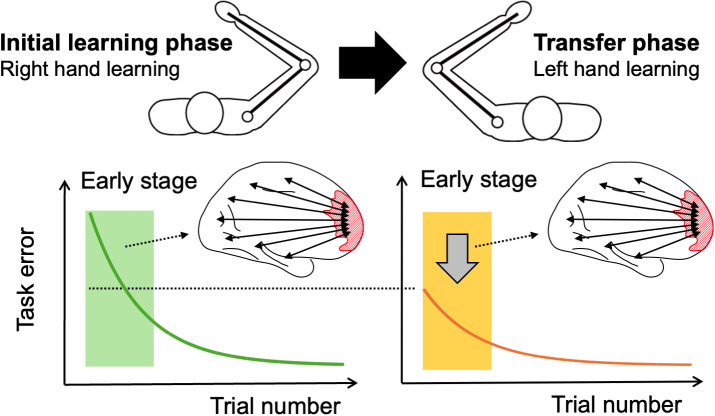 Figure 1
Peer Reviews
No public reviews on file for this paper yet. If you reviewed it on a platform where reviews are public (OpenReview, ICLR, NeurIPS, ICML), you can paste yours below so the community can read it here.
Videos
No videos yet. Explain this paper in a talk, walkthrough, or lecture? Add one.
Taxonomy
TopicsNeural dynamics and brain function · Photoreceptor and optogenetics research · Mitochondrial Function and Pathology