Improving health and housing outcomes through a simulation and economic model: an evidence-based protocol of a group model building approach to develop an agent-based model
Danielle M. Kline, Pranav Padmanabhan, Sarah E. Brewer, Magdalena Cerdá, Elysia Versen, Katherine M. Keyes, Margot Kushel, Erin C. Wilson, Paul Wesson, Ayaz Hyder, Alaina Boyer, Alia Al-Tayyib, Joshua A. Barocas

TL;DR
This study uses a simulation model to explore how housing and health outcomes can be improved for people experiencing homelessness in the U.S.
Contribution
The novel contribution is the development of an agent-based model using group model building to evaluate housing and health interventions.
Findings
The model will simulate dynamic processes affecting HIV incidence, overdose, and life expectancy.
It will assess outcomes across housing status, health, budget, and economic value dimensions.
Model code and results will be publicly shared for transparency and reproducibility.
Abstract
Homelessness in the United States increased every year since 2016, with a 38% increase from 2023 to 2024. Much of the increase is attributable to rising home and rent costs, economic hardship caused by the recent pandemic, and the ending of protective legislation. Notably, people who experience homelessness have an increased risk of substance use disorders, HIV infection and poorer HIV outcomes than people who are stably housed. The iHouse model aims to develop feasible, effective, and cost-effective tailored approaches to improve health outcomes in this population including life expectancy, overdose, and HIV. The study will employ Group Model Building methods and use insights from that process to develop an agent-based model simulating the dynamic processes contributing to HIV incidence and treatment, overdose, and life expectancy among people along the housing and homelessness…
Genes, proteins, chemicals, diseases, species, mutations and cell lines named across the full text — each resolved to its canonical identifier and authoritative record.
Click any figure to enlarge with its caption.
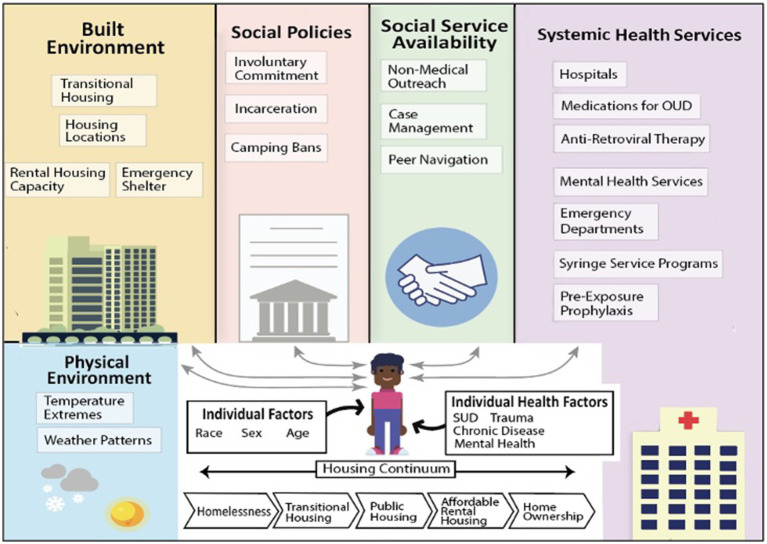 Figure 1
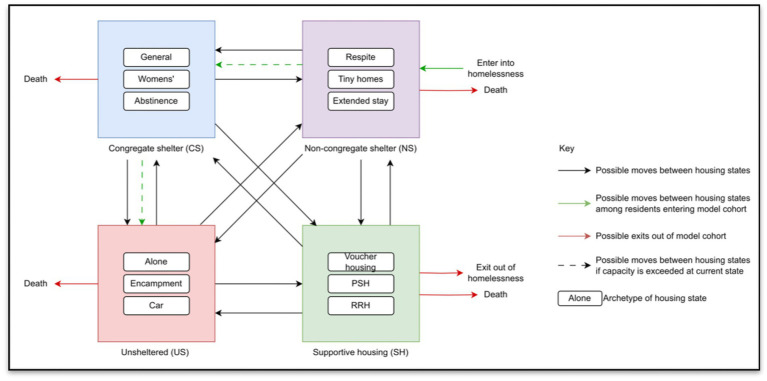 Figure 2
Peer Reviews
No public reviews on file for this paper yet. If you reviewed it on a platform where reviews are public (OpenReview, ICLR, NeurIPS, ICML), you can paste yours below so the community can read it here.
Videos
No videos yet. Explain this paper in a talk, walkthrough, or lecture? Add one.
Taxonomy
Topicsdemographic modeling and climate adaptation · Urban Transport and Accessibility · Healthcare Policy and Management