Molecular Survey of Chlamydial Infections in Three Public Bird Collections in Tehran, Iran
Seyed Mohamad Mahdi Hashemian, Seyed Ahmad Madani, Seyed Mostafa Peighambari

TL;DR
This study found high rates of chlamydial infections in birds at three public aviaries in Tehran, raising concerns about public health and conservation risks.
Contribution
The study provides new insights into the prevalence of Chlamydia spp. in diverse avian species in public bird collections in Iran.
Findings
Chlamydial infections were detected in 37 out of 108 bird samples from three public collections in Tehran.
High infection rates were observed in Psittaciformes (60%) and Columbiformes (77.8%).
The findings highlight a public health risk due to close contact between infected birds and humans.
Abstract
Avian Chlamydia spp. are capable of infecting different avian species and potentially cause the loss of valuable birds in rehabilitation facilities and zoos. They also pose a potential zoonotic risk to visitors and workers at such centres. This study aimed to assess the occurrence of chlamydia in two different public aviaries and a rehabilitation centre. One hundred and eight samples from 48 different avian species belonging to 11 different orders were collected. These samples were tested for chlamydia infection by detecting the Chlamydia 16s rRNA gene using polymerase chain reaction. Thirty‐seven samples were positive for Chlamydia DNA. High infection rates were detected in Psittaciformes (60%) and Columbiformes (77.8%). These findings indicate the relatively high frequency of chlamydial infections in birds of these orders. The occurrence of this infection in Falconiformes was…
Genes, proteins, chemicals, diseases, species, mutations and cell lines named across the full text — each resolved to its canonical identifier and authoritative record.
Click any figure to enlarge with its caption.
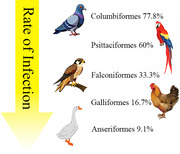 Figure 1
Peer Reviews
No public reviews on file for this paper yet. If you reviewed it on a platform where reviews are public (OpenReview, ICLR, NeurIPS, ICML), you can paste yours below so the community can read it here.
Videos
No videos yet. Explain this paper in a talk, walkthrough, or lecture? Add one.
Taxonomy
TopicsReproductive tract infections research · Rabies epidemiology and control · Syphilis Diagnosis and Treatment