A randomized study of apalutamide in Chinese patients with non-metastatic castration-resistant prostate cancer
Shusuan Jiang, Ye Tian, Hongqian Guo, Jianming Guo, Haiying Dong, Hong Luo, Wei Xue, Tao Xu, Lei Li, Mingxing Qiu, Liping Xie, Angela Lopez-Gitlitz, Sharon McCarthy, Yanmei Liu, Haocheng Ma, Hongchuan Liang, Yanhui Li, Na Chen, Dingwei Ye

TL;DR
This study shows that apalutamide combined with hormone therapy is effective and safe for Chinese patients with a specific type of prostate cancer.
Contribution
The study provides new evidence on the efficacy and safety of apalutamide in Chinese patients with non-metastatic castration-resistant prostate cancer.
Findings
Apalutamide reduced the risk of PSA progression by 76.7% compared to placebo.
The median metastasis-free survival was 36.8 months with apalutamide.
The safety profile was consistent with existing data, with manageable side effects.
Abstract
This post-approval commitment study addressed the limited data on the safety and efficacy of apalutamide in Chinese patients with non-metastatic castration-resistant prostate cancer (NM-CRPC). Utilizing a double-blinded, placebo-controlled trial with pre-planned crossover design, 75 patients were randomized (2:1) to receive apalutamide 240 mg daily or placebo while continuing androgen deprivation therapy. Apalutamide significantly reduced the risk of prostate-specific antigen (PSA) progression by 76.7% compared with placebo (hazard ratio [HR] = 0.233, p = 0.0052), with confirmed PSA response rate of 92.0% versus 12.0%. The median metastasis-free survival with apalutamide was 36.8 months, while the median overall survival was not reached. Grade 3 and 4 treatment-emergent adverse events were reported in 43.1% and 4.2% of patients, respectively, with hypertension, pneumonia, and rash being…
Genes, proteins, chemicals, diseases, species, mutations and cell lines named across the full text — each resolved to its canonical identifier and authoritative record.
Click any figure to enlarge with its caption.
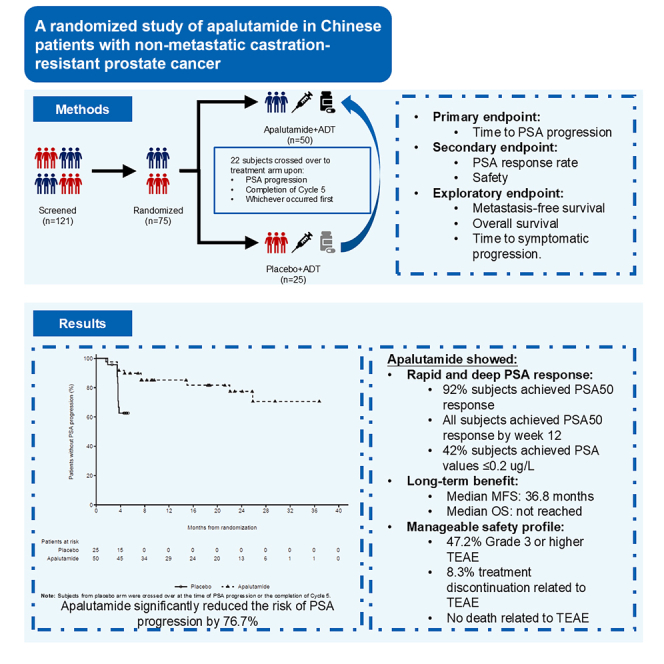 Figure 1
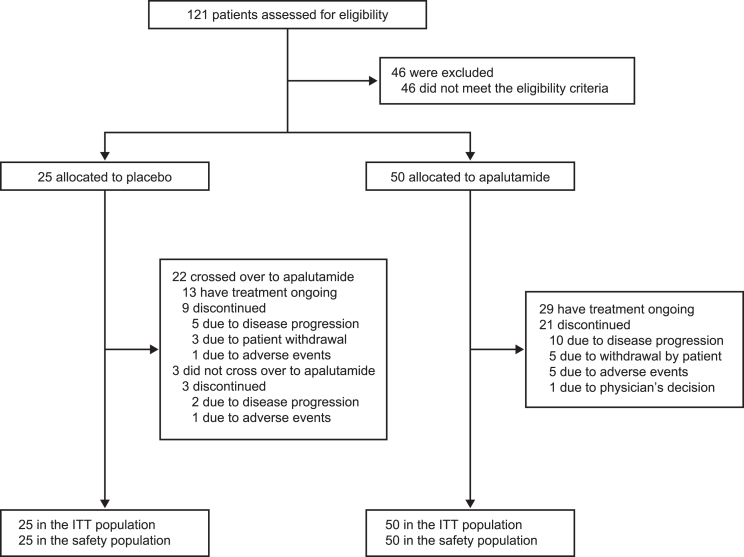 Figure 2
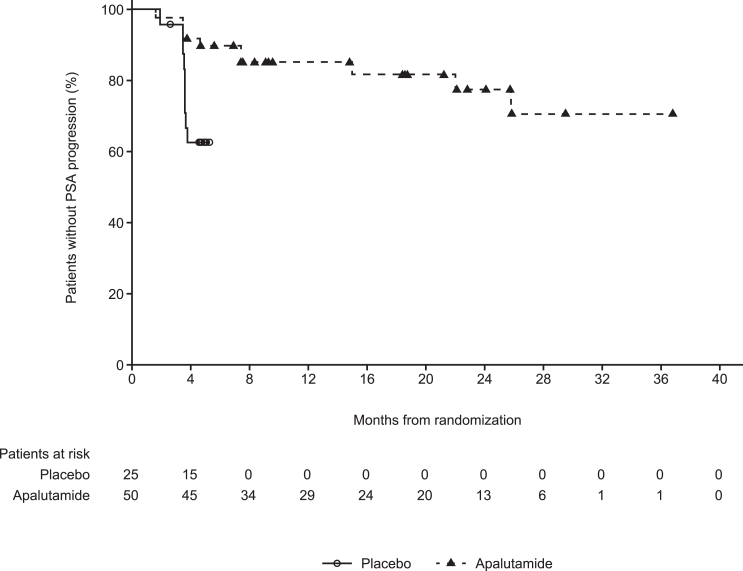 Figure 3
Peer Reviews
No public reviews on file for this paper yet. If you reviewed it on a platform where reviews are public (OpenReview, ICLR, NeurIPS, ICML), you can paste yours below so the community can read it here.
Videos
No videos yet. Explain this paper in a talk, walkthrough, or lecture? Add one.
Taxonomy
TopicsProstate Cancer Treatment and Research · Cancer-related Molecular Pathways · Cancer, Lipids, and Metabolism