Assessing Clinical Impressions of Early Warning Score Integration With the Rapid Response Team: Protocol for a Prospective Cohort Study
Alexandre Tran, Rashi Ramchandani, Jamie Brehaut, Natasha Hudek, Jessica Haines, Irene Watpool, Rebecca Porteous, Dora Kusevic, Kirby Bucciero, Kwadwo Kyeremanteng, Michael Hartwick, Kednapa Thavorn, Jonathan Hooper, Dalibor Kubelik, Christophe Herry, Nathan Scales, Brett Hryciw

TL;DR
This study evaluates how well a new early warning score system works with rapid response teams to identify patients at risk of deterioration.
Contribution
The study introduces a new method for assessing the feasibility of integrating a continuous monitoring system with an early warning score in a clinical setting.
Findings
The study will assess the feasibility of using the Visensia Safety Index with continuous monitoring.
Interviews will explore healthcare providers' impressions and challenges of implementing the system.
Feasibility will be measured by data collection success, alert timeliness, and staff task completion rates.
Abstract
The use of early warning scores (EWSs), which integrate real-time vital sign monitoring, can help rapid response teams (RRTs) proactively identify patients at risk of deterioration. However, existing EWSs demonstrate limited evidence for the reduction of clinically important adverse events. The Visensia Safety Index (VSI) is an EWS that combines heart rate, blood pressure, temperature, oxygen saturation, and respiration rate vital sign information to generate a VSI acuity score ranging from 0, signifying the lowest risk of deterioration, to 5, signifying highest risk of deterioration. Continuous monitoring of the risk of deterioration, with alerts triggered by a score of 3.0 or greater, prompts medical attention. This protocol outlines the methodology for assessing the feasibility of combining a portable continuous vital sign monitoring system (Masimo Root Monitor) with VSI monitoring…
Genes, proteins, chemicals, diseases, species, mutations and cell lines named across the full text — each resolved to its canonical identifier and authoritative record.
Click any figure to enlarge with its caption.
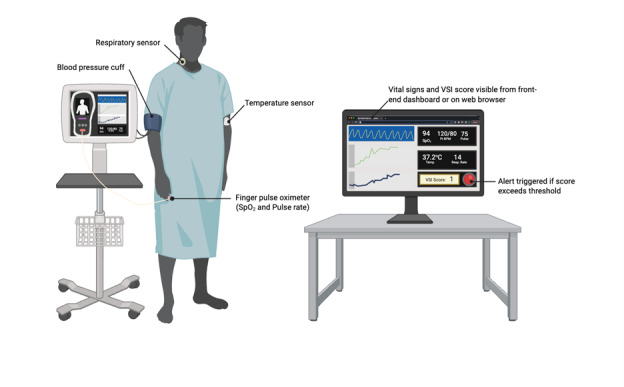 Figure 1
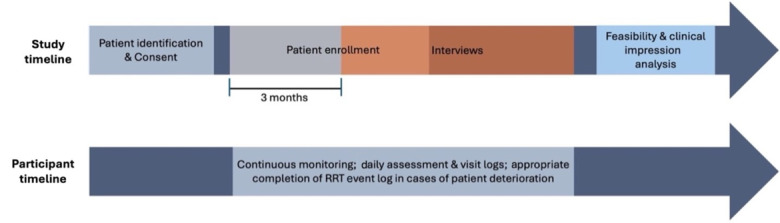 Figure 2
Peer Reviews
No public reviews on file for this paper yet. If you reviewed it on a platform where reviews are public (OpenReview, ICLR, NeurIPS, ICML), you can paste yours below so the community can read it here.
Videos
No videos yet. Explain this paper in a talk, walkthrough, or lecture? Add one.
Taxonomy
TopicsHealth Policy Implementation Science · Sepsis Diagnosis and Treatment · Meta-analysis and systematic reviews