Reduction of Tooth Replacement Disproportionately Affects the Evolution of Enamel Matrix Proteins
John Abramyan, Gengxin Li, Hannah Khansa

TL;DR
Lizards and mammals that stop replacing teeth evolve stronger enamel proteins, especially AMEL, to compensate for the loss.
Contribution
The study reveals that reduced tooth replacement disproportionately influences the evolution of enamel matrix proteins, particularly AMEL.
Findings
Acrodont lizards and mammals show accelerated evolution in enamel proteins after losing tooth replacement.
AMEL exhibits a particularly strong evolutionary response to the loss of tooth replacement.
The reduction in tooth generations correlates with changes in the coding and amino acid sequences of enamel proteins.
Abstract
In most vertebrates, teeth are continuously shed and replaced throughout life, while mammals and several lineages of reptiles have reduced replacement to only one or two generations. In contrast to the vast majority of their living relatives, members of the lizard families Chamaeleonidae and Agamidae have dispensed with lifelong tooth replacement, instead developing acrodont dentition that fuses to the jawbone to be used for the lifetime of the animal. Though, the loss of tooth replacement has not come without a cost. In order to mitigate the consequences that come with tooth replacement loss, mammals and acrodont lizards have evolved adaptations that strengthen enamel structure and minimize wear and tear experienced during the life of the animal. While these physical adaptations are well documented, the effect that loss of tooth replacement has had on the molecular components of teeth…
Genes, proteins, chemicals, diseases, species, mutations and cell lines named across the full text — each resolved to its canonical identifier and authoritative record.
Click any figure to enlarge with its caption.
 Figure 1
 Figure 2
 Figure 3
 Figure 4
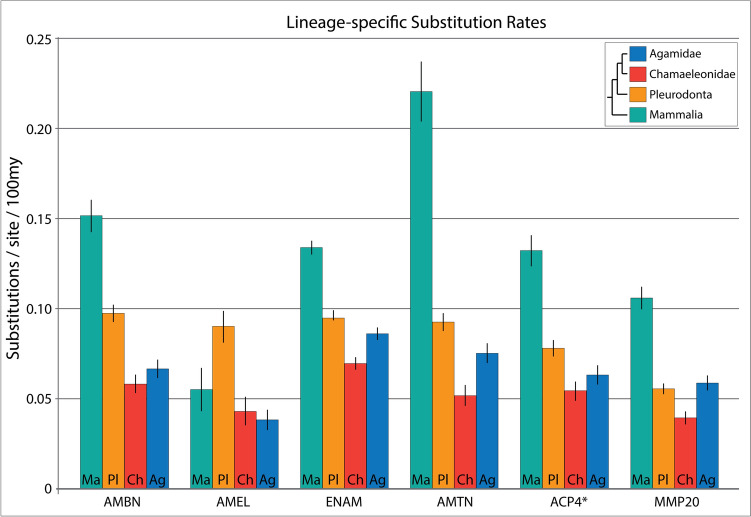 Figure 5
Peer Reviews
No public reviews on file for this paper yet. If you reviewed it on a platform where reviews are public (OpenReview, ICLR, NeurIPS, ICML), you can paste yours below so the community can read it here.
Videos
No videos yet. Explain this paper in a talk, walkthrough, or lecture? Add one.
Taxonomy
TopicsBone and Dental Protein Studies · Periodontal Regeneration and Treatments · Dental Trauma and Treatments