Translation, Validity, and Reliability of the Minnesota Tobacco Withdrawal Scale (MTWS) in Indonesian
Tribowo Ginting, Martina W Nasrun, Kristiana Siste, Jacub Pandelaki, Aria Kekalih, Melva Louisa, Agus Dwi A Susanto, Diah S Utami, Wresti Indriatmi, Immanuel N Tarigan, Ricky Nathaniel, Alya R Trishna

TL;DR
This study translated and validated the Minnesota Tobacco Withdrawal Scale for use in Indonesia, showing it is a reliable tool for assessing smoking withdrawal symptoms.
Contribution
The study provides the first validated Indonesian version of the Minnesota Tobacco Withdrawal Scale.
Findings
The Indonesian MTWS has strong content validity with an S-CVI/Ave score of 0.87.
Construct validity was confirmed with all items exceeding the critical r-value and a high KMO value of 0.970.
The scale demonstrated high internal consistency with a Cronbach's alpha of 0.923.
Abstract
Introduction Tobacco addiction remains a major public health issue in Indonesia, with smoking cessation often hindered by withdrawal symptoms. The Minnesota Tobacco Withdrawal Scale (MTWS) is a widely used assessment tool, but no validated Indonesian version has been available. This study aimed to translate, validate, and assess the reliability of the Indonesian MTWS. Methods A cross-sectional study was conducted from August to December 2022 with 174 adult smokers. The MTWS was translated and reviewed by five addiction specialists. Content validity was assessed using the Scale-Level Content Validity Index (S-CVI), construct validity through correlation analysis and exploratory factor analysis (EFA), and reliability via Cronbach's alpha. Results The content validity analysis showed that six statements had an Item Content Validity Index (I-CVI) score of 1.0, while 11 statements…
Genes, proteins, chemicals, diseases, species, mutations and cell lines named across the full text — each resolved to its canonical identifier and authoritative record.
Click any figure to enlarge with its caption.
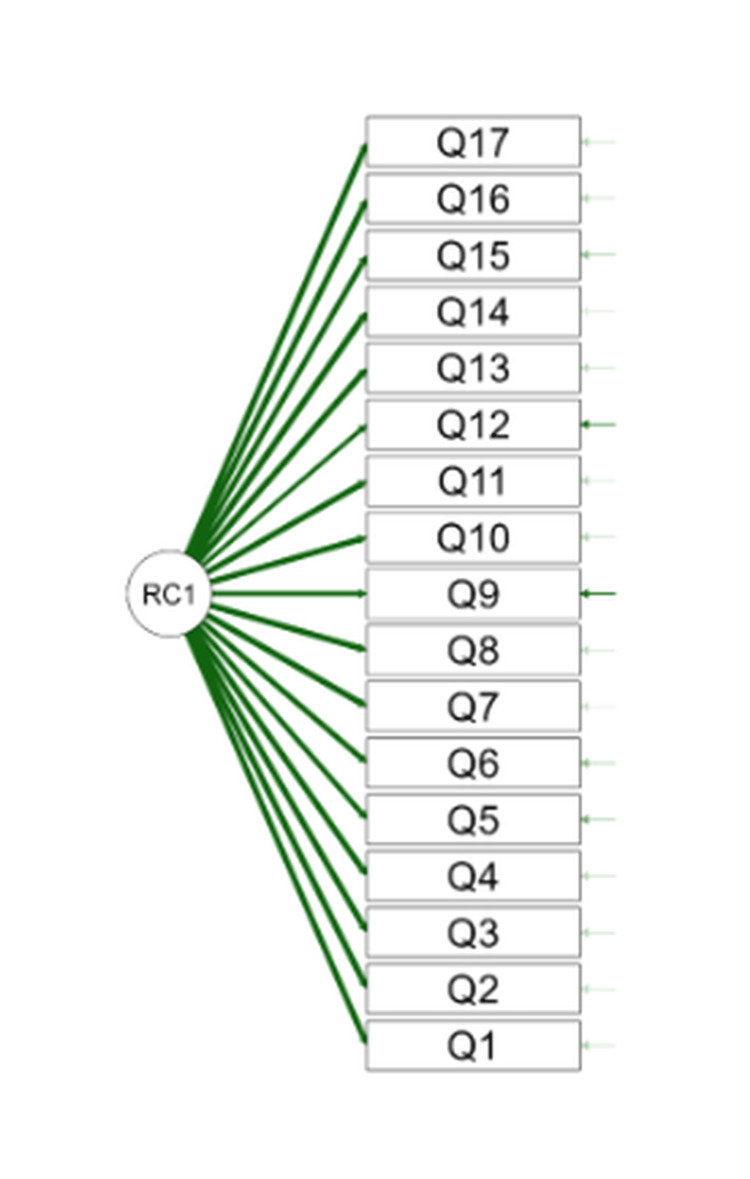 Figure 1
| Demographic characteristics | N (%) | |
| Age (mean ± standard deviation) in years | 36.64 ± 10.33 | |
| Sex | Male | 157 (90.2%) |
| Female | 17 (9.8%) | |
| Latest education | Junior high school | 6 (3.4%) |
| Senior high school | 78 (44.8%) | |
| Bachelor’s degree | 70 (40.2%) | |
| Masters degree | 20 (11.5%) | |
| Location | Jakarta | 71 (40.8%) |
| Java (outside of Jakarta) | 80 (46.0%) | |
| Sumatera | 14 (8.0%) | |
| Bali-Nusa Tenggara | 2 (1.1%) | |
| Kalimantan | 6 (3.4%) | |
| Sulawesi | 1 (0.6%) | |
| Type of cigarettes consumed | Cigarettes with a filter | 131 (75.3%) |
| Cigarettes without filter (kretek) | 23 (13.2%) | |
| Both | 20 (11.5%) | |
| Duration of smoking (median (minimum-maximum)) in years | 13,5 (1-50) | |
| Daily cigarette consumption (median (minimum-maximum)) in years | 12 (1-40) | |
| Attempt to quit smoking | Yes | 150 (86.2%) |
| No | 24 (13.8%) | |
| Professional attempt to quit smoking | Yes | 13 (7.5%) |
| No | 161 (92.5%) | |
| Statements | English version | Indonesian version |
| 1 | Angry, irritable, frustrated | Marah, mudah tersinggung, frustrasi |
| 2 | Anxious, nervous | Cemas, gugup |
| 3 | Depressed mood, sad | Suasana perasaan depresi, sedih |
| 4 | Difficulty concentrating | Sulit berkonsentrasi |
| 5 | Increased appetite, hungry, weight gain | Nafsu makan meningkat, lapar, peningkatan berat badan |
| 6 | Insomnia, sleep problems, awakening at night | Sulit tidur, tidur bermasalah, terbangun di malam hari |
| 7 | Restless | Gelisah |
| 8 | Impatient | Tidak sabar |
| 9 | Cheerful/elated | Ceria/sangat gembira |
| 10 | Constipation | Sulit buang air besar |
| 11 | Coughing | Batuk |
| 12 | Craving to smoke | Dorongan yang kuat untuk merokok |
| 13 | Decreased pleasure from events | Berkurangnya kesenangan dalam berbagai kegiatan |
| 14 | Dizziness | Pusing |
| 15 | Drowsy | Mengantuk |
| 16 | Impulsive | Impulsif |
| 17 | Mouth ulcers | Sariawan |
| Statements | Relevance |
| 1 | 0.8 |
| 2 | 1 |
| 3 | 1 |
| 4 | 1 |
| 5 | 0.8 |
| 6 | 1 |
| 7 | 1 |
| 8 | 0.8 |
| 9 | 0.8 |
| 10 | 0.8 |
| 11 | 0.8 |
| 12 | 1 |
| 13 | 0.8 |
| 14 | 0.8 |
| 15 | 0.8 |
| 16 | 0.8 |
| 17 | 0.8 |
| Total I-CVI | 14.8 |
| S-CVI/Ave | 0.87 |
| Statements | Calculated r value | Critical r value | Conclusion |
| 1 | 0.718 | 0.124 | Valid |
| 2 | 0.675 | 0.124 | Valid |
| 3 | 0.716 | 0.124 | Valid |
| 4 | 0.726 | 0.124 | Valid |
| 5 | 0.489 | 0.124 | Valid |
| 6 | 0.681 | 0.124 | Valid |
| 7 | 0.739 | 0.124 | Valid |
| 8 | 0.739 | 0.124 | Valid |
| 9 | 0.431 | 0.124 | Valid |
| 10 | 0.403 | 0.124 | Valid |
| 11 | 0.605 | 0.124 | Valid |
| 12 | 0.667 | 0.124 | Valid |
| 13 | 0.689 | 0.124 | Valid |
| 14 | 0.682 | 0.124 | Valid |
| 15 | 0.628 | 0.124 | Valid |
| 16 | 0.706 | 0.124 | Valid |
| 17 | 0.361 | 0.124 | Valid |
| Kaiser-Meyer Olkin test | MSA |
| Overall MSA | 0.970 |
| Q1 | 0.977 |
| Q2 | 0.959 |
| Q3 | 0.956 |
| Q4 | 0.982 |
| Q5 | 0.969 |
| Q6 | 0.970 |
| Q7 | 0.965 |
| Q8 | 0.984 |
| Q9 | 0.950 |
| Q10 | 0.982 |
| Q11 | 0.976 |
| Q12 | 0.968 |
| Q13 | 0.966 |
| Q14 | 0.953 |
| Q15 | 0.977 |
| Q16 | 0.972 |
| Q17 | 0.982 |
| Bartlett's test | ||
| Χ² | df | p-value |
| 4781.399 | 136.000 | <0.001 |
| Factor 1 | Uniqueness | |
| Q14 | 0.970 | 0.059 |
| Q7 | 0.950 | 0.098 |
| Q2 | 0.943 | 0.111 |
| Q13 | 0.938 | 0.120 |
| Q8 | 0.937 | 0.121 |
| Q4 | 0.933 | 0.129 |
| Q3 | 0.931 | 0.133 |
| Q11 | 0.928 | 0.139 |
| Q17 | 0.927 | 0.141 |
| Q16 | 0.926 | 0.142 |
| Q10 | 0.924 | 0.146 |
| Q1 | 0.915 | 0.162 |
| Q15 | 0.883 | 0.221 |
| Q6 | 0.877 | 0.231 |
| Q5 | 0.842 | 0.290 |
| Q12 | 0.755 | 0.431 |
| Q9 | 0.741 | 0.451 |
| Unrotated solution | Rotated solution | ||||||
| Eigenvalues | SumSq. Loadings | Proportionvar. | Cumulative | SumSq. Loadings | Proportionvar. | Cumulative | |
| Factor 1 | 14.044 | 13.874 | 0.816 | 0.816 | 13.874 | 0.816 | 0.816 |
| Factor Correlations | |
| Factor 1 | |
| Factor 1 | 1.000 |
| Additional fit indices | |||||
| RMSEA | RMSEA 90% confidence | SRMR | TLI | CFI | BIC |
| 0.105 | 0.092 - 0.118 | 0.023 | 0.944 | 0.951 | -267.348 |
| Statements | Cronbach’s alpha | Conclusion |
| 1 | 0.917 | Reliable |
| 2 | 0.917 | Reliable |
| 3 | 0.917 | Reliable |
| 4 | 0.916 | Reliable |
| 5 | 0.924 | Reliable |
| 6 | 0.919 | Reliable |
| 7 | 0.915 | Reliable |
| 8 | 0.915 | Reliable |
| 9 | 0.927 | Reliable |
| 10 | 0.923 | Reliable |
| 11 | 0.920 | Reliable |
| 12 | 0.921 | Reliable |
| 13 | 0.917 | Reliable |
| 14 | 0.916 | Reliable |
| 15 | 0.918 | Reliable |
| 16 | 0.916 | Reliable |
| 17 | 0.923 | Reliable |
Peer Reviews
No public reviews on file for this paper yet. If you reviewed it on a platform where reviews are public (OpenReview, ICLR, NeurIPS, ICML), you can paste yours below so the community can read it here.
Videos
No videos yet. Explain this paper in a talk, walkthrough, or lecture? Add one.
Taxonomy
TopicsSmoking Behavior and Cessation · Health and Wellbeing Research
Introduction
Tobacco addiction is still a major health problem in Indonesia. From the Global Adult Tobacco Survey 2021 held by the Indonesian Ministry of Health, the numbers of adult smokers grew by as much as 8.8 million people in a span of ten years (from 2011 to 2021), as in 2018, 33.8% of both sexes adult populations in Indonesia are smokers [1,2]. Its catastrophic effect not only impacts the health burden-smoking is a major factor of cerebrovascular attack, ischemic heart disease, and chronic obstructive pulmonary disease (COPD), which mortality rate increases by 29.2%, 29.0%, and 10.5% respectively from 2007 to 2017, but also the economic burden in Indonesia [3]. The economic cost of smoking for the entire population of Indonesia in 2019 ranged from Rp 184.36 trillion to Rp 410.76 trillion, as stated by Meilissa et al. (2021), which resulted in 61.2% to 91.8% of the 2019 deficit of Indonesia's National Health Insurance System (Badan Penyelenggara Jaminan Sosial Kesehatan (BPJS)) [4].
Given the profound health and economic impacts of tobacco use in Indonesia, addressing smoking cessation is critical, not only to reduce the national burden but also to support individuals in managing the challenges of quitting, particularly the often debilitating symptoms of tobacco withdrawal. In the process of smoking cessation, the symptoms of tobacco withdrawal may vary from person to person. The DSM-5 lists major symptoms of tobacco withdrawal-including irritability, frustration, anger, depressed mood, anxiety, difficulty in concentrating, increased appetite, and restlessness; these symptoms occur when blood or tissue concentration of nicotine decline in patients with chronic use of tobacco and often interrupt patients' daily functions, quality of life, and may cause significant distress both socially and occupationally [5].
To assess tobacco withdrawal symptoms, healthcare professionals may use the Minnesota Tobacco Withdrawal Scale (MTWS). It is a self-reported questionnaire based on what symptoms the patients are experiencing in the past 24 hours. It consists of major eight items of questions based on DSM-5 symptoms: 1) desire to smoke, 2) anger, irritability, or frustration, 3) anxiety or nervousness, 4) difficulty in concentrating, 5) impatience or restlessness, 6) hunger, 7) insomnia or awakening at night, and 8) depressive mood. There are also other possible symptoms questioned, such as constipation, dizziness, drowsiness, coughing, and several more. Items are rated from a scale of 0 to 4 (0: none, 1: slight, 2: mild, 3: moderate, 4: severe). These items are then added up, and it in total ranged from 0 to 32 [6].
In the movement of smoking cessation, monitoring patients' progress is an essential step, which can be done by using MTWS. MTWS is available in various languages, but it has yet to be translated into Indonesian. This study aimed to develop an Indonesian version of the MTWS and evaluate its content validity, construct validity, and internal reliability. With this Indonesian translation of the Minnesota Tobacco Withdrawal Scale, we hope to push the national smoking cessation movement forward.
Materials and methods
Research design
This research utilized a cross-sectional design and was carried out between August and December 2022, collecting data through an online questionnaire distributed via Google Forms. Ethical approval for the study was obtained from the Research Ethics Committee of the Faculty of Medicine, University of Indonesia (NO: KET-727/UN2.F1/ETIK/PPM.00.02/2022).
Subjects
The participants in this study were adult smokers residing in Indonesia. A sample size of 174 was determined based on the rule of thumb. Participants were recruited through consecutive sampling, through online and offline flyers distributed in Persahabatan Hospital, East Jakarta. Eligibility criteria included adults aged 18 and older who had been actively smoking for at least six months and exclusively used tobacco cigarettes. Individuals with medical or psychiatric conditions that impaired their ability to communicate or complete the questionnaire were excluded from the study.
Translation
The validation process of the MTWS questionnaire was not preceded by permission from the questionnaire maker because this questionnaire is an open questionnaire that is free to be translated. Each item of the MTWS questionnaire was translated by two sworn translators to further discuss the translation results that would be used, and then back-translated from Indonesian to English to test consistency.
Validity testing
Content Validity
Content validation was performed through a panel discussion, utilizing the Scale-Level Content Validity Index (S-CVI). Experts evaluated each question using a four-point scale, where 1 represented "not relevant" and 4 represented "relevant." Scores of 1-2 were classified as not relevant, while scores of 3-4 were deemed relevant. The Scale Content Validity Index/Average (S-CVI/Ave) was calculated by dividing the total of I-CVI scores by the number of items assessed. An S-CVI/Ave value exceeding 0.9 was considered indicative of strong content validity [7].
Construct Validity
Construct validity was evaluated by analyzing the correlation between each individual items and the overall questionnaire. The test compared the correlation coefficients of the items with a predetermined critical value. Items were deemed valid if their correlation coefficient exceeded the critical value. The assessment was performed using SPSS Statistics version 25 (IBM Inc., Armonk, New York).
Reliability Testing
The questionnaire’s reliability was assessed by calculating Cronbach's alpha (α) to evaluate internal consistency. A Cronbach's alpha value exceeding 0.6 was considered satisfactory. The data analysis was conducted using SPSS Statistics version 25.
Results
Demographics
A total of 174 subjects took part in the study. The majority of participants are male (90.2%), with a mean age of 36.64 years. Most participants have at least a high school education (85%) and reside in Jakarta or Java (86.8%). The predominant type of cigarette used is filtered cigarettes (75.3%). The median smoking duration is 13.5 years, with a median daily consumption of 12 cigarettes. While 86.2% have attempted to quit smoking, only 7.5% have sought professional help. The demographic characteristics of the subjects are shown in Table 1.
The two translated results were discussed with experts, consisting of five doctors specialized in addiction cases. The expert discussion produced a questionnaire that was mutually agreed upon for testing. A trial was conducted on 10 subjects, and then discussed with the experts. In the trial process with 10 subjects, all subjects clearly understood the instructions, and no further input was given by the subjects. A second expert discussion was conducted. In the discussion, a comparison was also made between the original questionnaire and the back-translated questionnaire. The comparison of the English and Indonesian versions of the questionnaire is shown in Table 2.
Validity testing
Content Validity
A panel of five experts conducted an assessment, evaluating the questionnaire's content validity. Among the 17 statements assessed, six received unanimous agreement on relevance, resulting in an Item Content Validity Index (I-CVI) score of 1.0. Meanwhile, the remaining 11 statements achieved an I-CVI score of 0.8. The questionnaire's overall Scale Content Validity Index/Average (S-CVI/Ave) was calculated at 0.87, indicating that it meets the criteria for content validity (Table 3).
Construct Validity
Among the 17 statement items in the MTWS questionnaire, six exhibit a strong correlation (r>0.7), seven demonstrate a moderate correlation (r=0.5-0.6), and four have a weak correlation (Table 4). However, all statement items show a calculated r-value exceeding the critical threshold (r=0.124), confirming their validity. For the four statements with weaker correlations, the expert panel reached a consensus that these items remain valid due to their clinical significance. These four statements are statement five (r=0.489), nine (r=0.431), 10 (r=0.403), and 17 (r=0.361). Consequently, they have been retained in the Indonesian version of the MTWS questionnaire.
In addition, an exploratory factor analysis (EFA) test was also conducted to assess construct validity. The Kaiser-Meyer-Olkin (KMO) value in this questionnaire was 0.970 (Table 5) with a Bartlett's Test of sphericity (BTS) value of p<0.001 (Table 6). This indicates that the number of samples and the correlation between items in this questionnaire are strong. The EFA test on all MTWS statements showed good loading factors (≥ 0.4) and only formed one domain (Table 7-9). The domain formed has an eigenvalue of more than one (14,044) and can cumulatively explain 81.6% of the variance. This questionnaire has a good goodness of fit value with a CFI value of 0.951; SRMR: 0.023, and RMSEA: 0.105 (90% CI: 0.092-0.118) (Table 10). Figure 1 shows the path diagram of Indonesian MTWS.
Path diagram of the Indonesian MTWS
Reliability testing
The reliability test on the MTWS questionnaire showed good results with a Cronbach's alpha (α) value of 0.923. In addition, the reliability test also found that all statements on the MTWS questionnaire had a Cronbach's alpha value above 0.9.
Discussion
This study aimed to assess the validity and reliability of the Indonesian-translated version of the MTWS questionnaire. A validated Indonesian version of the Minnesota Tobacco Withdrawal Scale (MTWS) has not been available prior to this study. Despite the widespread use of MTWS in various languages, no officially translated and tested version existed in Indonesia, highlighting the need for a culturally adapted and linguistically accurate tool to assess smoking withdrawal symptoms among Indonesian-speaking populations. With the majority of male participants (90.2%), this study's demographic characteristic is aligned with 2021's Indonesian Global Adult Tobacco Survey (GATS), which reported that 65.5% of males and 3.3% of females currently used tobacco, showing a gap for both sexes on tobacco consumption [1].
The validity and reliability assessment of the Indonesian version of the MTWS questionnaire, conducted by five experts, demonstrated strong content validity. Six statements received an Item Content Validity Index (I-CVI) score of 1.0, while 11 statements obtained a score of 0.8. Since all I-CVI values exceeded 0.79, and the final Scale Content Validity Index/Average (S-CVI/Ave) score was 0.87 (>0.8), the questionnaire was deemed content-valid.
In terms of construct validity, the Indonesian version of the MTWS was also validated, as each statement achieved an r-value above the critical threshold (r=0.124). Furthermore, the reliability analysis showed strong internal consistency, with a Cronbach's alpha (α) of 0.923, indicating high reliability.
The MTWS questionnaire is useful for assessing withdrawal symptoms in smokers, which is an essential step in smoking cessation [8]. The nicotine withdrawal syndrome is considered one of the most crucial factors for the high relapse rate in individuals undergoing smoking cessation therapy, as in Indonesia, only 15.7% of smokers have been reported to successfully quit smoking [9,10].
The MTWS questionnaire is freely accessible and available in multiple languages; however, no official Indonesian translation existed before this study. The Indonesian version can now be compared with previously published language versions. Notably, in terms of reliability, the Indonesian version exhibits a higher Cronbach's alpha (α) of 0.923 compared to the Malaysian version (0.91), the Italian version (0.84-0.87), and the Korean version (0.88) [11-13].
The Indonesian translation of the MTWS holds significant potential for healthcare professionals as a standardized tool to evaluate the severity of smoking withdrawal symptoms in patients. By systematically assessing withdrawal levels, healthcare workers can gain valuable insights into the challenges individuals face during the smoking cessation process. This, in turn, can inform the development of more effective intervention strategies and personalized support plans to improve cessation outcomes. Limitations of this study include gender-bias of the subjects (90.2% male vs. 9.8% female) and the subject's centered demographic area in Jakarta or Java (86.8%) which may limit generalizability, its data collection procedure through Google Forms (online) and using consecutive sampling; which may introduce self-selection and self-report bias, not assessing temporal stability of the instrument, and not including the comparison of the Indonesian MTWS with other validated instruments. As the findings support cross-sectional validity and internal consistency only, additions of test-retest reliability testing and predictive validity are encouraged for future longitudinal works.
Conclusions
Monitoring withdrawal symptoms is particularly important, as these symptoms, such as cravings, irritability, anxiety, and restlessness, can create substantial barriers to quitting. By utilizing the MTWS, healthcare providers can better understand the specific difficulties experienced by patients, allowing them to offer timely and targeted assistance. Ultimately, this tool may contribute to advancing smoking cessation efforts in Indonesia, supporting national public health initiatives aimed at reducing tobacco dependence and promoting a healthier population. The study concluded that the Indonesian version of the MTWS questionnaire is a valid and reliable assessment tool, making it well-suited for routine use in clinical and research settings.
The reference list from the paper itself. Each links out to its DOI / PubMed record.
- 1Global Adult Tobacco Survey Fact Sheet Indonesia 2021 5 2025 2022 https://cdn.who.int/media/docs/default-source/ncds/ncd-surveillance/data-reporting/indonesia/indonesia-national-2021-factsheet.pdf
- 2Laporan Nasional Riskesdas 2018 LAPORAN NASIONAL RISKESDAS 2018 2018 https://repository.badankebijakan.kemkes.go.id/id/eprint/3514/1/Laporan%20Riskesdas%202018%20Nasional.pdf
- 3Tobacco smoking and risk of all-cause mortality in Indonesia P Lo S One Holipah H Sulistomo HW Maharani A 015202010.1371/journal.pone.0242558 PMC 770749233259522 · doi ↗ · pubmed ↗
- 4The 2019 economic cost of smoking-attributable diseases in Indonesia Tob Control Meilissa Y Nugroho D Luntungan NN Dartanto T 09312022 https://tobaccocontrol.bmj.com/content/31/Suppl_2/s 13310.1136/tobaccocontrol-2021-05689035332102 · doi ↗ · pubmed ↗
- 5DSM-5 diagnostic classification Diagnostic and Statistical Manual of Mental Disorders American Psychiatric Association 2013
- 6Minnesota Tobacco Withdrawal Scale Vermont Center on Behavior and Health 6 2025 Hughes JR 2025 http://www.med.uvm.edu/behaviorandhealth/research/minnesota-tobacco-withdrawal-scale
- 7Content validity index in scale development (Article in Chinese)Zhong Nan Da Xue Xue Bao Yi Xue Ban Shi J Mo X Sun Z 1521553720122256142710.3969/j.issn.1672-7347.2012.02.007 · doi ↗ · pubmed ↗
- 8Investigating tobacco withdrawal in response to reduced nicotine cigarettes among smokers with opioid use disorder and other vulnerabilities Exp Clin Psychopharmacol Streck JM Sigmon SC Priest J 7147232820203202715810.1037/pha 0000350 PMC 7415473 · doi ↗ · pubmed ↗