Draft genome sequence of an Acinetobacter courvalinii isolate from Africa
Ahmed Olowo-Okere, E. Skiebe, G. Wilharm

TL;DR
This paper reports the draft genome sequence of an Acinetobacter courvalinii strain from Nigeria, including key gene features.
Contribution
The novelty lies in providing the first draft genome sequence of an African isolate of Acinetobacter courvalinii.
Findings
The isolate ABJ_C3_5 has a 3.76 Mbp genome with 43.01% GC content.
The genome encodes 3,620 predicted genes, including antibiotic resistance-related genes like adeB, adeF, ANT(3″)-IIc, and blaOXA-297.
Abstract
We present the draft genome sequence of an Acinetobacter courvalinii isolate from Africa. The strain ABJ_C3_5 was isolated from a Nigerian soil sample and has a 3.76 Mbp genome with a GC content of 43.01%. The genome encodes 3,620 predicted genes, including adeB, adeF, ANT(3″)-IIc, and blaOXA-297.
Genes, proteins, chemicals, diseases, species, mutations and cell lines named across the full text — each resolved to its canonical identifier and authoritative record.
Click any figure to enlarge with its caption.
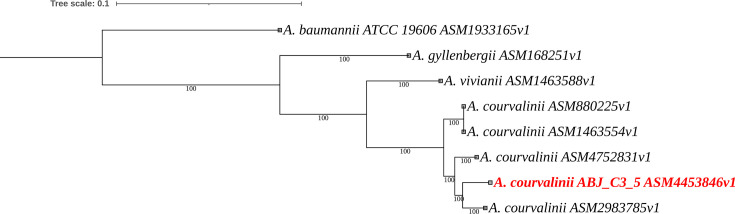 Fig 1
Fig 1| Metric | Value |
|---|---|
| No. of reads | 8,349,774 |
| Average read length | 268 |
| Completeness (%) | 100 |
| Contamination (%) | 0.21 |
| Total contigs | 79 |
| Largest contig (bp) | 313,113 |
| Total genome size (bp) | 3,763,920 |
| GC content (%) | 43.01 |
| 125,597 | |
|
| 9 |
| 29,135 | |
|
| 37 |
| Total genes | 3,620 |
| CDSs (total) | 3,545 |
| Coding genes | 3,510 |
| CDSs with protein | 3,510 |
| Total RNA genes | 75 |
| rRNAs | 6 |
| tRNAs | 63 |
| ncRNAs | 4 |
| Pseudogenes | 35 |
| Predicted antimicrobial resistance genes |
|
Peer Reviews
No public reviews on file for this paper yet. If you reviewed it on a platform where reviews are public (OpenReview, ICLR, NeurIPS, ICML), you can paste yours below so the community can read it here.
Videos
No videos yet. Explain this paper in a talk, walkthrough, or lecture? Add one.
Taxonomy
TopicsGenomics and Phylogenetic Studies · Antibiotic Resistance in Bacteria · Plant Pathogenic Bacteria Studies
ANNOUNCEMENT
Acinetobacter courvalinii was first described in 2016 and has since been isolated from various clinical and environmental sources (1, 2). A colistin-resistant, hypervirulent strain of A. courvalinii has also been described (3). However, to date, there have been no reports of A. courvalinii from either clinical or environmental sources in Africa. In this study, we sequenced and analyzed the genome of strain ABJ_C3_5, isolated from a flower garden within the University of Abuja, Gwagwalada, Nigeria, in August 2024.
The strain A. courvalinii ABJ_C3_5 was isolated from a soil sample (collected at 8°59′03″N, 7°10′16″E) pre-enriched in mineral salts medium supplemented with 0.2% sodium acetate. It was cultured on CHROMagar Acinetobacter (without the MDR supplement) and incubated at 37°C. A pure strain was obtained by subsequent serial sub-culturing on Columbia agar supplemented with 5% sheep blood. The genomic DNA of an overnight culture of the strain in Luria-Bertani broth was extracted using the MasterPure DNA Purification Kit (Epicentre) and quantified with a Qubit fluorometer. Sequencing of the genome on an Illumina NextSeq platform (Illumina, Inc., San Diego, CA, USA) generated 8,349,774 paired-end reads (2 × 300 bp). Raw reads were assembled using Shovill version 1.1.0 (https://github.com/tseemann/shovill), with the --trim option and the default SPAdes version 4.0 assembler (4). Genome assembly metrics, contamination, and completeness were determined using QUAST version 5.2.0 and CheckM2 version 1.0.2 (5, 6). Prediction of antibiotic resistance genes was done using ABRicate version 1.0.1 (https://github.com/tseemann/abricate) against the Comprehensive Antibiotic Resistance Database (7, 8). All tools were run with default parameters unless otherwise specified.
The draft assembly comprised 79 contigs, with a total genome size of 3,763,920 bp, a GC content of 43.01%, and an N50 of 125,597 bp. The completeness and contamination level of the genome were 100% and 0.21%, respectively. Genome annotation was performed using the NCBI Prokaryotic Genome Annotation Pipeline (9), which predicted 3,620 genes, including 3,510 protein-coding sequences, 63 tRNAs, 6 rRNAs, and 6 ncRNAs (Table 1).
Overall genome relatedness index was computed between the strain ABJ_C3_5 (ASM4453846v1) and the genome of A. courvalinii CCM 8635^T^ (ASM1463554v1) using pyani version 0.3.0 (10), EzAAI version 1.2.3 (11), and TYGS (12). Average nucleotide identity (ANI) was calculated at 96.5%, amino acid identity (AAI) at 97%, and digital DNA–DNA hybridization (dDDH) using TYGS formula 2 at 69%. Although the dDDH value falls slightly below the traditional 70% species threshold, both ANI and AAI exceed widely accepted species delineation cutoffs (13). To further establish the taxonomic position of the strain, a core genome phylogenomic tree of the strain and genomes of type strains of closely related Acinetobacter spp. was constructed using Panaroo version 1.3.4 (14) for core genome analysis and IQ-TREE version 2.3.6 (15) for maximum likelihood phylogenetic inference. The resulting tree was visualized using Interactive Tree Of Life (https://itol.embl.de))https://itol.embl.de). Strain A. courvalinii ABJ_C3_5 clustered robustly within the A. courvalinii clade, strongly confirming its placement within this species despite the marginal dDDH result (Fig. 1)
Core-genome phylogenetic tree of A. courvalinii strain ABJ_C3_5 and its closest related species
In addition, the genome harbored several genes associated with antimicrobial resistance, including the multidrug efflux pump genes, adeB and adeF, aminoglycoside resistance genes, ANT(3″)-IIc and AAC(6′)-Ir, and the class D beta-lactamase gene, blaOXA-297.
This study presents the draft genome sequence of an A. courvalinii isolate from Africa. The findings contained therein extend the known environmental and geographic range of the species and provide valuable insight into the species’ evolution, resistance mechanisms, and potential for dissemination in the environment.
The reference list from the paper itself. Each links out to its DOI / PubMed record.
- 1Nemec A, Radolfova-Krizova L, Maixnerova M, Vrestiakova E, Jezek P, Sedo O. 2016. Taxonomy of haemolytic and/or proteolytic strains of the genus Acinetobacter with the proposal of Acinetobacter courvalinii sp. nov. (genomic species 14 sensu Bouvet & Jeanjean), Acinetobacter dispersus sp. nov. (genomic species 17), Acinetobacter modestus sp. nov., Acinetobacter proteolyticus sp. nov. and Acinetobacter vivianii sp. nov. Int J Syst Evol Microbiol 66:1673–1685. doi:10.1099/ijsem.0.00093226822020 · doi ↗ · pubmed ↗
- 2Dey DK, Park J, Kang SC. 2020. Genotypic, phenotypic, and pathogenic characterization of the soil isolated Acinetobacter courvalinii. Microb Pathog 149:104287. doi:10.1016/j.micpath.2020.10428732569787 · doi ↗ · pubmed ↗
- 3Sykes EME, Mateo-Estrada V, Muzaleva A, Zhanel G, Dettman J, Chapados J, Gerdis S, Akineden Ö, Castillo-Ramírez S, Khan IUH, Kumar A. 2024. Characterization of a colistin resistant, hypervirulent hospital isolate of Acinetobacter courvalinii from Canada. Eur J Clin Microbiol Infect Dis 43:1939–1949. doi:10.1007/s 10096-024-04873-039073669 · doi ↗ · pubmed ↗
- 4Bankevich A, Nurk S, Antipov D, Gurevich AA, Dvorkin M, Kulikov AS, Lesin VM, Nikolenko SI, Pham S, Prjibelski AD, Pyshkin AV, Sirotkin AV, Vyahhi N, Tesler G, Alekseyev MA, Pevzner PA. 2012. SP Ades: a new genome assembly algorithm and its applications to single-cell sequencing. J Comput Biol 19:455–477. doi:10.1089/cmb.2012.002122506599 PMC 3342519 · doi ↗ · pubmed ↗
- 5Gurevich A, Saveliev V, Vyahhi N, Tesler G. 2025. QUAST: quality assessment tool for genome assemblies | Bioinformatics | Oxford Academic. Available from: https://academic.oup.com/bioinformatics/article/29/8/1072/228832. Retrieved 14 Jan 2025.10.1093/bioinformatics/btt 086PMC 362480623422339 · doi ↗ · pubmed ↗
- 6Chklovski A, Parks DH, Woodcroft BJ, Tyson GW. 2023. Check M 2: a rapid, scalable and accurate tool for assessing microbial genome quality using machine learning. Nat Methods 20:1203–1212. doi:10.1038/s 41592-023-01940-w 37500759 · doi ↗ · pubmed ↗
- 7Alcock BP, Huynh W, Chalil R, Smith KW, Raphenya AR, Wlodarski MA, Edalatmand A, Petkau A, Syed SA, Tsang KK, et al.. 2023. CARD 2023: expanded curation, support for machine learning, and resistome prediction at the comprehensive antibiotic resistance database. Nucleic Acids Res 51:D 690–D 699. doi:10.1093/nar/gkac 92036263822 PMC 9825576 · doi ↗ · pubmed ↗
- 8Seemann T. 2023. Abricate: mass screening of contigs for antimicrobial and virulence genes. Available from: https://github.com/tseemann/abricate. Retrieved 18 May 2025.