Metagenome-assembled genome of Synechococcus sp. “Tanasi” from the Tellico Reservoir, Tennessee, USA
David J. Niknejad, Robbie M. Martin, Emily E. Chase, Randall H. Morse, Gary M. Lucas, Jennifer M. DeBruyn, Forbes R. Walker, Eric A. Webb, Steven W. Wilhelm

TL;DR
This paper presents a new metagenome-assembled genome of a Synechococcus strain from the Tennessee River Basin, an underrepresented ecosystem.
Contribution
The study provides a new genomic resource from an underrepresented aquatic region, aiding taxonomic classification of Synechococcus.
Findings
A metagenome-assembled genome of Synechococcus sp. “Tanasi” was generated from the Tellico Reservoir.
The genome contributes to genomic data diversity for Synechococcus classification efforts.
The Tennessee River Basin is highlighted as an underrepresented source in current databases.
Abstract
Synechococcus-like cyanobacteria are vital to aquatic ecosystems. Taxonomists have begun to reassign genomic clades within this group to new taxa. This process depends on genomic data from diverse habitats. Here, we present a metagenome-assembled genome of a Synechococcus sp. strain from the Tennessee River Basin, an ecosystem under-represented in databases.
Genes, proteins, chemicals, diseases, species, mutations and cell lines named across the full text — each resolved to its canonical identifier and authoritative record.
Click any figure to enlarge with its caption.
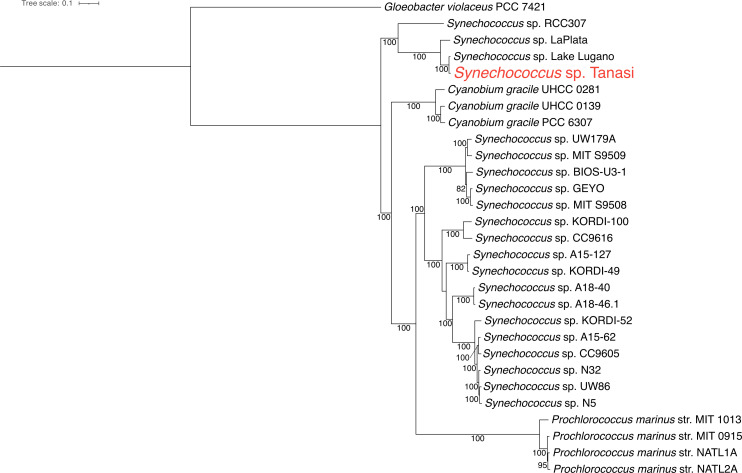 Fig 1
Fig 1- —National Institute of Environmental Health Scienceshttp://dx.doi.org/10.13039/100000066
- —National Science Foundationhttp://dx.doi.org/10.13039/501100008982
- —Tennessee Valley Authorityhttp://dx.doi.org/10.13039/100011743
- —Simons Foundationhttp://dx.doi.org/10.13039/100000893
Peer Reviews
No public reviews on file for this paper yet. If you reviewed it on a platform where reviews are public (OpenReview, ICLR, NeurIPS, ICML), you can paste yours below so the community can read it here.
Videos
No videos yet. Explain this paper in a talk, walkthrough, or lecture? Add one.
Taxonomy
TopicsGenomics and Phylogenetic Studies · Microbial Community Ecology and Physiology · Molecular Biology Techniques and Applications
ANNOUNCEMENT
Picocyanobacteria, especially members of the Synechococcus collective (1), contribute to primary productivity, food webs, and biogeochemical cycles of fresh and marine waters worldwide (2). The Synechococcus collective is globally distributed and abundant in lakes and reservoirs (2). The taxonomic assignment of Synechococcus is convoluted, and organisms previously assigned to this genus were polyphyletic (1). Taxonomists are reassigning genomic clades within this group to new monophyletic genera, but this process depends on the acquisition of genomic information from diverse environments inhabited by Synechococcus-like organisms (3).
The Tennessee River Basin is a hotspot of aquatic biodiversity (4–6), yet the microbial diversity of this ecosystem is virtually unexplored. Tellico Reservoir is a 15,560-acre impoundment within the Tennessee River Basin formed in 1979 by damming the Little Tennessee River. We present a metagenome-assembled genome (MAG) of Synechococcus sp. Tanasi collected from the Tellico Reservoir, Tennessee, USA. The strain was named after a Cherokee Nation settlement now submerged beneath the Tellico Reservoir (7).
Samples for metagenomic sequencing were collected at 0.5 m on 21 July 2022 and 31 August 2022, near Little Tennessee River mile 12.0 (35°39.558N, 84°15.120W) and on 21 July 2022, near river mile 11.5 (35°39.518N, 84°15.969W). Approximately 240 mL of water was filtered through 0.22 µm Sterivex filters. Filters were immediately frozen in liquid nitrogen. DNA was extracted from filters using the phenol-chloroform method (8). Using 400–450 ng total DNA, libraries were prepared at the SeqCenter (Pittsburgh, PA) using the Illumina DNA Prep Kit with IDT 10 bp UDI indices and sequenced on the Illumina NextSeq 2000 platform, producing 2 × 151-bp-PE reads.
Default parameters were used in bioinformatic software unless specified. A total of 25,595,806 reads from the three libraries were pooled and assembled with metaWRAP (v1.3.2) (9) using Megahit (v1.1.3) (10). Assembled contigs were binned using the metaWRAP package with metaBAT2 (v2.12.2) (11), MaxBin2 (v2.2.6) (12), and CONCOCT (v1.0.0) (13). Bin quality was assessed using CheckM2 (v1.0.1) (14), BUSCO (v5.7.1) (15), and QUAST (v5.2.0) (16). Genome completeness was estimated with CheckM2. Taxonomy was assigned using GTDB-Tk (v2.3.2) employing the R07-RS207 database release (17). Average nucleotide identity (ANI), calculated by FastANI (v0.1.3) (18), provided insight into the relatedness of our MAG to other genomes. Genomes for ANI comparison were selected from hits in GTDB, those used in the “Insert Genome Into Species Tree” (v2.2.0) in KBase (19), and by manual searches in GenBank. The genome was annotated with PGAP (v6.9) (20). A phylogenetic tree of related genomes was built using GToTree (v1.8.6) (21) and IQ-TREE (v2.3.6) (22) and visualized using iTOL (v6) (23).
The Synechococcus sp. Tanasi MAG consists of 44 contigs (N_50_ = 92,698 bp) with a total length of 2,535,063 bp and a GC content of 67.64%. It is estimated to be 98.5% complete with 0.05% contamination and contains 2,700 putative protein-encoding and 45 RNA-encoding genes. The most closely related genomes are a Synechococcus sp. MAG from Lake Lugano, Italy (ANI = 96.8%) (24) and an “uncultured cyanobacterium” from LaPlata, Puerto Rico (ANI = 86.8%) (25). These three genomes clustered together (Fig. 1).
Maximum likelihood phylogenetic tree of closely related cyanobacteria and the MAG presented in this paper, constructed by IQ-TREE (v2.3.6). The tree was rooted by Gloeobacter violaceus PCC7421. A best-fitting model was selected for each marker gene using ModelFinder Plus, and 1,000 ultrafast bootstraps were used to construct this tree. Bootstrap values are indicated at the nodes. Taxa included in the tree were selected from Lee et al. (26), with Prochlorococcus spp. sequences added to confirm this distinct lineage, plus the Lake Lugano and LaPlata MAGs, which were identified by GTDB-Tk and ANI as most closely related to our MAG.
The reference list from the paper itself. Each links out to its DOI / PubMed record.
- 1Salazar VW, Tschoeke DA, Swings J, Cosenza CA, Mattoso M, Thompson CC, Thompson FL. 2020. A new genomic taxonomy system for the Synechococcus collective. Environ Microbiol 22:4557–4570. doi:10.1111/1462-2920.1517332700350 · doi ↗ · pubmed ↗
- 2Callieri C. 2008. Picophytoplankton in freshwater ecosystems: the importance of small-sized phototrophs. Freshw Rev 1:1–28. doi:10.1608/FRJ-1.1.1 · doi ↗
- 3Komárek J, Johansen JR, Šmarda J, Strunecký O. 2020. Phylogeny and taxonomy of Synechococcus-like cyanobacteria. Fottea 20:171–191. doi:10.5507/fot.2020.006 · doi ↗
- 4Jacquemin SJ, Ebersole JA, Dickinson WC, Ciampaglio CN. 2016. Late Pleistocene fishes of the Tennessee River Basin: an analysis of a late Pleistocene freshwater fish fauna from Bell Cave (site A Cb-2) in Colbert County, Alabama, USA. Peer J 4:e 1648. doi:10.7717/peerj.164826855876 PMC 4741074 · doi ↗ · pubmed ↗
- 5Etnier DA, Starnes WC. 1993. The fishes of Tennessee. University of Tennessee Press, Knoxville.
- 6Parmalee PW, Hughes MH. 1993. Freshwater mussels (Mollusca: Pelecypoda: Unionidae) of Tellico Lake: twelve years after impoundment of the Little Tennessee River. Annals of the Carnegie Museum 62:81–93. doi:10.5962/p.226649 · doi ↗
- 7Schroedl GF. 2017. Overhill Cherokees. Tennessee Encyclopedia. Available from: http://tennesseeencyclopedia.net/entries/overhill-cherokees
- 8Martin RM, Wilhelm SW. 2018. Phenol/chloroform extraction of DNA from cyanobacteria. Protocols.io. Available from: 10.17504/protocols.io.ptndnme · doi ↗