Complete genome sequence of Shinella sp. strain 1A1, an ʟ-glucose-utilizing bacterium isolated from soil
Yuki Doi, Akito Hama, Akira Nakamura

TL;DR
This paper reports the complete genome sequence of a soil bacterium, Shinella sp. strain 1A1, that can use L-glucose.
Contribution
The study provides the full genomic characterization of Shinella sp. strain 1A1, including its chromosome and plasmids.
Findings
The genome consists of a 3.45 Mb chromosome with 3,261 protein-coding genes.
It includes two plasmids with 1,623 and 51 protein-coding genes respectively.
Abstract
The complete genome sequence of an ʟ-glucose-utilizing bacterium, Shinella sp. strain 1A1 isolated from soil, was determined. Strain 1A1 contained a 3.45 Mb circular chromosome with 3,261 protein-coding genes, 9 rRNA, and 52 tRNA genes and 1.77 Mb and 44.5 kb circular plasmids with 1,623 and 51 protein-coding genes, respectively.
Genes, proteins, chemicals, diseases, species, mutations and cell lines named across the full text — each resolved to its canonical identifier and authoritative record.
Click any figure to enlarge with its caption.
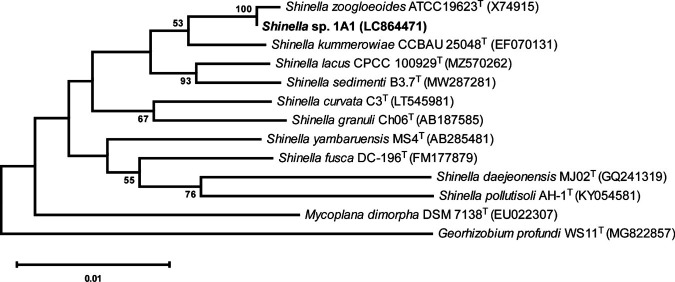 Fig 1
Fig 1- —Japan Society for the Promotion of Sciencehttp://dx.doi.org/10.13039/501100001691
Peer Reviews
No public reviews on file for this paper yet. If you reviewed it on a platform where reviews are public (OpenReview, ICLR, NeurIPS, ICML), you can paste yours below so the community can read it here.
Videos
No videos yet. Explain this paper in a talk, walkthrough, or lecture? Add one.
Taxonomy
TopicsGenomics and Phylogenetic Studies · Bacteriophages and microbial interactions · Infective Endocarditis Diagnosis and Management
ANNOUNCEMENT
ʟ-glucose is an enantiomer of ᴅ-glucose, and living organisms were believed not to catabolize ʟ-glucose (1). Previously, we reported two ʟ-glucose-utilizing bacteria, belonging to the genera Paracoccus and Luteolibacter (2, 3). We isolated strain 1A1 as an ʟ-glucose-utilizer from a soil of the fertilizer test field in Tsukuba-Plant Innovation Research Center, University of Tsukuba (Tsukuba, Japan) by enrichment culturing in a minimal medium containing ʟ-glucose (ʟ-GlcMM, [2]) at 28°C with shaking, and colony formation on ʟ-GlcMM plates at 28°C for 4 days. The 16S rRNA gene sequence, determined with the colony-PCR fragment using primers 10F (5′-GAGTTTGATCCTGGCTCAG-3′) and 1492R (5′-GGTTACCTTGTTACGACTT-3′), and a phylogenetic analysis by the neighbor-joining method indicated that strain 1A1 is classified into the genus Shinella, with S. zoogloeoides as the closest related species (Fig. 1).
Phylogenetic tree based on the 16S rRNA gene sequence of strain 1A1 and related taxa. The tree was constructed by the neighbor-joining method in MEGA11. Accession numbers are shown in parentheses.
Strain 1A1 was cultured in ʟ-GlcMM for 72 h at 28°C. Genomic DNA extracted using Genomic-tip 20G (Qiagen) was purified using DNA Clean Beads (MGI Tech) and sheared to 10–25 kb with Megaruptor 3 (Diagenode) without size selection. The DNA library constructed using the SMRTbell Prep Kit 3.0 and SMRTbell gDNA Sample Amplification kit (PacBio) was sequenced with a Revio system and the Revio polymerase kit (PacBio). High-fidelity reads were generated by SMRT Link v. 13.1.0.221970 (PacBio). Trimming of PCR adapters and duplicate reads was conducted with lima v. 2.9.0 and pbmakdup v. 1.0.3 (PacBio), respectively. Short reads (≤1,000 bases) were eliminated using Filtlong v. 0.2.1 (https://github.com/rrwick/Filtlong), and the remaining 18,842 reads with an average length of 11,054 bp were assembled using Flye v. 2.9.3-b1797 (4) with default settings. Genomic circularity was confirmed by Bandage v. 0.8.1 (5), and the assembled data were confirmed using CheckM2 v. 1.0.1 (6) with 99.7% coverage and 1.58% contamination.
Strain 1A1 genomic DNA was a total of 5,264,811 bp with a GC content of 65.0% (N50 value, 3,446,576 bp), with a single circular chromosome (3,446,576 bp) and two circular plasmids, p1A1_1 and p1A1_2 (1,773,658 and 44,577 bp). Automatic annotation by Prokka v. 1.14.6 (7) indicated that the chromosome contained 3,261 protein-coding genes, 9 rRNA, and 52 tRNA genes. Plasmids p1A1_1 and p1A1_2 contained 1,623 and 51 protein-coding genes, respectively, with 5 tRNA genes in plasmid p1A1_1. This genome architecture resembles that of S. zoogloeoides strain Teo12 with the average nucleotide identity (ANI) value (8) of 97.63%. In contrast, the type strain of this species, ATCC 19623^T^, has a different architecture of 3.99 Mb chromosome and four plasmids of 373, 340, 109, and 34.7 kb, and showed ANI value of 88.46%, which is below the threshold of the species delineation (95%, 9). Most protein-coding genes in the chromosome and p1A1_1 of strain 1A1 showed high identities (>90%) to chromosome and plasmid p1_Teo12 of strain Teo12, respectively, except for some genes with less identities (<40%) located in several clusters. In contrast, those in p1A1_2 did not show any identities (<20%) to plasmids p2_Teo12 and p3_Teo12.
The complete genome sequence of strain 1A1 will support investigation on bacterial ʟ-glucose catabolism and contribute to the correct classification of the genus Shinella.
The reference list from the paper itself. Each links out to its DOI / PubMed record.
- 1Rudney H. 1940. The utilization of ʟ-glucose by mammalian tissues and bacteria. Science 92:112–113. doi:10.1126/science.92.2379.11217755265 · doi ↗ · pubmed ↗
- 2Shimizu T, Takaya N, Nakamura A. 2012. An ʟ-glucose catabolic pathway in Paracoccus species 43P. J Biol Chem 287:40448–40456. doi:10.1074/jbc.M 112.40305523038265 PMC 3504760 · doi ↗ · pubmed ↗
- 3Yachida M, Nakamura A. 2024. Complete genome sequence of Luteolibacter sp. strain LG 18, an ʟ-glucose-utilizing bacterium isolated from soil. Microbiol Resour Announc 13:e 0088823. doi:10.1128/mra.00888-2338353546 PMC 10927676 · doi ↗ · pubmed ↗
- 4Kolmogorov M, Yuan J, Lin Y, Pevzner PA. 2019. Assembly of long, error-prone reads using repeat graphs. Nat Biotechnol 37:540–546. doi:10.1038/s 41587-019-0072-830936562 · doi ↗ · pubmed ↗
- 5Wick RR, Schultz MB, Zobel J, Holt KE. 2015. Bandage: interactive visualization of de novo genome assemblies. Bioinformatics 31:3350–3352. doi:10.1093/bioinformatics/btv 38326099265 PMC 4595904 · doi ↗ · pubmed ↗
- 6Chklovski A, Parks DH, Woodcroft BJ, Tyson GW. 2023. Check M 2: a rapid, scalable and accurate tool for assessing microbial genome quality using machine learning. Nat Methods 20:1203–1212. doi:10.1038/s 41592-023-01940-w 37500759 · doi ↗ · pubmed ↗
- 7Seemann T. 2014. Prokka: rapid prokaryotic genome annotation. Bioinformatics 30:2068–2069. doi:10.1093/bioinformatics/btu 15324642063 · doi ↗ · pubmed ↗
- 8Goris J, Konstantinidis KT, Klappenbach JA, Coenye T, Vandamme P, Tiedje JM. 2007. DNA-DNA hybridization values and their relationship to whole-genome sequence similarities. Int J Syst Evol Microbiol 57:81–91. doi:10.1099/ijs.0.64483-017220447 · doi ↗ · pubmed ↗