Draft genome sequence of Shewanella algae JC874
Mahima Dhurka, Atham Hari Naga Papa Rao, Ria Biswas, Lakshmanan Vighnesh, Chintalapati Sasikala, Chintalapati Venkata Ramana

TL;DR
This paper presents the genome sequence of a Shewanella algae strain isolated from an alga, which can cause disease in aquatic organisms and humans.
Contribution
The novel contribution is the first draft genome sequence of Shewanella algae strain JC874.
Findings
The genome of S. algae strain JC874 was sequenced and found to be 4.8 Mb in size.
The strain was isolated from Codium sp. and showed plaques when cultured with Bacillus tequilensis JC1001.
Abstract
Shewanella algae are ubiquitous. They are pathogens affecting aquatic organisms and are emerging as pathogens to humans. Here, we present the genome of S. algae strain JC874, isolated from an alga, Codium sp. It showed plaques on mixed culture streaking with Bacillus tequilensis JC1001. The genome size is 4.8 Mb.
Genes, proteins, chemicals, diseases, species, mutations and cell lines named across the full text — each resolved to its canonical identifier and authoritative record.
Click any figure to enlarge with its caption.
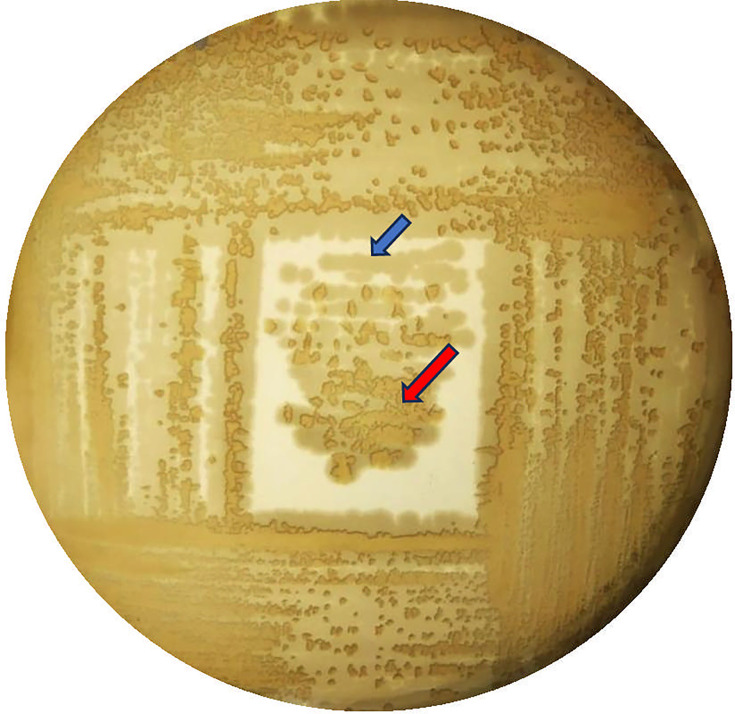 Fig 1
Fig 1Peer Reviews
No public reviews on file for this paper yet. If you reviewed it on a platform where reviews are public (OpenReview, ICLR, NeurIPS, ICML), you can paste yours below so the community can read it here.
Videos
No videos yet. Explain this paper in a talk, walkthrough, or lecture? Add one.
Taxonomy
TopicsAquaculture disease management and microbiota · Microbial Community Ecology and Physiology · Genomics and Phylogenetic Studies
ANNOUNCEMENT
There are reports that marine macroalgae have antibacterial properties (1). In this study, we examined the antimicrobial properties of Codium sp., a marine macroalga collected from Pudumadam (9.2771°N, 78.9939°E) of the Gulf of Mannar, Tamil Nadu, India. A small (1 cm × 1 cm) piece of the alga was placed on a lawn of Bacillus tequilensis JC1001 grown on Luria-broth (LB, HIMEDIA, M575) agar plate. After incubation at 37°C for 24 h, a zone of inhibition around the algal sample was observed. We further sub-cultured from the zone around the algal sample and carried out mixed culture streaking, on which we could observe plaques (Fig. 1), which resembled the plaques formed by bacteriophages (2) and predatory bacteria (3). Through subsequent streaking, we could isolate the axenic culture and assign it as strain JC874. The absence of plaques in axenic culture indicates that the bacteriophages are unlikely to be involved, suggesting that the strain JC874 may be a putative predator.
Plate showing the plaques formed by Shewanella algae JC874 on B. tequilensis JC1001. The blue arrow shows strain JC1001, and the red arrow shows the plaques. Both cultures did not show any plaques when cultured independently (data not shown).
For identification of the strain JC874, its 16S rRNA gene was amplified using PCR with the primer pair 27F and 1492R. BLAST analysis of the gene sequence (1,399 bp) showed the highest identity of 99.3% with the type strain of Shewanella algae JCM21037^T^. A single colony of the strain JC874 was inoculated in LB broth (HIMEDIA, M575), cultured for about 24 h, and was outsourced to LifeCell International Pvt Ltd, where the genomic DNA was extracted using the DNeasy Blood and Tissue kit (QIAGEN, 69504). A genomic DNA library was prepared using the NEBNext Ultra DNA Library Preparation Kit (Illumina) and sequenced on the NovaSeq 6000 platform with 150 bp paired-end reads to generate raw sequencing data. A total of 34,331,398 raw reads were generated and processed using fastp v0.12.4 (4), which, after QC, gave 34,201,152 reads. The reads were assembled into contigs using Unicycler v0.5.0 (5), and contigs less than 200 bp were discarded. A total of 71 contigs were generated, resulting in a genome assembly size of 4.8 Mb with a N_50_ 305.5 kb. The statistics of the assembled genome were assessed using QUAST v5.0.2 (6), and read alignment of the assembly was checked by mapping back to the reads using Bowtie2 v2.4.5 (7), which showed an alignment of 98.7%. The default parameters were used for all software. The genome was submitted to NCBI and is available with the accession number JAWJDV000000000. The genome was annotated by the NCBI Prokaryotic Genome Annotation Pipeline (PGAP) version 6.6. The total genome encodes for 4,206 protein-coding genes, 3 rRNA, 95 tRNA, and a GC content of 53%. The genome shows a completeness of 99.46% and 0.04% contamination, according to PGAP. The genome of strain JC874 provides a valuable resource for exploring its putative predatory behavior and facilitates comparative analyses with other known bacterial predators.
The reference list from the paper itself. Each links out to its DOI / PubMed record.
- 1Pérez MJ, Falqué E, Domínguez H. 2016. Antimicrobial action of compounds from marine seaweed. Mar Drugs 14:52. doi:10.3390/md 1403005227005637 PMC 4820306 · doi ↗ · pubmed ↗
- 2Abedon ST, Yin J. 2009. Bacteriophage plaques: theory and analysis, p 161–174. In Clokie MR, Kropinski AM (ed), Bacteriophages Methods and Protocols, Methods Mol Biol vol. Humana Press, Clifton, N.J.10.1007/978-1-60327-164-6_1719066821 · doi ↗ · pubmed ↗
- 3Enos BG, Anthony MK, De Giorgis JA, Williams LE. 2018. Prey range and genome evolution of Halobacteriovorax marinus predatory bacteria from an estuary. m Sphere 3:e 00508-17. doi:10.1128/m Sphere.00508-17PMC 576074929359184 · doi ↗ · pubmed ↗
- 4Chen S, Zhou Y, Chen Y, Gu J. 2018. Fastp: an ultra-fast all-in-one FASTQ preprocessor. Bioinformatics 34:i 884–i 890. doi:10.1093/bioinformatics/bty 56030423086 PMC 6129281 · doi ↗ · pubmed ↗
- 5Wick RR, Judd LM, Gorrie CL, Holt KE. 2017. Unicycler: resolving bacterial genome assemblies from short and long sequencing reads. P Lo S Comput Biol 13:e 1005595. doi:10.1371/journal.pcbi.100559528594827 PMC 5481147 · doi ↗ · pubmed ↗
- 6Gurevich A, Saveliev V, Vyahhi N, Tesler G. 2013. QUAST: quality assessment tool for genome assemblies. Bioinformatics 29:1072–1075. doi:10.1093/bioinformatics/btt 08623422339 PMC 3624806 · doi ↗ · pubmed ↗
- 7Langmead B, Salzberg SL. 2012. Fast gapped-read alignment with Bowtie 2. Nat Methods 9:357–359. doi:10.1038/nmeth.192322388286 PMC 3322381 · doi ↗ · pubmed ↗