Genome sequence of Bacillus altitudinis HH-03 isolated from dairy pipeline
Yan-Hong Lu, Xi-Bei Fan, Ning Lv, Yang Liu, Zhan-Hui Guo, Rui-Long Xie, Zhe-Xue Quan

TL;DR
This paper reports the genome sequence of a bacterium isolated from a dairy pipeline, which could help improve cleaning processes in the dairy industry.
Contribution
The study provides a new genome sequence for Bacillus altitudinis HH-03 and highlights its potential for improving clean-in-place processes.
Findings
The genome of Bacillus altitudinis HH-03 is 3.85 Mbp with 41.2% GC content.
The genome contains 4,010 predicted protein-coding genes.
The genomic data may aid in developing more effective cleaning processes in dairy pipelines.
Abstract
In this study, Bacillus altitudinis HH-03 was isolated from a dairy pipeline, and its genomic information was obtained by performing sequencing. The genome size of strain HH-03 was 3.85 Mbp with a GC content of 41.2%. Based on the annotation procedure, 4,010 protein-coding genes were identified. The genomic information of strain HH-03 will be helpful for the development of clean-in-place processes.
Genes, proteins, chemicals, diseases, species, mutations and cell lines named across the full text — each resolved to its canonical identifier and authoritative record.
Click any figure to enlarge with its caption.
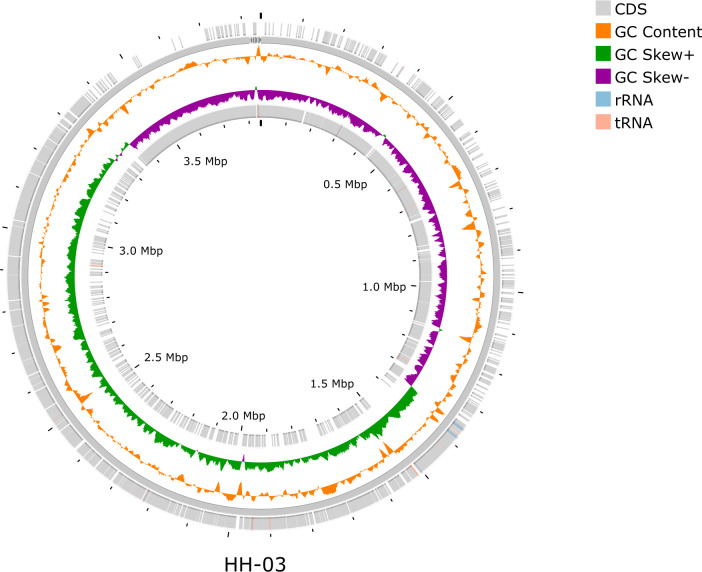 Fig 1
Fig 1- —State Administration for Market Regulation, China
Peer Reviews
No public reviews on file for this paper yet. If you reviewed it on a platform where reviews are public (OpenReview, ICLR, NeurIPS, ICML), you can paste yours below so the community can read it here.
Videos
No videos yet. Explain this paper in a talk, walkthrough, or lecture? Add one.
Taxonomy
TopicsBacteriophages and microbial interactions · Genomics and Phylogenetic Studies · Identification and Quantification in Food
ANNOUNCEMENT
Dairy products are susceptible to contamination by Bacillus during processing and production since Bacillus can form endospores and biofilms (1), possesses high heat resistance and dispersal abilities, and can grow and multiply in milk pipelines (2). A significantly elevated incidence of Bacillus cereus contamination was reported in unprocessed milk samples (3), and Bacillus altitudinis contamination was detected in pre-pasteurized milk (4).
We isolated heat-tolerant bacteria from the washed water of the milk pipeline in Hubei Province, China, after boiling the sample for 10 min and growing the bacteria on nutrient agar with manganese at 37°C for 2 days. Most colonies were identified as Bacillus altitudinis based on nearly complete 16S rRNA gene sequences obtained by amplification and sequencing. The strain HH-03 was streaked onto nutrient agar with manganese solid medium and incubated at 37°C for 24 h. A distinct single colony was subsequently inoculated into liquid nutrient agar with manganese and cultured at 37°C for 24 h . Then, the 16S rRNA gene sequences were amplified and sequenced to verify culture purity. We selected strain HH-03 for further genome analysis. Genomic DNA from the pure culture of strain HH-03 was extracted using the MagAttract HMW DNA Kit (Qiagen, USA). The sequencing library was constructed using the Transposase Enzyme Linked Long-read Sequencing (TELL-Seq) WGS Library Prep Kit (Universal Sequencing Technology, USA) and the sequencing primers provided by the TELL-Seq Illumina Sequencing Primer Kit (Universal Sequencing Technology, USA), following the manufacturer’s instructions (5). The libraries were sequenced on an Illumina NovaSeq 6000, 150 bp paired-end platform to obtain raw sequencing data. Quality control and assembly of the raw sequencing data of strain HH-03 were conducted using the TELL-Read and TELL-Link processes provided by Universal Sequencing Technology (5).
The 632 M raw reads were assembled de novo using TELL-Read with parameters “-s T507 -g NONE” and TELL-Link with “-p 507.” Contig sequencing depths were quantified using BWA (v0.7.17) (6), with the assembled sequences showing a mean sequencing depth of 112.
The obtained contigs were subjected to BLAST analysis against the NCBI database to identify contaminated sequences. Following the removal of contigs exhibiting inadequate sequencing depth below 80 and contamination, the strain HH-03 yielded 12 contigs, with the largest one being 3.82 Mbp in length.
To gain insight into the genome structure, the coding sequences of the positive and negative strands of the genome, the location of non-coding RNAs, and the spliced genome were plotted in a genome feature circle diagram. The spliced FASTA files were uploaded to CGViewer (7), an online genome feature map website, for online interactive operations, and the genomes were annotated using PGAP (v6.9) (8). The genomic circle diagram of strain HH-03 is shown in Fig. 1. The assembled genome size of the sample was 3,846,532 bp with a GC content of 41.2%. Additionally, the sample contained 3,796 coding sequences (with protein), 11 complete rRNA genes, and 75 tRNA genes.
The figure represents the distribution of various genomic features, with the following color codes: gray: coding sequences (CDS); orange: GC content; green: positive GC skew (GC Skew+); purple: negative GC skew (GC Skew-); blue: rRNA genes; pink: tRNA genes.
Strain HH-03 was subjected to average nucleotide identity (ANI) analysis by using JSpeciesWS (9). The highest ANI value for strain HH-03 genome was 97.85% with Bacillus altitudinis (GCF_001191605.1), indicating that strain HH-03 should be identified as Bacillus altitudinis.
The genomic information of Bacillus altitudinis HH-03 will be helpful for the development of clean-in-place processes.
The reference list from the paper itself. Each links out to its DOI / PubMed record.
- 1Abee T, Kovács AT, Kuipers OP, van der Veen S. 2011. Biofilm formation and dispersal in Gram-positive bacteria. Curr Opin Biotechnol 22:172–179. doi:10.1016/j.copbio.2010.10.01621109420 · doi ↗ · pubmed ↗
- 2Marchand S, De Block J, De Jonghe V, Coorevits A, Heyndrickx M, Herman L. 2012. Biofilm formation in milk production and processing environments; influence on milk quality and safety. Comp Rev Food Sci Food Safe 11:133–147. doi:10.1111/j.1541-4337.2011.00183.x · doi ↗
- 3Owusu-Kwarteng J, Wuni A, Akabanda F, Tano-Debrah K, Jespersen L. 2017. Prevalence, virulence factor genes and antibiotic resistance of Bacillus cereus sensu lato isolated from dairy farms and traditional dairy products. BMC Microbiol 17:65. doi:10.1186/s 12866-017-0975-928288581 PMC 5348786 · doi ↗ · pubmed ↗
- 4Didouh N, Khadidja M, Campos C, Sampaio-Maia B, Boumediene MB, Araujo R. 2023. Assessment of biofilm, enzyme production and antibiotic susceptibility of bacteria from milk pre- and post-pasteurization pipelines in Algeria. Int J Food Microbiol 407:110389. doi:10.1016/j.ijfoodmicro.2023.11038937708608 · doi ↗ · pubmed ↗
- 5Chen Z, Pham L, Wu T-C, Mo G, Xia Y, Chang PL, Porter D, Phan T, Che H, Tran H, Bansal V, Shaffer J, Belda-Ferre P, Humphrey G, Knight R, Pevzner P, Pham S, Wang Y, Lei M. 2020. Ultralow-input single-tube linked-read library method enables short-read second-generation sequencing systems to routinely generate highly accurate and economical long-range sequencing information. Genome Res 30:898–909. doi:10.1101/gr.260380.11932540955 PMC 7370886 · doi ↗ · pubmed ↗
- 6Li H, Durbin R. 2009. Fast and accurate short read alignment with Burrows-Wheeler transform. Bioinformatics 25:1754–1760. doi:10.1093/bioinformatics/btp 32419451168 PMC 2705234 · doi ↗ · pubmed ↗
- 7Stothard P, Grant JR, Van Domselaar G. 2019. Visualizing and comparing circular genomes using the CG View family of tools. Brief Bioinform 20:1576–1582. doi:10.1093/bib/bbx 08128968859 PMC 6781573 · doi ↗ · pubmed ↗
- 8Li W, O’Neill KR, Haft DH, Di Cuccio M, Chetvernin V, Badretdin A, Coulouris G, Chitsaz F, Derbyshire MK, Durkin AS, Gonzales NR, Gwadz M, Lanczycki CJ, Song JS, Thanki N, Wang J, Yamashita RA, Yang M, Zheng C, Marchler-Bauer A, Thibaud-Nissen F. 2021. Ref Seq: expanding the prokaryotic genome annotation pipeline reach with protein family model curation. Nucleic Acids Res 49:D 1020–D 1028. doi:10.1093/nar/gkaa 110533270901 PMC 7779008 · doi ↗ · pubmed ↗