Genome sequence of cluster B1 Mycobacterium smegmatis phages Thunderbird, Gwilliam, and Jiraiya
Atalie B. Bogh, Jacob D. Gwilliam, Peter Mourik, Jacob D. Scott, Matthew N. Jackson, Rachel E. Moffat, Monterey D. Domike, Abbey R. Larson, George Higgins, Payson C. Danielson, Hyunbi Hwang, Matthew J. East, Ethan Walbom, Shule M. Aggabao, Harry M. Peless, Elisa A. Correa Lazaro

TL;DR
This paper presents the genome sequences of three mycobacteriophages that infect a specific strain of Mycobacterium smegmatis.
Contribution
The study provides new genome sequences for three B1 subcluster mycobacteriophages.
Findings
The genomes of Thunderbird, Gwilliam, and Jiraiya are approximately 69 kb in length.
These phages belong to the B1 subcluster of mycobacteriophages.
The study aims to improve understanding of these phages' genes and potential therapeutic applications.
Abstract
Thunderbird, Gwilliam, and Jiraiya are mycobacteriophages in the B1 subcluster that infect Mycobacterium smegmatis strain mc²155. The genomes of these three phages are ~69 kb in length. Studying these phages will enhance our understanding of subcluster B1 mycobacteriophages, their genes, their putative functions, and potential impact as mycobacterial therapeutic agents.
Genes, proteins, chemicals, diseases, species, mutations and cell lines named across the full text — each resolved to its canonical identifier and authoritative record.
Click any figure to enlarge with its caption.
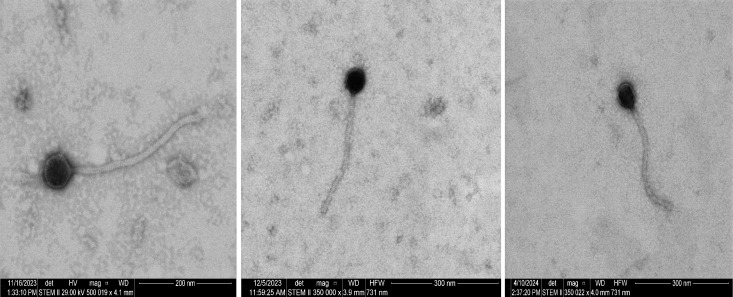 Fig 1
Fig 1| Phage name | Thunderbird | Gwilliam | Jiraiya |
|---|---|---|---|
| GPS coordinates | 40.245316 N, 111.650324 W | 40.262446 N, 111.652869 W | 40.244674 N, 111.650366 W |
| Isolation details | 2024, 12°C, surface | 2023, 10°C, 5 cm | 2023, 37°C, 3 cm |
| Collection material notes | Moist soil under a waterfall | A raised garden bed after a good growing season. Gathered soil after a rainstorm in the fall. Soil was still semi-dry. | Moist soil around the roots of a plant |
| Sequence reads | 1.80 | 1.33 | 1.09 |
| Sequence depth | 3,382 | 5,474 | 1,814 |
| Genome length (base pairs) | 68,862 | 69,646 | 68,861 |
| GC content (%) | 66.4 | 66.4 | 66.4 |
| Character of genome ends | Circularly permuted | Circularly permuted | Circularly permuted |
| Most similar phage | JakeO | Usavi (99.03%) | Thunderbird (99.83%) |
| # ORFs | 102 | 102 | 103 |
| # Orphams | 0 | 0 | 0 |
| # tRNAs | 0 | 0 | 0 |
| # ORFs with putative function (%) | 26 | 32 | 31 |
| # ORFs with no putative function (%) | 76 | 70 | 72 |
Peer Reviews
No public reviews on file for this paper yet. If you reviewed it on a platform where reviews are public (OpenReview, ICLR, NeurIPS, ICML), you can paste yours below so the community can read it here.
Videos
No videos yet. Explain this paper in a talk, walkthrough, or lecture? Add one.
Taxonomy
TopicsBacteriophages and microbial interactions · Genomics and Phylogenetic Studies · Mycobacterium research and diagnosis
ANNOUNCEMENT
To better understand both the potential impact of mycobacteriophages as therapeutic agents and the diversity of mycobacteriophages in local soil (1), the three phages in this study were isolated from soil samples taken in Provo, Utah (Table 1). An established protocol was used for phage isolation and purification. Briefly, 5 mL of soil was placed in a 15 mL conical vial and suspended in 8–10 mL Middlebrook 7H9 broth prior to mixing by inverting five times and filtering through a 0.45 µm filter (2). A 500 µL aliquot was used to infect 250 µL of log phase Mycobacterium smegmatis mc^2^155 host cells, mixed with top agar then plated on 7H10 agar prior to incubation at 37°C for two days. Plaques, which were generally small, clear, and round, were picked using a sterile micropipette tip. Following at least four rounds of plaque purification, a high titer lysate (>1E10^9^ PFU/mL) was prepared by flooding nearly confluent “web-plates” with 7H9 broth, incubating for 2 h at room temperature, decanting, and filtering through a 0.22 µm filter.
DNA was extracted from the lysate by using the Norgen Phage DNA Isolation Kit following manufacturer’s protocol prior to library preparation and sequencing. Briefly, 0.5 µg of DNA per sample was used for DNA library preparation using the NEBNext Ultra DNA Library Prep Kit for Illumina (NEB, USA) following manufacturer’s recommendations, and unique index codes were added to each sample. The DNA samples were sonicated to a size of 350 bp, then DNA fragments were end-polished, A-tailed, and ligated with the full-length adaptor for Illumina sequencing with further PCR amplification. PCR products were purified (AMPure XP system), and libraries were analyzed for size distribution with an Agilent 2100 Bioanalyzer and quantified using real-time PCR.
The genomes were sequenced using Illumina NovaSeq X PE150 with the corresponding sequencing kit, generating 1.09–1.80 million 150 bp paired-end reads per genome. Reads were trimmed using TrimGalore v0.6.6 (3) with a minimum length of 20 bases and minimum phred quality score of 20. Trimmed reads underwent assembly with Newbler v2.9 (4), prior to validation and evidence of genome circularization via reads spanning the 5′ and 3′ ends of the consensus sequence using CONSED v2.9 (5) with default parameters.
Fasta files of each genome sequence were first auto-annotated by the Genemark 3.0 (6) and Glimmer 2.5 (7) algorithms within DNA Master (8) using default parameters. These gene annotations were then manually verified using default parameters for Starterator, Phamerator genome maps (9), tRNAscanSE tRNA analysis (10), HHPRED (11), GeneMarkS coding potential maps (12), PhageScope (13), and BLASTp (14). Using BLAST similarity and phagesDB annotations (https://phagesdb.org/) (15), these three phages were assigned to the B1 subcluster. Negative-stained scanning transmission electron microscopy (STEM; 2% uranyl acetate) imaging showed that these phages have a siphovirus-like morphotype (Fig. 1).
Scanning-transmission electron micrographs of the Thunderbird (left panel), Gwilliam (center panel), and Jiraiya (right panel) phages, with 20–29 kV and an 86 pA probe. Micrographs were collected using a STEM II detector and an ion beam with a brightfield light in immersion mode at ~350,000×–500,000× magnification on a Helios Nanolab 600 FEI instrument.
BLASTN and fastANI identified the most similar phages to these three (16). Thunderbird has 102 ORFs, 26 encode proteins with predicted function (25.5%); Jiraiya has 103 ORFs, 31 with predicted function (29.8%); Gwilliam has 102 ORFs, 32 with predicted function (32.0%). We found no tRNAs, tail assembly chaperone frameshifts, or orphams in these phages. We observed one ORF, predicted to encode a 119 amino acid protein that was present in both Thunderbird (ORF 54) and in Jiraiya (ORF 55) but not Gwilliam.
The reference list from the paper itself. Each links out to its DOI / PubMed record.
- 1Fraga AG, Trigo G, Murthy RK, Akhtar S, Hebbur M, Pacheco AR, Dominguez J, Silva-Gomes R, Gonçalves CM, Oliveira H, Castro AG, Sharma U, Azeredo J, Pedrosa J. 2019. Antimicrobial activity of mycobacteriophage D 29 lysin B during Mycobacterium ulcerans infection. P Lo S Negl Trop Dis 13:e 0007113. doi:10.1371/journal.pntd.000711331425525 PMC 6730932 · doi ↗ · pubmed ↗
- 2Rodrigues L, Viveiros M, Aínsa JA. 2015. Measuring efflux and permeability in mycobacteria. Edited by T. Parish and D. Roberts. Methods Mol Biol 1285:227–239. doi:10.1007/978-1-4939-2450-9_1325779319 · doi ↗ · pubmed ↗
- 3Felix K. 2023. Git Hub - Felix Krueger/Trim Galore: a wrapper around Cutadapt and Fast QC to consistently apply adapter and quality trimming to Fast Q files, with extra functionality for RRBS data. Available from: https://github.com/Felix Krueger/Trim Galore
- 4Margulies M, Egholm M, Altman WE, Attiya S, Bader JS, Bemben LA, Berka J, Braverman MS, Chen YJ, Chen Z, et al.. 2005. Genome sequencing in microfabricated high-density picolitre reactors. Nature 437:376–380. doi:10.1038/nature 0395916056220 PMC 1464427 · doi ↗ · pubmed ↗
- 5Gordon D, Green P. 2013. Consed: a graphical editor for next-generation sequencing. Bioinformatics 29:2936–2937. doi:10.1093/bioinformatics/btt 51523995391 PMC 3810858 · doi ↗ · pubmed ↗
- 6Besemer J, Borodovsky M. 2005. Gene Mark: web software for gene finding in prokaryotes, eukaryotes and viruses. Nucleic Acids Res 33:W 451–4. doi:10.1093/nar/gki 48715980510 PMC 1160247 · doi ↗ · pubmed ↗
- 7Delcher AL, Bratke KA, Powers EC, Salzberg SL. 2007. Identifying bacterial genes and endosymbiont DNA with Glimmer. Bioinformatics 23:673–679. doi:10.1093/bioinformatics/btm 00917237039 PMC 2387122 · doi ↗ · pubmed ↗
- 8Pope WH, Jacobs-Sera D. 2018. Annotation of bacteriophage genome sequences using DNA master: an overview. Methods Mol Biol 1681:217–229. doi:10.1007/978-1-4939-7343-9_1629134598 · doi ↗ · pubmed ↗