Complete genome sequence of Weissella soli strain 3-88 isolated from Kaldá river in Iceland
Taya Tang, Søren Valsøe, Axel Soto-Serrano, Derek V. Byrne, Lukasz Krych, Jørgen J. Leisner

TL;DR
This paper presents the full genome sequence of a Weissella soli strain from Iceland's Kaldá river, using advanced sequencing technology.
Contribution
The study provides a new genome sequence and classification of a Weissella soli strain from a unique geographical location.
Findings
The genome of Weissella soli strain 3-88 was sequenced using Oxford Nanopore technology.
Average nucleotide identity values were calculated to classify the strain within W. soli.
Abstract
Here, we report the genome sequence of Weissella soli 3-88 isolated from Kaldá river in Iceland, using Oxford Nanopore sequencing. We classified the strain within W. soli by calculating and reporting its average nucleotide identity values compared to other W. soli strains.
Genes, proteins, chemicals, diseases, species, mutations and cell lines named across the full text — each resolved to its canonical identifier and authoritative record.
Click any figure to enlarge with its caption.
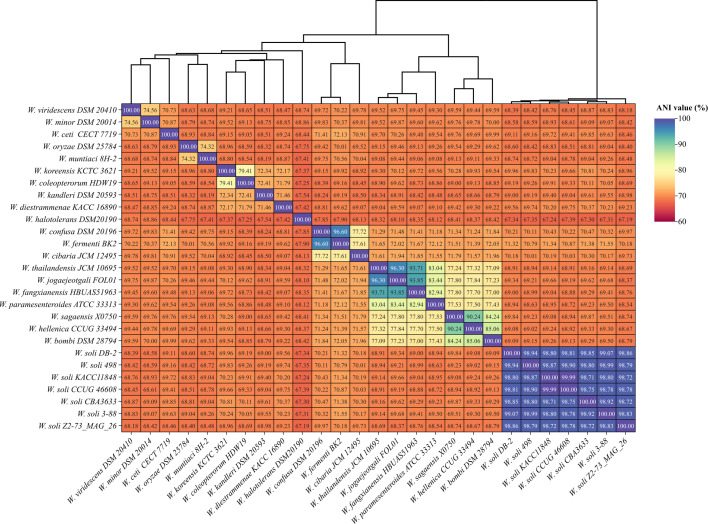 Fig 1
Fig 1| Characteristic | Value |
|---|---|
| Description of location | |
| Location | Kaldá river, Iceland, near Eldborg crater |
| Time | 30 August 2024 |
| Type | River water |
| Geographic coordinates | 64°46′43.2″N 22°18′06.1″W |
| Genome statistics | |
| Assembly size (bp) | 1,678,388 |
| Number of circular contigs | 1 |
| Contig N50 (bp) | 1,678,388 |
| Contig L50 | 1 |
| GC (%) | 43.9 |
| Genome coverage | 87 × |
| Number of 5S rRNA | 6 |
| Number of 16S rRNA | 6 |
| Number of 23S rRNA | 6 |
| Number of tRNAs | 65 |
| Total number of genes | 1678 |
| Total number of CDS | 1592 |
| Total number of pseudogenes | 7 |
| TYGS taxonomy |
|
| GTDB taxonomy |
|
| EPS | |
| Data accession | |
| BioProject |
|
| BioSample |
|
| SRA |
|
| Genome assembly |
|
- —Sino-Danish Center (SDC)
Peer Reviews
No public reviews on file for this paper yet. If you reviewed it on a platform where reviews are public (OpenReview, ICLR, NeurIPS, ICML), you can paste yours below so the community can read it here.
Videos
No videos yet. Explain this paper in a talk, walkthrough, or lecture? Add one.
Taxonomy
TopicsBacteriophages and microbial interactions · Microbial infections and disease research · Viral gastroenteritis research and epidemiology
ANNOUNCEMENT
Weissella soli, found in soil and foods, has technological potential as a producer of exopolysaccharides (EPS) and lactic acid (1–3). A W. soli isolate was obtained from the Kaldá river in Iceland (Table 1) by incubating an unfiltered, undiluted surface water sample in all-purpose Tween (APT) broth (Difco, Sparks, MD) under microaerophilic conditions, using a candlelight, at uncontrolled room temperature for 7 days, before transfer to APT agar (1.35%; Merck, Darmstadt) and anaerobic incubation at 25°C. Gram-positive, catalase-negative lactic acid bacterial colonies were re-streaked and cultured in APT broth for genomic analysis.
Genomic DNA was extracted using the Bead-Beat Micro AX Gravity kit (A&A Biotechnology, Gdynia, Poland), which combined with the Native Barcoding Kit (SQK-NBD114.96, Oxford, UK), ensures isolation of high molecular weight DNA and generation of raw reads with an N50 of approximately 10 kb. DNA concentration was measured with a Qubit 4 fluorometer (Thermo Fisher, Waltham, USA). The final library with ligated motor protein was washed with Long Fragment Buffer to enrich for DNA fragments larger than 3 kb. DNA sequencing was conducted on a PromethION 2 Solo platform using R10.4.1 flow cell (FLO-PRO114M). Basecalling was conducted using the [email protected] basecalling model, and demultiplexing and adapter trimming were performed with Dorado v0.8.1 (https://github.com/nanoporetech/dorado). Bedtools v2.30.0 (4) and seqkit v2.1.0 (5) were utilized to convert the obtained bam files to FASTQ format and to remove duplicated reads, respectively.
Genome assembly and circularization were conducted using Hybracter v0.9.0 (6) using the flye --nano-hq model (7) and the Plassembler (8) plsdb_2023_11_03_v2 database. Reads were filtered at a minimum length of 1,000 bp and a quality score of 16, and the subsample depth value was set at 110×. After filtering, a total of 19,966 reads with an N50 of 9,799 bp were used for the assembly. Chromosome size was estimated automatically with the --auto flag. Polishing with medaka was omitted due to its potential to reduce accuracy (9). The genome was reoriented to start at DnaA using dnaapler v0.8.1 (10).
The complete genome was classified with the Type strain Genome Server (TYGS) v391 (11) and GTDBtk v. 2.3.2 against the Genome Taxonomy Database (release 214) (12). Annotation was conducted using the NCBI Prokaryotic Genome Annotation Pipeline (PGAP) (13–15). The average nucleotide identity (ANI) values between strain 3-88 and other Weissella spp. genomes were calculated by Orthologous ANI tool (16) and visualized using Chiplot (https://www.chiplot.online/) (Fig. 1).
Heatmap of pairwise ANI values among Weissella soli strains and type strains of various Weissella species, including one freshwater isolate from this study and 26 strains obtained from GenBank. The dendrogram at the top illustrates hierarchical clustering of ANI values based on the Euclidean-distance method.
The genome sequence contained genes (bp 1377492–1391637) corresponding to the eps cluster for EPS production via the Wzx-Wzy pathway, the most common pathway for heterosaccharide EPS biosynthesis in lactic acid bacteria, yet understudied in Weisella (17). The regulatory genes cpsBC were detected by homology with those of Lactococcus lactis KLDS 4.0325 using Protein Basic Local Alignment Tool (BLASTP) (18). The Wzx and Wzy flippase and polymerase functions were inferred based on transmembrane domain similarity to KLDS 4.0325, with domains predicted using DeepTMHMM v1.0 (19). Finally, BLASTP analysis resulted in no significant hits against the well-established glucansucrase of Weisella confusa LBAE C39-2 (18, 20).
The reference list from the paper itself. Each links out to its DOI / PubMed record.
- 1Magnusson J, Jonsson H, Schnürer J, Roos S. 2002. Weissella soli sp. nov., a lactic acid bacterium isolated from soil. Int J Syst Evol Microbiol 52:831–834. doi:10.1099/00207713-52-3-83112054246 · doi ↗ · pubmed ↗
- 2Fukuda D, Nolasco-Hipolito C. 2022. Draft genome sequence of Weissella soli strain DB-2, isolated from Nukadoko. Microbiol Resour Announc 11:e 0116021. doi:10.1128/mra.01160-2135084226 PMC 8800448 · doi ↗ · pubmed ↗
- 3Montero-Zamora J, Fernández-Fernández S, Redondo-Solano M, Mazón-Villegas B, Mora-Villalobos JA, Barboza N. 2022. Assessment of different lactic acid bacteria isolated from agro-industrial residues: first report of the potential role of Weissella soli for lactic acid production from milk whey. Appl Microbiol 2:626–635. doi:10.3390/applmicrobiol 2030048 · doi ↗
- 4Quinlan AR, Hall IM. 2010. BED Tools: a flexible suite of utilities for comparing genomic features. Bioinformatics 26:841–842. doi:10.1093/bioinformatics/btq 03320110278 PMC 2832824 · doi ↗ · pubmed ↗
- 5Shen W, Le S, Li Y, Hu F. 2016. Seq Kit: a cross-platform and ultrafast toolkit for FASTA/Q file manipulation. P Lo S One 11:e 0163962. doi:10.1371/journal.pone.016396227706213 PMC 5051824 · doi ↗ · pubmed ↗
- 6Bouras G, Houtak G, Wick RR, Mallawaarachchi V, Roach MJ, Papudeshi B, Judd LM, Sheppard AE, Edwards RA, Vreugde S. 2024. Hybracter: enabling scalable, automated, complete and accurate bacterial genome assemblies. Microb Genom 10:001244. doi:10.1099/mgen.0.00124438717808 PMC 11165638 · doi ↗ · pubmed ↗
- 7Bouras G, Sheppard AE, Mallawaarachchi V, Vreugde S. 2023. Plassembler: an automated bacterial plasmid assembly tool. Bioinformatics 39:btad 409. doi:10.1093/bioinformatics/btad 40937369026 PMC 10326302 · doi ↗ · pubmed ↗
- 8Kolmogorov M, Yuan J, Lin Y, Pevzner PA. 2019. Assembly of long, error-prone reads using repeat graphs. Nat Biotechnol 37:540–546. doi:10.1038/s 41587-019-0072-830936562 · doi ↗ · pubmed ↗