Draft genome of Conoideocrella luteorostrata ARSEF 14590 (Clavicipitaceae), an entomopathogenic fungus with a wealth of biosynthetic and biocontrol potential
Brian Lovett, Jason E. Stajich, Hana Barrett, Lindsay R. Kasson, Daniel G. Panaccione, Cecilia A. Reiter, Jessica L. Fuss, Gregory Biddle, Matt T. Kasson

TL;DR
This paper presents the draft genome of a fungus that infects harmful insects in Christmas tree farms, highlighting its potential for pest control.
Contribution
The study provides the first scaffold-level genome assembly and biosynthetic gene cluster survey for Conoideocrella luteorostrata.
Findings
The genome of strain ARSEF 14590 was assembled at the scaffold level.
An initial survey identified potential biosynthetic gene clusters in the fungus.
Abstract
The fungus Conoideocrella luteorostrata is a recently discovered pathogen of invasive elongate hemlock scale insects (EHS; Fiorinia externa) in Christmas tree farms in the eastern U.S. Here, we report a scaffold-level genome and assembly along with an initial survey of biosynthetic gene clusters for strain ARSEF 14590 from EHS.
Genes, proteins, chemicals, diseases, species, mutations and cell lines named across the full text — each resolved to its canonical identifier and authoritative record.
Click any figure to enlarge with its caption.
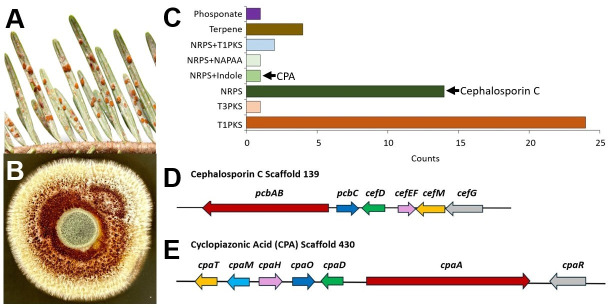 Fig 1
Fig 1| Species | Strain no. | Genome assembly | Size (Mb) | NRPS | NRPS_T1PKS | NRPS_Other | T1PKS | Terpene | Indole | NAPAA | Isocyanide | Other | Total BCGs |
|---|---|---|---|---|---|---|---|---|---|---|---|---|---|
|
| MBC 622 |
| 32.68 | 13 | 4 | 2 | 11 | 5 | 0 | 1 | 1 | 0 | 37 |
|
| MBC 508 |
| 31.39 | 4 | 1 | 1 | 7 | 2 | 0 | 0 | 2 | 0 | 17 |
|
| MBC 710 |
| 31.32 | 5 | 1 | 1 | 9 | 3 | 0 | 0 | 2 | 0 | 21 |
|
| MBC 593 |
| 29.97 | 2 | 1 | 1 | 9 | 4 | 0 | 0 | 2 | 1 | 20 |
|
| MBC 735 |
| 26.99 | 5 | 0 | 1 | 11 | 5 | 1 | 1 | 2 | 3 | 29 |
|
| MBC 819 |
| 26.95 | 4 | 1 | 0 | 11 | 5 | 2 | 1 | 2 | 3 | 29 |
|
| MBC 612 |
| 26.91 | 5 | 1 | 0 | 11 | 6 | 2 | 1 | 2 | 3 | 31 |
|
| MBC 877 |
| 26.89 | 5 | 1 | 1 | 7 | 6 | 1 | 1 | 2 | 3 | 27 |
|
| MBC 610 |
| 26.82 | 5 | 1 | 1 | 9 | 6 | 1 | 0 | 2 | 4 | 29 |
|
| B249 |
| 30.15 | 1 | 2 | 1 | 4 | 2 | 0 | 1 | 0 | 0 | 11 |
|
| CCC 1102 |
| 30.33 | 9 | 0 | 0 | 6 | 4 | 1 | 1 | 0 | 0 | 21 |
|
| CCC434 |
| 30.49 | 7 | 0 | 0 | 8 | 4 | 1 | 1 | 0 | 0 | 21 |
|
| PRL 1980 |
| 52.59 | 3 | 0 | 0 | 6 | 2 | 2 | 1 | 0 | 0 | 14 |
|
| CCC 1483 |
| 27.64 | 7 | 0 | 0 | 6 | 3 | 2 | 1 | 0 | 0 | 19 |
|
| PRL1580 |
| 28.57 | 7 | 0 | 0 | 7 | 2 | 1 | 1 | 0 | 0 | 18 |
|
| ILB388 |
| 29.21 | 4 | 2 | 0 | 4 | 4 | 2 | 1 | 0 | 0 | 17 |
|
| CCC 1485 |
| 27.8 | 7 | 0 | 0 | 7 | 2 | 1 | 1 | 0 | 0 | 18 |
|
| LM72 |
| 34.19 | 6 | 0 | 1 | 8 | 3 | 2 | 0 | 0 | 0 | 20 |
|
| 136 |
| 35.88 | 6 | 0 | 1 | 6 | 2 | 1 | 0 | 0 | 1 | 17 |
|
| ARSEF 14590 |
| 47.39 | 14 | 2 | 2 | 24 | 4 | 0 | 0 | 0 | 2 | 48 |
|
| NFE708 |
| 38.12 | 10 | 0 | 1 | 6 | 4 | 0 | 1 | 1 | 2 | 25 |
|
| E357 |
| 39.19 | 5 | 0 | 0 | 10 | 3 | 1 | 1 | 1 | 1 | 22 |
|
| E1124 |
| 44.64 | 6 | 0 | 0 | 10 | 3 | 0 | 0 | 1 | 0 | 20 |
|
| Nfe728 |
| 34.12 | 7 | 2 | 0 | 6 | 4 | 1 | 1 | 1 | 2 | 24 |
|
| Fl1 |
| 34.97 | 8 | 0 | 2 | 8 | 4 | 0 | 1 | 0 | 2 | 26 |
|
| E2772 |
| 42.97 | 3 | 0 | 0 | 7 | 1 | 1 | 0 | 1 | 1 | 14 |
|
| TT-2021a |
| 37.25 | 9 | 1 | 0 | 5 | 3 | 0 | 0 | 1 | 2 | 21 |
|
| ARSEF 324 |
| 44.71 | 12 | 3 | 1 | 9 | 5 | 2 | 0 | 1 | 0 | 33 |
|
| ARSEF 1941 |
| 30.45 | 8 | 3 | 1 | 9 | 3 | 0 | 1 | 1 | 1 | 27 |
|
| MEAPA 0093 |
| 39.55 | 11 | 7 | 2 | 17 | 2 | 2 | 1 | 1 | 3 | 46 |
|
| 4556 |
| 37.77 | 8 | 7 | 1 | 19 | 3 | 1 | 1 | 1 | 2 | 43 |
|
| ARSEF 977 |
| 43.47 | 14 | 9 | 1 | 16 | 6 | 3 | 1 | 2 | 2 | 54 |
|
| ESALQ1638 |
| 38.59 | 12 | 8 | 1 | 21 | 3 | 3 | 1 | 1 | 3 | 53 |
|
| M-1000 |
| 44.29 | 11 | 6 | 1 | 23 | 4 | 4 | 1 | 2 | 4 | 56 |
|
| MrS1GZL-1 |
| 34.73 | 9 | 3 | 0 | 9 | 2 | 1 | 1 | 0 | 1 | 26 |
|
| ARSEF 23 |
| 41.66 | 10 | 6 | 1 | 19 | 6 | 3 | 1 | 1 | 4 | 51 |
|
| BCC 4849 |
| 37.98 | 12 | 6 | 2 | 18 | 2 | 2 | 0 | 1 | 2 | 45 |
|
| RCEF 2490 |
| 30.87 | 4 | 1 | 0 | 6 | 5 | 0 | 1 | 0 | 3 | 20 |
|
| IasaF13 |
| 35.3 | 10 | 0 | 0 | 7 | 1 | 0 | 0 | 0 | 0 | 18 |
|
| 170 |
| 44.22 | 10 | 3 | 0 | 14 | 8 | 0 | 1 | 0 | 1 | 37 |
| Average BGCs | 35.23 | 7 | 2 | 1 | 10 | 4 | 1 | 1 | 1 | 1 | 28 |
- —Christmas Tree Promotion Board
- —National Institutes of Healthhttp://dx.doi.org/10.13039/100000002
- —National Science Foundationhttp://dx.doi.org/10.13039/501100008982
Peer Reviews
No public reviews on file for this paper yet. If you reviewed it on a platform where reviews are public (OpenReview, ICLR, NeurIPS, ICML), you can paste yours below so the community can read it here.
Videos
No videos yet. Explain this paper in a talk, walkthrough, or lecture? Add one.
Taxonomy
TopicsEntomopathogenic Microorganisms in Pest Control · Plant Pathogens and Fungal Diseases · Plant and fungal interactions
ANNOUNCEMENT
Our recent discovery of epizootics of the entomopathogenic fungus Conoideocrella luteorostrata (CL) on elongate hemlock scale insects (EHS; Fiorinia externa) in Christmas tree orchards in North Carolina (1) and by others elsewhere in the United States (2) has generated interest regarding its use as a biological control agent (Fig. 1). CL was reported from various Hemiptera across the southeastern United States in the early 1900s (1), yet it remains unclear if earlier accounts were actually caused by Aschersonia (1, 3, 4), given its overlapping morphology and host range. >230 Clavicipitaceae genomes have been sequenced to date (5), but a majority belong to just five of >50 recognized genera (6, 7) including Claviceps, Epichloë, Ustilaginoidea, Metarhizium, and Aschersonia (8–15). Genome sequencing is urgently needed for the remaining genera, including Conoideocrella, given ongoing taxonomic conflicts (1, 16) and recent discoveries (17, 18).
Conoideocrella luteorostrata (A) in situ sporulating atop infected Fiorinia externa nymphs (courtesy of Dr. Matt Bertone, NCSU, reproduced with permission) and (B) in vitro (strain ARSEF 14590) after 2 weeks growth on potato dextrose agar (courtesy of Matt Kasson). (C) AntiSMASH predicted biosynthetic gene clusters (BGCs) for ARSEF 14590 across all classes. Intact BCGs for both cephalosporin C (D) and cyclopiazonic acid (E) were found in ARSEF 14590. Cephalosporin C BGC includes: pcbAB, acv synthetase; pcbC, isopenicillin N synthase; cefD, isopenicillin N epimerase; cefEF, cephalosporin biosynthesis expandase/hydroxylase; cefM, transporter (multi-drug resistance homolog); and cefG, isopenicillin N-CoA synthetase. Cyclopiazonic Acid BGC includes: cpaT, MFS transporter; cpaM, N-methyltransferase, cpaH, Cytochrome P450 monooxygenase; cpaO, monoamine oxidase; cpaD, Tryptophan dimethylallyltransferase; cpaA, a multifunctional CPA synthase; and cpaR, transcription factor.
A mycelial culture of the recently characterized strain ARSEF 14590 (1) isolated from an infected EHS crawler in Ashe County, North Carolina (Table 1) in 2020 was grown out for ~2 weeks on potato dextrose agar at 22°C. Genomic DNA was extracted from fungal tissue with a Qiagen DNeasy PowerSoil Pro Kit. DNA sequencing libraries were prepared with sparQ DNA fragment and library kit (Quanta Bio, Beverly, MA), which uses enzymatic shearing to fragment and sizing, and DNA quantitation was performed on an Agilent 2100 Bioanalyzer System and High Sensitivity DNA Kit using the manufacturer’s protocols. An Illumina NextSeq 1000 (Marshall University Genomics Core Facility, Huntington, WV) generated 8.668M 2 × 150 bp paired sequence reads or 2.6 Gb from CL ARSEF 14590. The assembled scaffold-level (n = 864) genome for CL strain ARSEF 14590 was 47.39 Mbp (coverage, 51.6 x; N50, 111.30 kb; L50, 126; G + C content, 49%). The assembly was cleaned of vector contamination and redundant contigs were cleaned as previously described (19) using SPAdes v3.15.2 (20) run within AAFTF (v0.4.1; 21) with the trim and filter steps to quality control the reads with fastp (v0.23.2; 22) and BBMap (v39.19; 23) to remove phiX and adaptor sequence, before running the assembly step using defaults set in AAFTF. This is followed by vectrim, sourpurge with phylum = Ascomycota, and rmdup steps to remove contaminating contigs with default parameters. Assemblies were subjected to five rounds of polishing with Pilon (v1.24; 24) with Illumina reads. Genome annotation was performed with funannotate (v1.8.15; 25) utilizing alignment of proteins in UniProt and BUSCO with sordariomycetes_odb10 for training, and tRNA genes were predicted using tRNAscan-SE v2.0.9 (26). BUSCO v5.4.4 (27), using the ascomycota_odb10 data set (28), identified 1,696/1,706 (99.5%) complete, 1,684 (98.7%) single copy, 14 (0.8%) duplicated, and 2 (0.1%) fragmented markers. Default parameters were used or when specified, available in the pipeline code, parameters, and logfiles archived in Github and Zenodo (29). The final genome annotation included a total of 12,844 protein-coding genes and 110 tRNAs. AntiSMASH v5.0 (30) predicted 48 biosynthetic gene clusters (BGCs) for ARSEF 14590 using “strict” parameters*,* including 10 NRPS and 24 T1PKS BGCs (Table 1). Intact NRPS-containing BGCs for cephalosporin C, an important β-lactam antibiotic (31), and cyclopiazonic acid, a fungal neurotoxin chemically related to ergoline alkaloids (32) (Fig. 1), highlights just some of the BGCs whose natural products may serve important roles in CL-EHS interactions with additional potential applications in medicine and agriculture.
The reference list from the paper itself. Each links out to its DOI / PubMed record.
- 1Lovett B, Barrett H, Macias AM, Stajich JE, Kasson LR, Kasson MT. 2024. Morphological and phylogenetic resolution of Conoideocrella luteorostrata (Hypocreales: Clavicipitaceae), a potential biocontrol fungus for Fiorinia externa in United States Christmas tree production areas. Mycologia 116:267–290. doi:10.1080/00275514.2023.229633738275281 · doi ↗ · pubmed ↗
- 2Urbina H, Ahmed MZ. 2022. Characterization of the entomopathogenic fungal species Conoideocrella luteorostrata on the scale insect pest Fiorinia externa Infesting the christmas tree Abies fraseri in the USA. Florida Entomologist 105:10–21. doi:10.1653/024.105.0103 · doi ↗
- 3Fasulo TR, Weems HV. 1999. Featured creatures: Citrus Whitefly. Available from: https://entnemdept.ufl.edu/creatures/citrus/citrus_whitefly.htm
- 4Martini X, Diepenbrock LM, Ray KL, Burrow JD. 2022. Citrus pest quick guide: Citrus Whitefly (Dialeurodes citri). University of Florida IFAS. Available from: https://edis.ifas.ufl.edu/publication/in 1322
- 5NIH, NCBI, NLM. 2025. Datasets. Genomes, ‘Selected Taxa’ = Clavicipitaceae. Available from: https://www.ncbi.nlm.nih.gov/datasets/genome/?taxon=34397
- 6Sung GH, Sung JM, Hywel-Jones NL, Spatafora JW. 2007. A multi-gene phylogeny of Clavicipitaceae (Ascomycota, Fungi): identification of localized incongruence using a combinational bootstrap approach. Mol Phylogenet Evol 44:1204–1223. doi:10.1016/j.ympev.2007.03.01117555990 · doi ↗ · pubmed ↗
- 7Zhang ZY, Feng Y, Tong SQ, Ding CY, Tao G, Han YF. 2023. Morphological and phylogenetic characterisation of two new soil-borne fungal taxa belonging to Clavicipitaceae (Hypocreales, Ascomycota). Myco Keys 98:113–132. doi:10.3897/mycokeys.98.10624037324546 PMC 10267719 · doi ↗ · pubmed ↗
- 8Wyka SA, Mondo SJ, Liu M, Dettman J, Nalam V, Broders KD. 2021. Whole-genome comparisons of ergot fungi reveals the divergence and evolution of species within the genus Claviceps are the result of varying mechanisms driving genome evolution and host range expansion. Genome Biol Evol 13:evaa 267. doi:10.1093/gbe/evaa 26733512490 PMC 7883665 · doi ↗ · pubmed ↗