Influenza B virus from respiratory samples of individuals with influenza-like illness in a University Campus in Arizona USA, in February 2025
Angelica U. Negrete, Stacy Nelson, Matthew Scotch, Temitope O. C. Faleye

TL;DR
Three influenza B viruses were identified in a university in Arizona in February 2025, all belonging to a specific genetic group.
Contribution
The study identifies and classifies a specific clade and subclade of influenza B viruses in a localized outbreak.
Findings
Three influenza B viruses were detected in individuals with flu-like symptoms on a university campus.
All three viruses belong to the B/Victoria lineage, clade V1A.3a.2, and subclade C.5.1.
The neuraminidase segments of the viruses belong to clade B.7.
Abstract
We describe three influenza B viruses detected in respiratory samples from individuals with flu-like symptoms on a university campus in Arizona, USA, in February 2025. Analysis of the hemagglutinin segments shows all three are B/Victoria, clade V1A.3a.2, and subclade C.5.1 with NA segments that belong to clade B.7.
Genes, proteins, chemicals, diseases, species, mutations and cell lines named across the full text — each resolved to its canonical identifier and authoritative record.
Click any figure to enlarge with its caption.
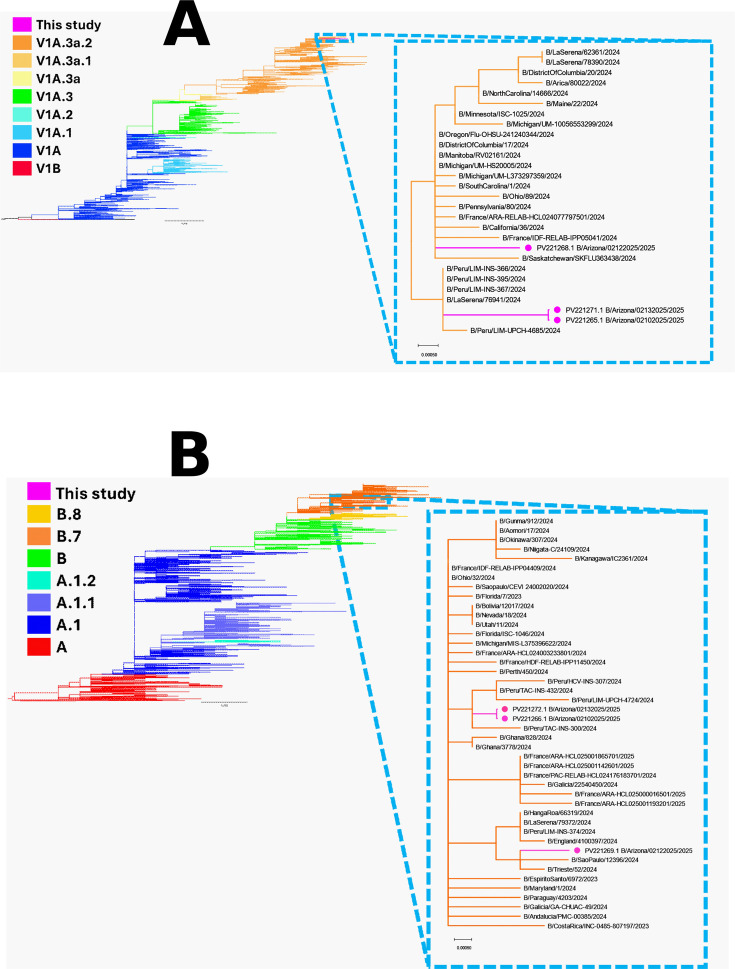 Fig 1
Fig 1| Nextclade | GenBank | |||||||||
|---|---|---|---|---|---|---|---|---|---|---|
| S/N | Raw Reads (mean length) | Mapped reads | Segment (length) | Accession (GC%) | Mean depth | Clade | Subclade | Accession number | Percentage similarity (%) | Query cover (%) |
| 1 | 37,142 (1,028) | 684 | HA (1,847) | 191.9 | V1A.3a.2 | C.5.1 |
| 99.89 | 100 | |
| NA (1,527) | 368.8 | B.7 |
| 100 | 100 | |||||
| NS (1,066) | 95.7 |
| 100 | 100 | ||||||
| 2 | 14,127 (1,104) | 2,116 | HA (1,847) | 468.7 | V1A.3a.2 | C.5.1 |
| 99.57 | 100 | |
| NA (1,529) | 878.1 | B.7 |
| 99.87 | 100 | |||||
| NS (1,066) | 160.0 |
| 99.81 | 100 | ||||||
| 3 | 27,994 (1,368) | 16,784 | HA (1,847) | 4,357.9 | V1A.3a.2 | C.5.1 |
| 99.89 | 100 | |
| NA (1,527) | 6,885.0 | B.7 |
| 100 | 100 | |||||
| NS (1,066) | 1,649.8 |
| 100 | 100 | ||||||
Peer Reviews
No public reviews on file for this paper yet. If you reviewed it on a platform where reviews are public (OpenReview, ICLR, NeurIPS, ICML), you can paste yours below so the community can read it here.
Videos
No videos yet. Explain this paper in a talk, walkthrough, or lecture? Add one.
Taxonomy
TopicsInfluenza Virus Research Studies · Respiratory viral infections research · Viral gastroenteritis research and epidemiology
ANNOUNCEMENT
Influenza viruses are members of the family Orthomyxoviridae. Members of four of the genera (influenza A virus [IAV], IBV, ICV, and IDV) in the family have been associated with respiratory infections in humans and animals. The enveloped, pleomorphic virions usually encase eight-segment, negative-sense RNA genomes of about 14 kb (1). For prevention and control, the hemagglutinin (HA) and neuraminidase (NA) segments of IBV are of utmost importance. Two IBV lineages (Victoria and Yamagata; based on HA) have traditionally been documented to circulate mainly in humans (2). Yamagata has not been confirmed since March 2020, leading to speculation that it may be extinct (3). Here, we describe three IBV variants detected within a week in February 2025, on a university campus in Tempe, Arizona, USA.
The nasal swabs analyzed here were collected within a week (10th, 12th, and 13th) in February 2025 as part of an ongoing influenza-like illness surveillance program on a university campus in Arizona, USA. Samples were flagged as containing IBV using the rapid OneStep + Ultra Influenza A and B antigen detection test kit (Henry Schein, Melville, New York, USA) as part of routine clinical care at the university health services. Subsequently, the samples were transported to our laboratory where RNA was extracted from the sample using QIAamp viral RNA minikit (ThermoFisher Scientific, Waltham, MA, USA) following the manufacturer’s instructions. The extract was used for cDNA synthesis using the SSIV first-strand cDNA synthesis kit (ThermoFisher Scientific, Waltham, MA, USA) and BHANAF primer (4). The HA, NA, and nonstructural (NS) segments were amplified using the BHANAF and BHANAR primers (4) alongside Phusion-plus PCR master mix (ThermoFisher Scientific, Waltham, MA, USA) as previously described (4, 5). Amplicons were cleaned using magnetic beads (Quantabio, Beverly, MA, USA). Sequencing libraries were prepared using the ligation sequencing amplicons Native Barcoding Kit 24 V14 (SQK-NBD114.24), pooled, and sequenced on a Flongle flow cell and MK1b. Base calling, trimming, and template-guided assembly were done using MinKNOW v24.11.10, Porechop v0.2.4 (6), and Minimap v2.24 (7), respectively. IBV contigs were typed using both a BLASTn search of the GenBank database and Nextclade (8). Trees generated from Nextclade were annotated using Figtree v1.4.4. Default parameters were used for all software except where otherwise noted.
The HA, NA, and NS segments were amplified from all three samples. Precisely, 24.7% (19,584) of the 79,263 reads generated mapped to the three segments (Table 1). Mean depth ranged from 95× to 6,885×, and all sequences were >99% similar to the closest hits in GenBank (Table 1). Nextclade typed all three HA segments as B/Victoria, clade V1A.3a.2, and subclade C.5.1, while the NA segments belonged to clade B.7 (Table 1). Both HA and NA trees alongside BLASTn search results suggest that the three viruses might be part of two different transmission clusters (Fig. 1 and Table 1). None of the amino acid substitutions H134Y, H273N, or D197N associated with resistance (9) to NA inhibitors was found in any of the NAs described here.
Phylogenetic trees showing influenza B virus HA (A) and NA (B) detected in this study (highlighted using purple circles). The trees were made using Nextclade and annotated using Figtree.
The IBV genomic segments described here belong to the clades documented to be circulating globally (10, 11). IBV vaccine strains selected for the 2025–2026 northern hemisphere influenza season have been shown to elicit an immune response capable of neutralizing viruses with HA from the clade (V1A.3a.2, subclade C.5.1) detected in this study (11).
The reference list from the paper itself. Each links out to its DOI / PubMed record.
- 1Krishnappa R, Paramasivam R. 2014. Molecular signature of influenza A. O Alib 01:1–7. doi:10.4236/oalib.1100979 · doi ↗
- 2Taubenberger JK, Kash JC. 2010. Influenza virus evolution, host adaptation, and pandemic formation. Cell Host Microbe 7:440–451. doi:10.1016/j.chom.2010.05.00920542248 PMC 2892379 · doi ↗ · pubmed ↗
- 3Caini S, Meijer A, Nunes MC, Henaff L, Zounon M, Boudewijns B, Del Riccio M, Paget J. 2024. Probable extinction of influenza B/Yamagata and its public health implications: a systematic literature review and assessment of global surveillance databases. Lancet Microbe 5:100851. doi:10.1016/S 2666-5247(24)00066-138729197 · doi ↗ · pubmed ↗
- 4Zhou B, Deng Y-M, Barnes JR, Sessions OM, Chou T-W, Wilson M, Stark TJ, Volk M, Spirason N, Halpin RA, Kamaraj US, Ding T, Stockwell TB, Salvatore M, Ghedin E, Barr IG, Wentworth DE. 2017. Multiplex reverse transcription-PCR for simultaneous surveillance of influenza A and B viruses. J Clin Microbiol 55:3492–3501. doi:10.1128/JCM.00957-1728978683 PMC 5703814 · doi ↗ · pubmed ↗
- 5Faleye TOC, Adams D, Adhikari S, Sandrolini H, Halden RU, Varsani A, Scotch M. 2021. Use of hemagglutinin and neuraminidase amplicon-based high-throughput sequencing with variant analysis to detect co-infection and resolve identical consensus sequences of seasonal influenza in a university setting. BMC Infect Dis 21:810. doi:10.1186/s 12879-021-06526-534388979 PMC 8360813 · doi ↗ · pubmed ↗
- 6Wick R. 2017. Porechop: adapter trimmer for oxford nanopore reads. Available from: https://github.com/rrwick/Porechop/
- 7Li H. 2018. Minimap 2: pairwise alignment for nucleotide sequences. Bioinformatics 34:3094–3100. doi:10.1093/bioinformatics/bty 19129750242 PMC 6137996 · doi ↗ · pubmed ↗
- 8Aksamentov I, Roemer C, Hodcroft EB, Neher RA. 2021. Nextclade: clade assignment, mutation calling and quality control for viral genomes. JOSS 6:3773. doi:10.21105/joss.03773 · doi ↗