Behavioral and Morphological Adaptations of Tortoise Tick Hyalomma aegyptium to Testudo graeca: Evidence for Complex Evolutionary History
Sirri Kar, Baris Donmez, Bugrahan Regaip Kilinc, Zafer Sakaci, Sengul Talay, Dennis Bente, Agustin Estrada‐Peña

TL;DR
This study explores how the tick Hyalomma aegyptium has adapted behaviorally and physically to live on the spur-thighed tortoise, suggesting a complex evolutionary history.
Contribution
The study provides evidence that H. aegyptium's adaptations may have originated from an extinct giant tortoise before shifting to Testudo.
Findings
Tick infestation traits are influenced by developmental stage, sex, and host characteristics.
H. aegyptium shows specialized adaptations to minimize harm to the host while surviving environmental challenges.
The tick's evolutionary history may involve an extinct tortoise species before adapting to Testudo.
Abstract
In vector arthropods, the host relationship plays a central role in population dynamics and is crucial for determining the current and future course of vector ecology and the eco‐epidemiology of vector‐borne diseases, particularly under the influence of climate and environmental changes. However, since this relationship is driven by complex ecological cascades, accurately characterizing its attributes, particularly in a cause‐and‐effect context, remains challenging, leaving substantial gaps in understanding. In this study, we examined the infestation characteristics of the tick species Hyalomma aegyptium on its specific host, the spur‐thighed tortoise Testudo graeca , to investigate the principles of behavioral and morphological adaptation and its ecological consequences. A field study was conducted in 2021 and 2022 in Turkish Thrace to obtain phenology‐based data under natural…
Genes, proteins, chemicals, diseases, species, mutations and cell lines named across the full text — each resolved to its canonical identifier and authoritative record.
Click any figure to enlarge with its caption.
 Figure 1
 Figure 2
 Figure 3
 Figure 4
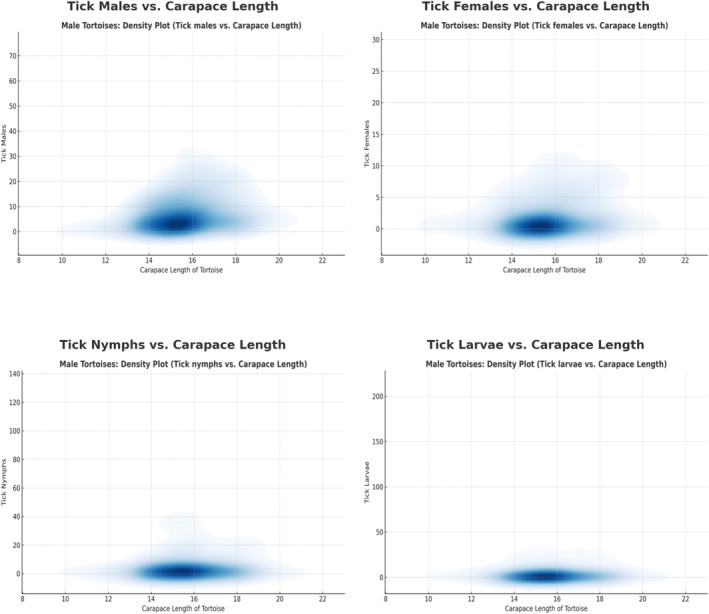 Figure 5
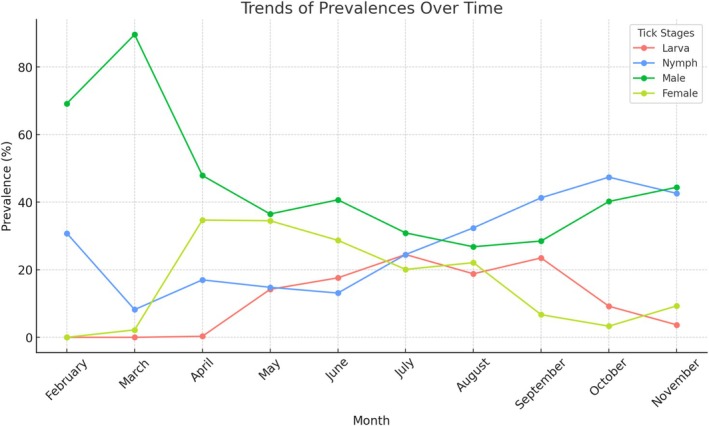 Figure 6
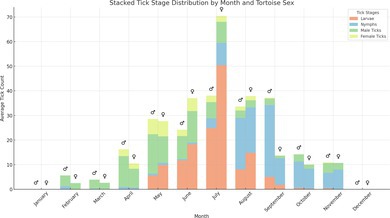 Figure 7
Peer Reviews
No public reviews on file for this paper yet. If you reviewed it on a platform where reviews are public (OpenReview, ICLR, NeurIPS, ICML), you can paste yours below so the community can read it here.
Videos
No videos yet. Explain this paper in a talk, walkthrough, or lecture? Add one.
Taxonomy
TopicsVector-borne infectious diseases · Insect and Arachnid Ecology and Behavior · Viral Infections and Vectors