The role of skin testing, drug challenge and IFN-γ ELISpot in delayed hypersensitivity to iodinated contrast media
Ana Maria Copaescu, Kyra Y. L. Chua, Effie Mouhtouris, Natasha E. Holmes, Moneerah AlGassim, Ibtihal Al Otaibi, Florian Stehlin, Ghislaine A. C. Isabwe, Christos Tsoukas, Jean-Francois Toupin, Derek Lee, Moshe Ben-Shoshan, Elizabeth J. Phillips, Jason A. Trubiano

TL;DR
This study evaluates diagnostic methods for delayed hypersensitivity reactions to iodinated contrast media, finding that skin testing is more effective than IFN-γ ELISpot.
Contribution
The study provides new insights into the diagnostic performance of dIDT and IFN-γ ELISpot for delayed hypersensitivity to iodinated contrast media.
Findings
dIDT confirmed T cell-mediated allergy in 85% of patients with suspected DHR.
Only 35% of patients tolerated an alternative ICM after testing.
IFN-γ ELISpot showed no diagnostic utility in the four patients tested.
Abstract
The use of in vivo and ex vivo diagnostic tools for delayed hypersensitivity reactions (DHRs) associated with iodinated contrast media (ICM) is currently ill-defined. To evaluate the role of in vivo and ex vivo diagnostic tools for DHRs occurring >6 h following intravenous low-osmolality ICM. We conducted a prospective, multicenter, international cohort study. The patients were recruited from two tertiary care adult allergy clinics, Austin Health, Australia and the McGill University Health Centre, Canada. Eligible participants were adults who reported a DHR after receiving ICM. In vivo testing (skin testing and intravenous challenge) was performed to identify an alternative agent. Ex vivo testing using interferon-γ enzyme-linked ImmunoSpot assay was performed in four Australian patients to explore its diagnostic performance. The culprit ICM was identified by dIDT in 17/20 (85%) while…
Genes, proteins, chemicals, diseases, species, mutations and cell lines named across the full text — each resolved to its canonical identifier and authoritative record.
Click any figure to enlarge with its caption.
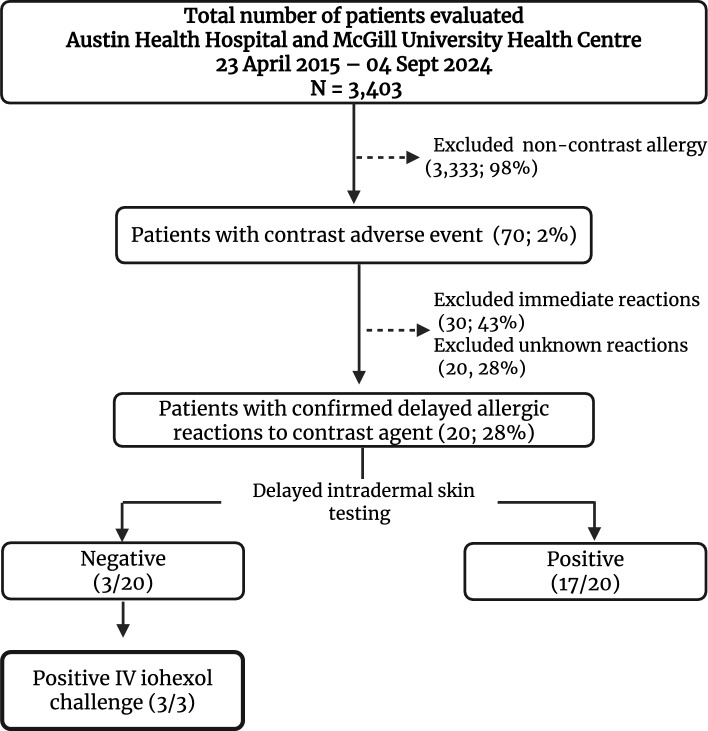 Figure 1
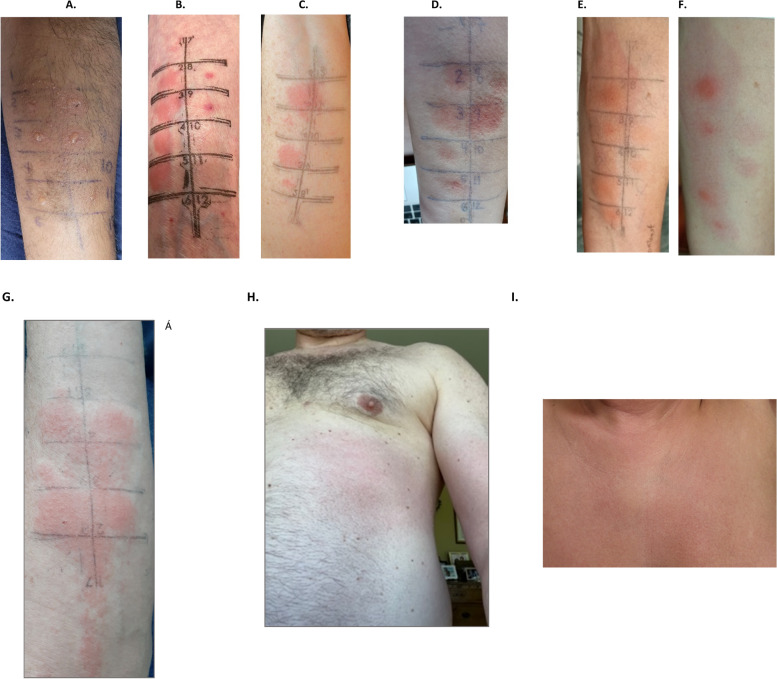 Figure 2
Peer Reviews
No public reviews on file for this paper yet. If you reviewed it on a platform where reviews are public (OpenReview, ICLR, NeurIPS, ICML), you can paste yours below so the community can read it here.
Videos
No videos yet. Explain this paper in a talk, walkthrough, or lecture? Add one.
Taxonomy
TopicsDrug-Induced Adverse Reactions · Contact Dermatitis and Allergies · Mast cells and histamine