Correlation of lymphocyte-to-monocyte, platelet-to-lymphocyte, and neutrophil-to-lymphocyte ratios with skin-symptom improvement following antimicrobial treatment in palmoplantar pustulosis
Kuninori Iwayama, Takayuki Manabe, Ko-Ichi Ohtaki, Masayuki Chuma, Mari Kishibe, Masaru Honma, Yoshikazu Tasaki

TL;DR
This study explores how blood cell ratios correlate with skin symptom improvement in a skin disease called palmoplantar pustulosis after antimicrobial treatment.
Contribution
The study introduces blood cell ratios (LMR, PLR, NLR) as potential biomarkers for treatment response in mild palmoplantar pustulosis.
Findings
Antimicrobial treatment improved PPPASI 25 and erythema/desquamation symptoms compared to controls.
Changes in LMR, PLR, and NLR correlated with PPPASI improvement following treatment.
LMR, PLR, and NLR may serve as biomarkers for antimicrobial treatment efficacy in mild PPP.
Abstract
Palmoplantar Pustulosis (PPP) is a chronic inflammatory skin disease that presents as pustules on the palms and soles. There are no oral medications for patients with mild PPP, with apremilast, a new oral PDE4 inhibitor, indicated for moderate to severe cases of the disease. We previously reported that antimicrobial therapy improved PPP symptoms according to dermatological assessment (improvement or not), with a negative correlation between lymphocyte-to-monocyte ratio (LMR) and improvement of symptoms. However, the correlation between PPP area-and-severity index (PPPASI) and LMR could not be evaluated. Herein, we used the PPPASI to evaluate the effect of antimicrobial therapy and investigate whether LMR, platelet-to-lymphocyte ratio (PLR), and neutrophil-to-lymphocyte ratio (NLR), which reflect inflammation, could be used as indicators of treatment efficacy. Eleven patients who were…
Genes, proteins, chemicals, diseases, species, mutations and cell lines named across the full text — each resolved to its canonical identifier and authoritative record.
Click any figure to enlarge with its caption.
 Figure 1
 Figure 2
 Figure 3
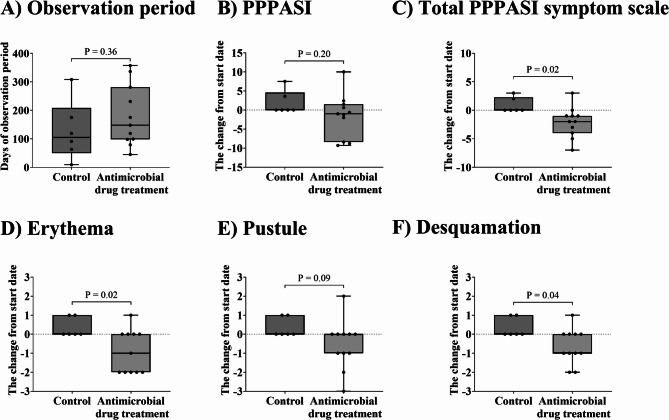 Figure 4
Peer Reviews
No public reviews on file for this paper yet. If you reviewed it on a platform where reviews are public (OpenReview, ICLR, NeurIPS, ICML), you can paste yours below so the community can read it here.
Videos
No videos yet. Explain this paper in a talk, walkthrough, or lecture? Add one.
Taxonomy
TopicsUrticaria and Related Conditions · Dermatology and Skin Diseases · Genital Health and Disease