Supporting self-managed abortion care in “practice not premise”: a qualitative study of provider perspectives, roles, and information pathways to care in India*
Laura E. Jacobson, Caila Brander, Balasubramanian Palanisamy, Sruthi Chandrasekaran, Blair G. Darney, Julia M. Goodman, Ruvani Jayaweera, Caitlin Gerdts

TL;DR
This study examines how healthcare providers in India view and support self-managed abortion, finding that while they often prefer clinician-managed care, they still play roles in providing information and support for self-managed options.
Contribution
The study provides new insights into provider roles and perspectives on self-managed abortion in India, highlighting pathways for improving reproductive health policies.
Findings
Most providers accept abortion conditionally but encourage clinician-managed care over self-managed abortion.
Providers support self-managed abortion by offering information, dispensing medication, and managing pain.
Pharmacy workers and local providers often guide individuals toward self-managed abortion care.
Abstract
This qualitative study explored provider perspectives on self-managed abortion (SMA) in India, their roles, and how they share information about pathways to both clinician- and self-managed abortion care. We conducted 33 semi-structured interviews with a range of providers (medical, community health, and pharmacy) in three states in India: Jharkhand, Bihar, and Tamil Nadu. Using thematic analysis, we examined provider perspectives on SMA, their involvement in abortion care, and how they contribute to information sharing around access pathways. We categorised findings by provider type, direction of care pathways, abortion modality (clinician-managed vs. SMA), and the kind of care delivered. Our findings showed most providers described abortion as conditionally acceptable and primarily encouraged clinician-managed care. Concerns about SMA safety and potential liability often led them to…
Genes, proteins, chemicals, diseases, species, mutations and cell lines named across the full text — each resolved to its canonical identifier and authoritative record.
Click any figure to enlarge with its caption.
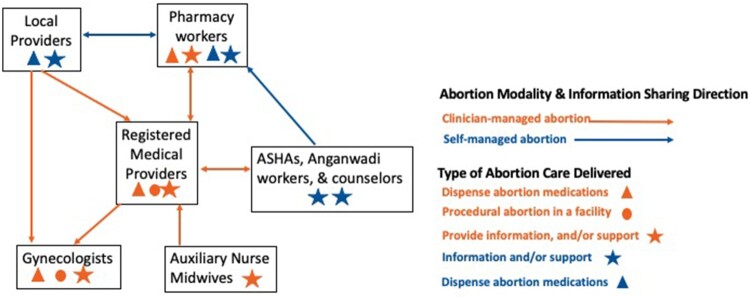 Figure 1
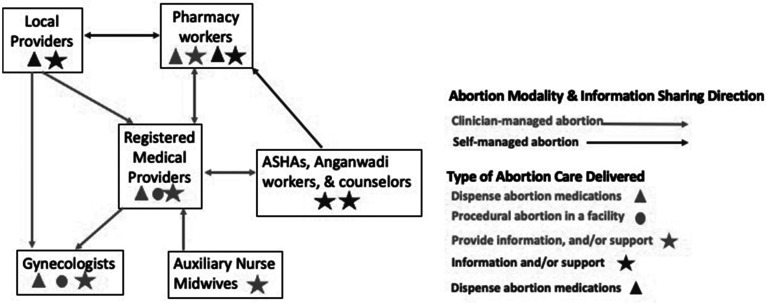 Figure 2
Peer Reviews
No public reviews on file for this paper yet. If you reviewed it on a platform where reviews are public (OpenReview, ICLR, NeurIPS, ICML), you can paste yours below so the community can read it here.
Videos
No videos yet. Explain this paper in a talk, walkthrough, or lecture? Add one.
Taxonomy
TopicsGlobal Maternal and Child Health · Reproductive Health and Contraception · Maternal and Perinatal Health Interventions