Teaching Recombinable Motifs Through Simple Examples
Huang Ham, Bonan Zhao, Thomas L. Griffiths, Natalia Vélez

TL;DR
This paper explores how teachers use simple examples to teach abstract concepts, finding that simplicity helps learners grasp underlying patterns better.
Contribution
The study introduces a pedagogical sampling model that explains how teachers select simpler examples to improve learning outcomes.
Findings
Human teachers create simpler necklaces to teach motifs, which are easier for learners to interpret.
Learners perform better when taught by human teachers compared to model-generated examples.
Simpler examples lead to better recovery of underlying motifs by learners.
Abstract
A hallmark of effective teaching is that it grants learners not just a collection of facts about the world, but also a toolkit of abstractions that can be applied to solve new problems. How do humans teach abstractions from examples? Here, we applied Bayesian models of pedagogy to a necklace‐building task where teachers create necklaces to teach a learner “motifs” that can be flexibly recombined to create new necklaces. In Experiment 1 (N = 151), we find that human teachers produce necklaces that are simpler (i.e., have lower algorithmic complexity) than would be expected by chance, as indexed by a model that samples uniformly from all necklaces that contain the target motifs. This tendency to select simpler examples is captured by a pedagogical sampling model that tries to maximize the learner's belief in the true motifs by prioritizing examples that have fewer alternative…
Genes, proteins, chemicals, diseases, species, mutations and cell lines named across the full text — each resolved to its canonical identifier and authoritative record.
Click any figure to enlarge with its caption.
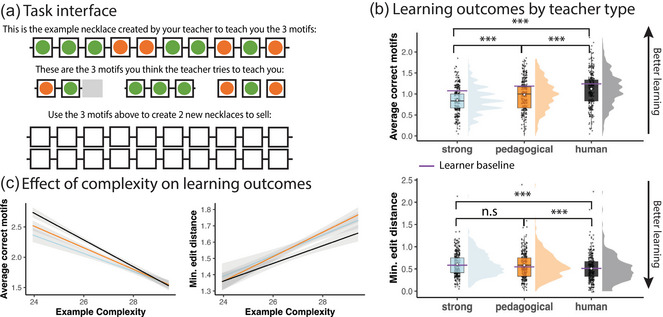 Figure 1
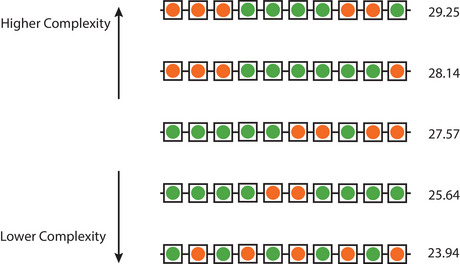 Figure 2
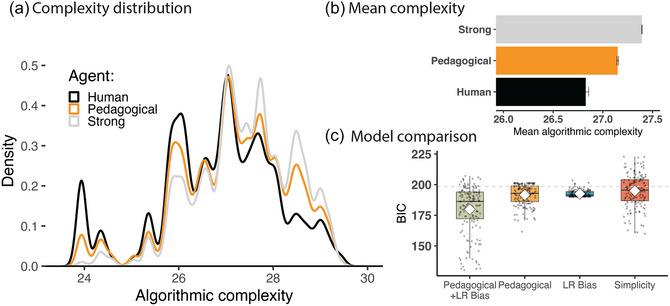 Figure 3
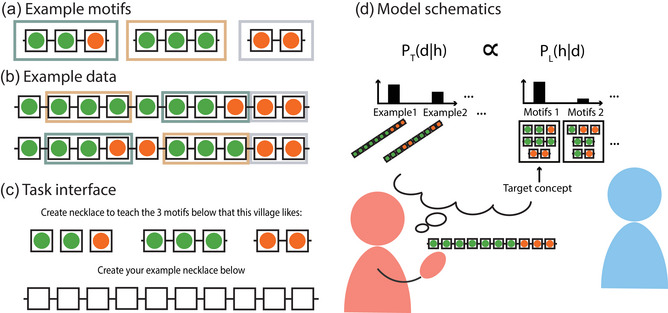 Figure 4
Peer Reviews
No public reviews on file for this paper yet. If you reviewed it on a platform where reviews are public (OpenReview, ICLR, NeurIPS, ICML), you can paste yours below so the community can read it here.
Videos
No videos yet. Explain this paper in a talk, walkthrough, or lecture? Add one.
Taxonomy
TopicsHuman Motion and Animation · Intelligent Tutoring Systems and Adaptive Learning · Visual and Cognitive Learning Processes