Regularization of electromagnetic scattering problems via the Abel integral transform
Elena Vinogradova, Paul Smith

TL;DR
This paper introduces a new method using the Abel integral transform to solve complex electromagnetic scattering problems, making numerical solutions more stable and accurate.
Contribution
The novel use of Abel integral transforms with Jacobi polynomials regularizes ill-posed scattering equations for stable numerical solutions.
Findings
Applying Abel transforms to series equations produces well-posed systems.
The method leads to stable and convergent numerical solutions with guaranteed accuracy.
Examples include scattering from slotted cylinders and shells with apertures.
Abstract
The Abel integral transform is a powerful mathematical tool for solving mixed boundary value problems for the Helmholtz and Maxwell equations. It is particularly effective for treating two- and three-dimensional electromagnetic wave scattering from cavity backed apertures. Such scattering problems give rise to dual, triple (and higher order) series and integral equations. These equations are inherently ill-posed and discretization results in ill-conditioned systems that resist stable numerical solution. Their regularization commences by representing the basis functions occurring in the equations in terms of Jacobi polynomials of a particular class. A sequence of Abel integral transforms is applied to each member of the series equations producing Jacobi polynomials of a different class. The transforms are arranged so that the resulting system is well-posed and may be converted to a…
Genes, proteins, chemicals, diseases, species, mutations and cell lines named across the full text — each resolved to its canonical identifier and authoritative record.
Click any figure to enlarge with its caption.
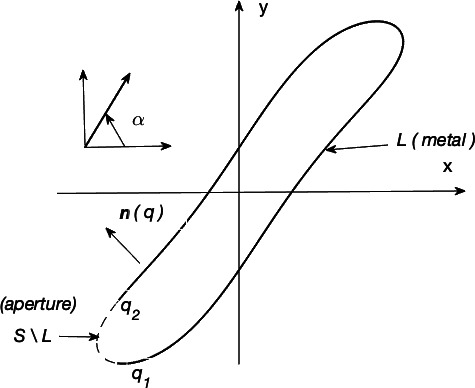 Figure 1
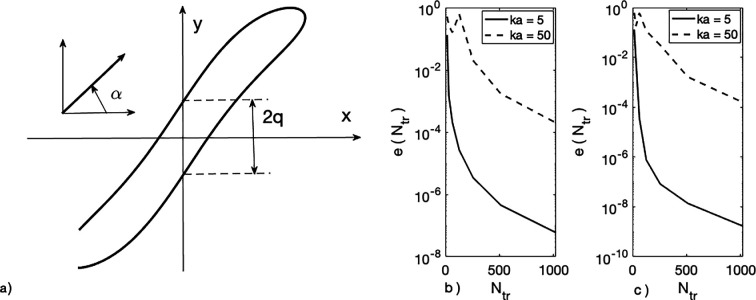 Figure 2
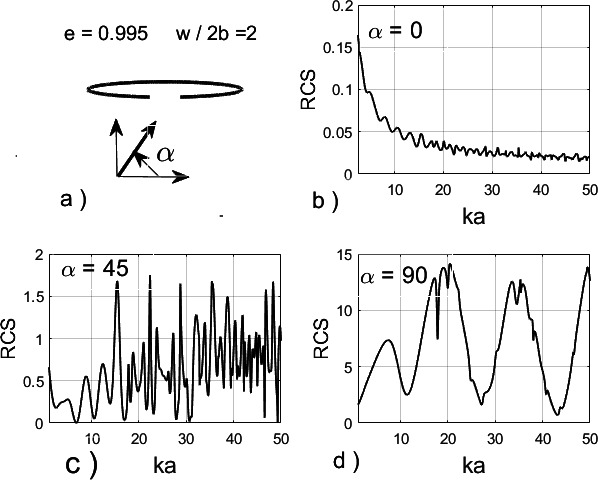 Figure 3
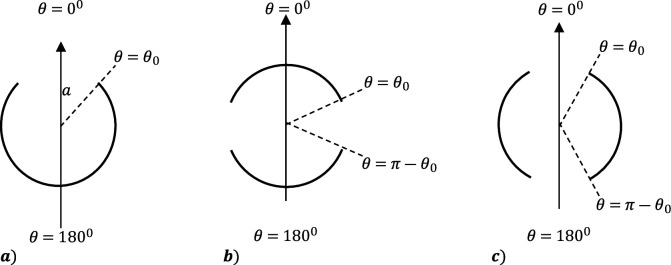 Figure 4
Peer Reviews
No public reviews on file for this paper yet. If you reviewed it on a platform where reviews are public (OpenReview, ICLR, NeurIPS, ICML), you can paste yours below so the community can read it here.
Videos
No videos yet. Explain this paper in a talk, walkthrough, or lecture? Add one.
Taxonomy
TopicsElectromagnetic Scattering and Analysis · Numerical methods in inverse problems · Microwave Imaging and Scattering Analysis