Parental reflective functioning and internalizing symptoms predict altruistic prosocial behaviour in children
Daniel McGlade, Helena Rutherford, Eamon McCrory, Nikolaus Steinbeis

TL;DR
This study shows that how parents understand their child's mental state and the child's mental health predict altruistic behavior in children over time.
Contribution
The study reveals a novel link between parental reflective functioning and child altruism, mediated by internalizing symptoms.
Findings
Parental reflective functioning was associated with child internalizing symptoms at baseline.
Higher parental reflective functioning and lower child internalizing symptoms predicted increased altruistic behavior after one year.
Mental health and caregiving experiences significantly influence prosocial behavior in children.
Abstract
Mental health has a profound impact on how we interact with the world. How it shapes prosocial behaviour during middle childhood, a period crucial for establishing healthy relationships, remains poorly understood. Moreover, whilst child mental health and prosocial behaviour are influenced by caregiving experience more broadly, less is known about how they are shaped by parental reflective functioning (PRF), that is parents' capacity to represent their child's underlying mental states. A longitudinal design, with assessments at baseline and 1 year follow‐up, was used with 233 children (111 boys; 6–13 years old; 54.9% White, 17.2% Asian, 2.58% Black, 14.2% Multiple ethnic groups, 2.58% Other, 8.58% data unavailable). Using path modelling, we examined interrelations between baseline PRF, baseline child internalizing symptoms, and follow‐up child altruistic prosocial behaviour. At baseline,…
Genes, proteins, chemicals, diseases, species, mutations and cell lines named across the full text — each resolved to its canonical identifier and authoritative record.
Click any figure to enlarge with its caption.
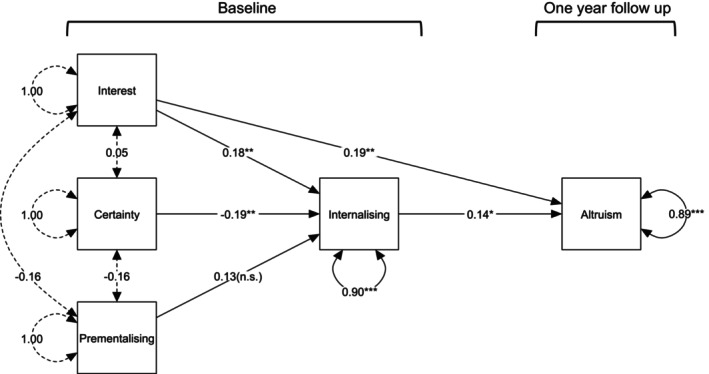 Figure 1
Peer Reviews
No public reviews on file for this paper yet. If you reviewed it on a platform where reviews are public (OpenReview, ICLR, NeurIPS, ICML), you can paste yours below so the community can read it here.
Videos
No videos yet. Explain this paper in a talk, walkthrough, or lecture? Add one.
Taxonomy
TopicsChild and Adolescent Psychosocial and Emotional Development · Attachment and Relationship Dynamics · Early Childhood Education and Development