Mobile Health Technology for Personalized Tobacco Cessation Support Among Cancer Survivors and Caregivers in Laos (Project SurvLaos): Protocol for a Pilot Randomized Controlled Trial
Phayvanh Keopaseuth, Phonepadith Xangsayarath, Shweta Kulkarni, Khatthanaphone Phandouangsy, Chanthavy Soulaphy, Phetsamone Alounlungsy, Vangnakhone Dittaphong, Dalouny Xayavong, Champadeng Vongdala, Latsamy Siengsounthone, Michael Businelle, Summer G Frank-Pearce

TL;DR
This study tests a mobile health app to help cancer survivors and caregivers in Laos quit smoking, aiming to improve health outcomes and reduce tobacco-related risks.
Contribution
The study introduces a mobile health-based automated treatment program tailored for Lao cancer survivors and caregivers, a population with no existing tobacco cessation programs.
Findings
The trial will assess feasibility through message delivery rates and participant retention.
Preliminary efficacy will be measured by 7-day point prevalence abstinence at 3 months.
Qualitative insights will explore factors influencing smoking cessation success or failure.
Abstract
Tobacco use remains a major cause of preventable deaths and evidence suggests that smoking cessation offers considerable benefits for patients with and survivors of cancer. In the Lao People’s Democratic Republic (Lao PDR), approximately 60% of male patients and 15% of female patients with cancer smoke cigarettes. Nevertheless, there is no tobacco treatment program for this population. This pilot randomized controlled trial (RCT) aims to evaluate the feasibility and preliminary efficacy of our mobile health–based automated treatment (AT) program to help Lao cancer survivors and caregivers quit smoking cigarettes. We used an intervention mixed methods research design, which included a pilot 2-group interventional RCT and an embedded qualitative component to explain RCT outcomes. In the pilot RCT, cancer survivors or caregivers (n=80, no dyads) who smoked were recruited from national…
Genes, proteins, chemicals, diseases, species, mutations and cell lines named across the full text — each resolved to its canonical identifier and authoritative record.
Click any figure to enlarge with its caption.
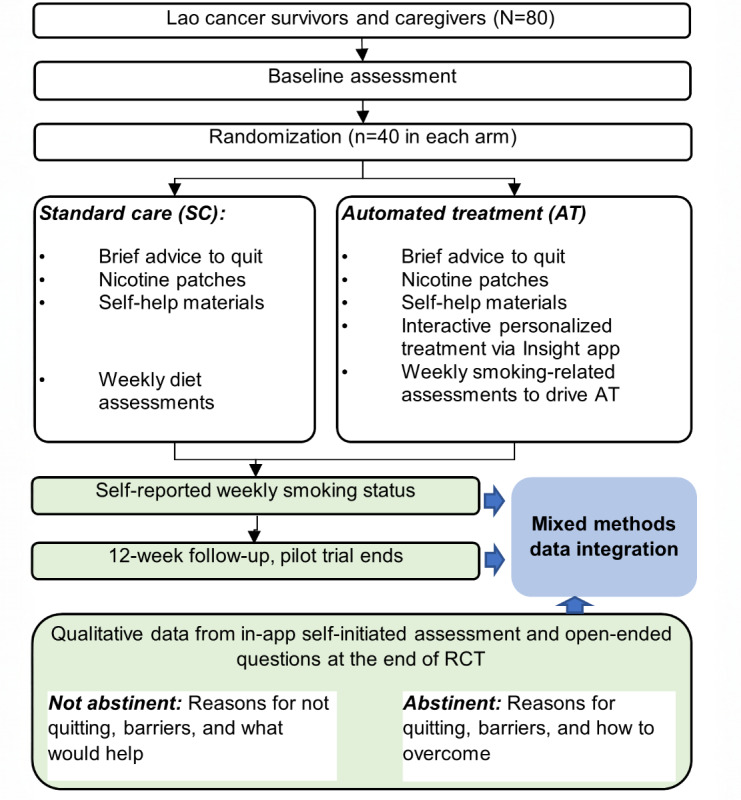 Figure 1
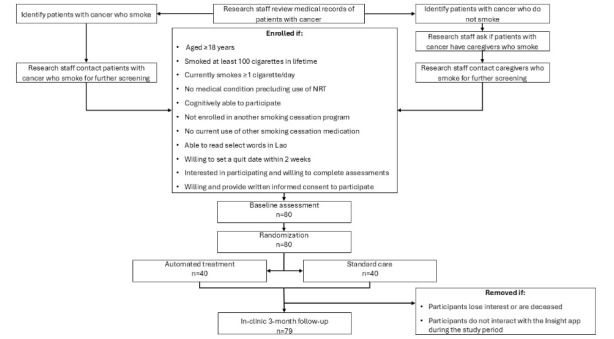 Figure 2
Peer Reviews
No public reviews on file for this paper yet. If you reviewed it on a platform where reviews are public (OpenReview, ICLR, NeurIPS, ICML), you can paste yours below so the community can read it here.
Videos
No videos yet. Explain this paper in a talk, walkthrough, or lecture? Add one.
Taxonomy
TopicsMobile Health and mHealth Applications · Chronic Obstructive Pulmonary Disease (COPD) Research