High-frequency rTMS as a first-line treatment for gambling disorder – A case report
Carmen Concerto, Fabrizio Bella, Cecilia Chiarenza, Ilenia White, Raffaele Micieli, Saverio Madonia, Stefania Lanzafame, Riccardo Spigarelli, Vera Pagano, Cristiano Cutuli, Fabio Brogna, Pasquale Caponnetto, Alessandro Rodolico, Maria Salvina Signorelli, Antonino Petralia

TL;DR
High-frequency rTMS was used to treat gambling disorder and significantly reduced symptoms like craving and anxiety without side effects.
Contribution
This is the first case report using high-frequency rTMS as a first-line treatment for gambling disorder.
Findings
rTMS reduced gambling severity score from 20.5 to 2.0 over three months.
Craving levels dropped from 85 to 15 on the Visual Analog Scale.
Improvements in emotional stability and extroversion were observed without cognitive side effects.
Abstract
•High-frequency rTMS was used as a first-line treatment for Gambling Disorder (GD).•rTMS significantly reduced craving, impulsivity, anxiety, and depressive symptoms.•Clinical improvements were maintained at 3-month follow-up without adverse effects.•rTMS enhanced emotional stability and extroversion without cognitive side effects.•This case supports rTMS as a safe, effective, non-pharmacological treatment for GD. High-frequency rTMS was used as a first-line treatment for Gambling Disorder (GD). rTMS significantly reduced craving, impulsivity, anxiety, and depressive symptoms. Clinical improvements were maintained at 3-month follow-up without adverse effects. rTMS enhanced emotional stability and extroversion without cognitive side effects. This case supports rTMS as a safe, effective, non-pharmacological treatment for GD. Gambling Disorder is a chronic and debilitating condition,…
Genes, proteins, chemicals, diseases, species, mutations and cell lines named across the full text — each resolved to its canonical identifier and authoritative record.
Click any figure to enlarge with its caption.
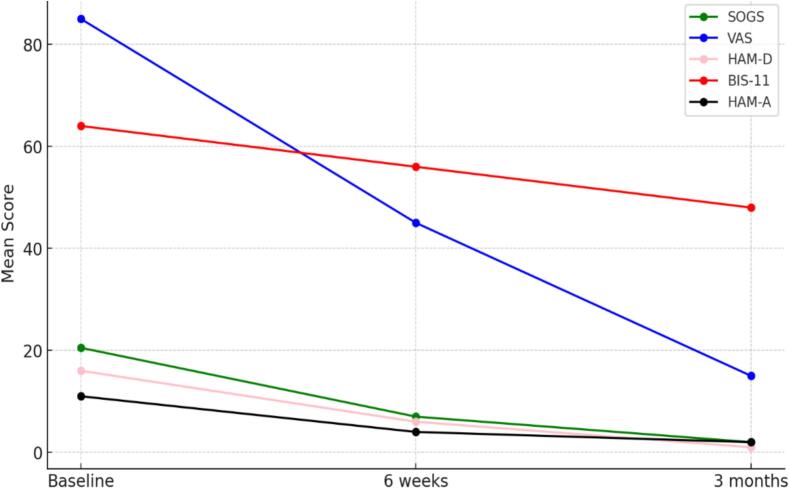 Figure 1
Peer Reviews
No public reviews on file for this paper yet. If you reviewed it on a platform where reviews are public (OpenReview, ICLR, NeurIPS, ICML), you can paste yours below so the community can read it here.
Videos
No videos yet. Explain this paper in a talk, walkthrough, or lecture? Add one.
Taxonomy
TopicsTranscranial Magnetic Stimulation Studies · Obsessive-Compulsive Spectrum Disorders · Advanced Neuroimaging Techniques and Applications