A comprehensive analysis of the role of stem cell transplantation in mantle cell lymphoma: real-world data from the Korean Society of Blood and Marrow Transplantation registry: Stem cell transplantation outcomes in mantle cell lymphoma
Dong Won Baek, Joon Ho Moon, Jae Hoon Lee, Ka-Won Kang, Ho Sup Lee, Hyeon-Seok Eom, Eunyoung Lee, Ji Hyun Lee, Jeong-Ok Lee, Seong Kyu Park, Seok Jin Kim, Youngil Koh, Jong-Ho Won, Jung-Hee Lee, Joon Seong Park, Jae-Cheol Jo, Yeung-Chul Mun, Deok-Hwan Yang, Ga-Young Song

TL;DR
This study uses real-world data to compare the effectiveness of autologous and allogeneic stem cell transplants in treating mantle cell lymphoma.
Contribution
The study provides real-world evidence on stem cell transplantation outcomes in MCL using a Korean registry.
Findings
Autologous and allogeneic SCT showed similar 3-year progression-free and overall survival rates in MCL patients.
Allogeneic transplants with HLA-matched donors improved outcomes for refractory MCL patients.
Auto-SCT was more beneficial for patients in remission after salvage therapy.
Abstract
Stem cell transplantation (SCT) has historically played a major role in the long-term remission of mantle cell lymphoma (MCL), an incurable hematological malignancy. Using data from the Korean Society of Bone and Marrow Transplantation registry, we retrospectively analyzed the role of autologous (auto) and allogeneic (allo) SCT in long-term MCL survival. This study analyzed data from 188 patients (age ≥ 19 years at the time of transplantation) who underwent a transplant for MCL from 2011 to 2020. Progression-free survival (PFS) was defined as the time from transplantation to disease progression, relapse, or death from any cause. Overall survival (OS) was defined as the time from transplantation to death from any cause or the last follow-up. In total, 109 patients underwent consolidative SCT after first-line chemotherapy. The 3-year PFS and OS rates were 65.4% and 78.5%, respectively,…
Genes, proteins, chemicals, diseases, species, mutations and cell lines named across the full text — each resolved to its canonical identifier and authoritative record.
Click any figure to enlarge with its caption.
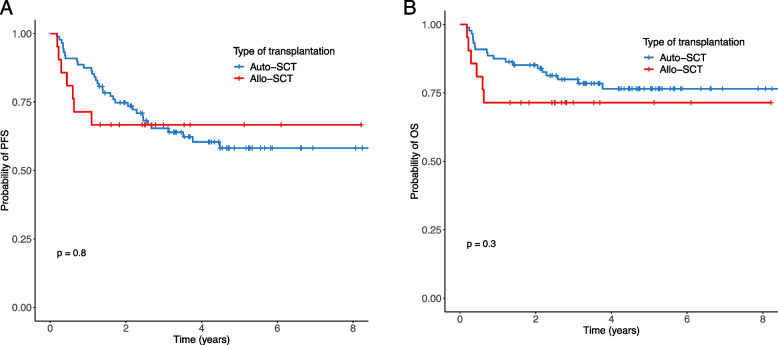 Figure 1
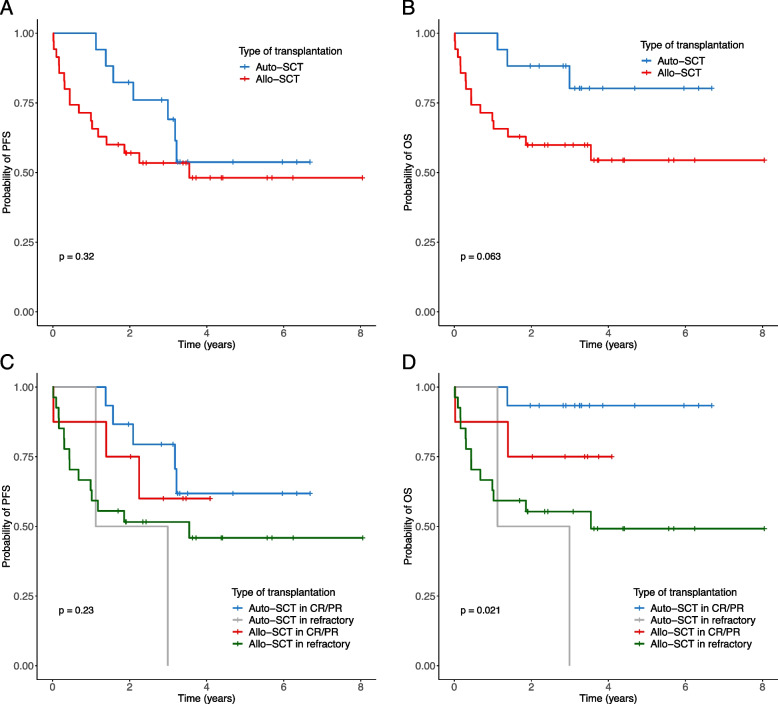 Figure 2
Peer Reviews
No public reviews on file for this paper yet. If you reviewed it on a platform where reviews are public (OpenReview, ICLR, NeurIPS, ICML), you can paste yours below so the community can read it here.
Videos
No videos yet. Explain this paper in a talk, walkthrough, or lecture? Add one.
Taxonomy
TopicsLymphoma Diagnosis and Treatment · Viral-associated cancers and disorders · Vascular Tumors and Angiosarcomas