Do we need two hammers in our toolbox? An empirical note about the potential redundancy of measuring subjective quality of life
Otto R. F. Smith, Marit Knapstad, Leif Edvard Aarø

TL;DR
This study examines if measuring subjective quality of life and psychological distress are redundant for university students.
Contribution
The study provides empirical evidence suggesting potential redundancy between SQoL and distress measures.
Findings
SQoL and PHQ-2/HSCL-5 showed similar psychometric properties.
Associations with baseline correlates were similar across measures.
Using SQoL alongside PHQ-2 or HSCL-5 may be redundant.
Abstract
Scales for the measurement of subjective quality of life (SQoL) and psychological distress are often used as if they measure different underlying concepts. This assumption is addressed in the present study by examining the discriminant validity between a set of items measuring SQoL and both the 2-item version of the Patient Health Questionnaire (PHQ-2) and the 5-item version of the Hopkins Symptom Checklist (HSCL-5). The present study is based on baseline data (n = 1,599) collected as part of the Students’ Psychological Health Over Time (SPOT) study, conducted among Norwegian university students. Data were examined by means of a bifactor analytical framework. The SQoL instrument was compared in separate analyses against the PHQ-2 and the HSCL-5. Psychometric indices derived from the bi-factor model suggested that the SQoL instrument and the PHQ-2/HSCL-5 were essentially…
Genes, proteins, chemicals, diseases, species, mutations and cell lines named across the full text — each resolved to its canonical identifier and authoritative record.
Click any figure to enlarge with its caption.
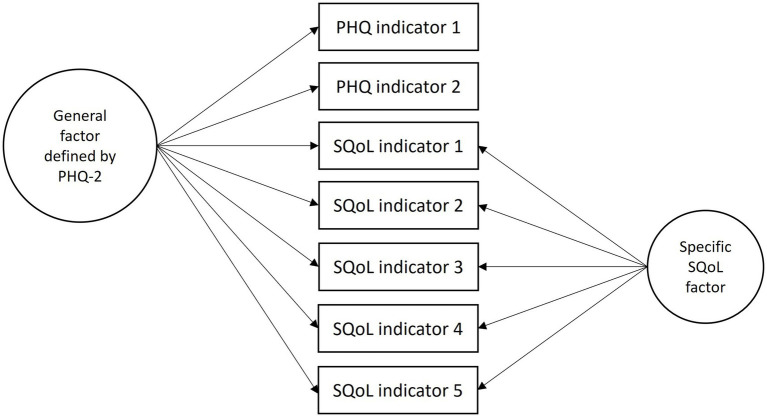 Figure 1
Peer Reviews
No public reviews on file for this paper yet. If you reviewed it on a platform where reviews are public (OpenReview, ICLR, NeurIPS, ICML), you can paste yours below so the community can read it here.
Videos
No videos yet. Explain this paper in a talk, walkthrough, or lecture? Add one.
Taxonomy
TopicsPsychological Well-being and Life Satisfaction · Health disparities and outcomes · Optimism, Hope, and Well-being