Food hoarders and non-hoarders in Paridae – a cognition perspective
Anders Brodin

TL;DR
This paper explores the different winter survival strategies and cognitive abilities of hoarding and non-hoarding parid birds.
Contribution
It highlights a cognitive trade-off between spatial memory in hoarders and innovation in non-hoarders within the Paridae family.
Findings
Hoarder parids have larger hippocampi and excel in spatial memory.
Non-hoarding parids like great tits are innovative foragers in human-modified habitats.
Chickadees in North America show similar problem-solving skills to European great tits.
Abstract
Parids are well-known birds both in Europe and North America. Despite being arboreal foragers of similar size, there is a striking dichotomy in the wintering strategies in the family. Most species are food hoarding specialists that store large amounts of winter food in autumn. A small stable group will then defend a large winter territory in which they store food. From a cognition perspective these species are spatial memory specialists with the volume of the hippocampus, a brain structure that is important for spatial memorization, correlating to the degree of specialisation for food hoarding. The wintering strategy in non-hoarding parids, the Eurasian great and blue tits, and species that are closely related to these, is very different. They are generalist foragers that have adapted especially well to anthropogenic habitats such as gardens and city parks. The great tit stands out as…
Genes, proteins, chemicals, diseases, species, mutations and cell lines named across the full text — each resolved to its canonical identifier and authoritative record.
Click any figure to enlarge with its caption.
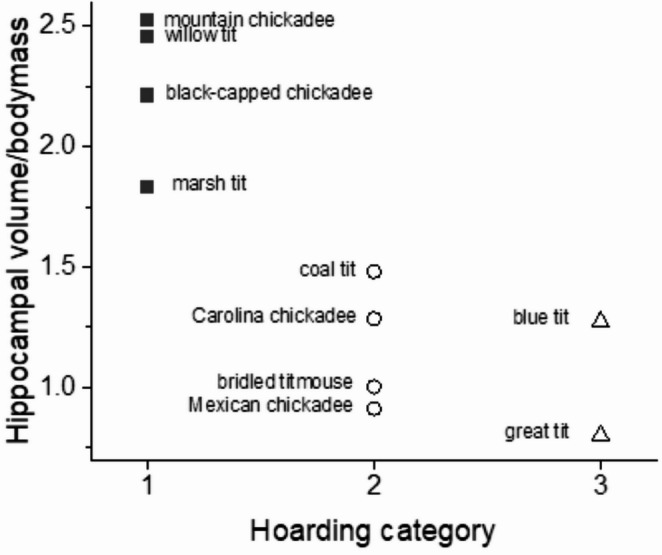 Figure 1
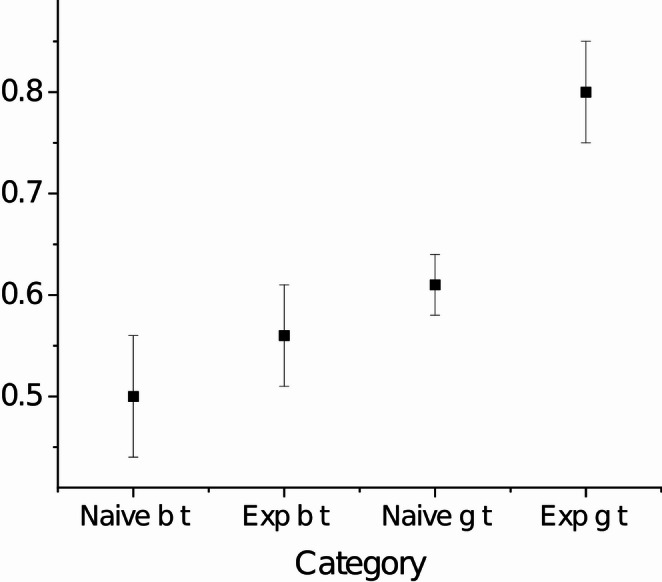 Figure 2
Peer Reviews
No public reviews on file for this paper yet. If you reviewed it on a platform where reviews are public (OpenReview, ICLR, NeurIPS, ICML), you can paste yours below so the community can read it here.
Videos
No videos yet. Explain this paper in a talk, walkthrough, or lecture? Add one.
Taxonomy
TopicsPrimate Behavior and Ecology · Animal Vocal Communication and Behavior · Hemispheric Asymmetry in Neuroscience