No evidence for paradoxical effects of tocilizumab in rodents
Christoph Garbers

TL;DR
This paper challenges claims that tocilizumab has paradoxical effects in rodents, arguing that the findings are inconsistent with known IL-6 biology.
Contribution
The paper provides a critical analysis refuting paradoxical effects of tocilizumab in rodent models based on established IL-6 biology.
Findings
The results from Weng and colleagues are not compatible with known IL-6 biology.
The evidence provided is insufficient to support paradoxical effects of tocilizumab in rodents.
Abstract
Interleukin-6 (IL-6) is a multifunctional cytokine with important functions in health and disease. In order to activate its target cells, IL-6 binds first to the IL-6 receptor (IL-6R), which in turn induces the recruitment and homodimerization of the signal-transducing β-receptor gp130 and the activation of intracellular signaling cascades, including the phosphoinositide 3-kinase (PI3K)-AKT cascade. IL-6 is involved in the pathogenesis of multiple inflammatory diseases, and tocilizumab, a monoclonal antibody that binds to the IL-6R and thus blocks the biological activities of IL-6, is in clinical use worldwide for the treatment of patients with inflammatory diseases, including rheumatoid arthritis. Recently, Weng and colleagues published a paper in Naunyn–Schmiedeberg’s Archives of Pharmacology describing paradoxical effects of tocilizumab when used on murine cells in vitro and in a rat…
Genes, proteins, chemicals, diseases, species, mutations and cell lines named across the full text — each resolved to its canonical identifier and authoritative record.
Click any figure to enlarge with its caption.
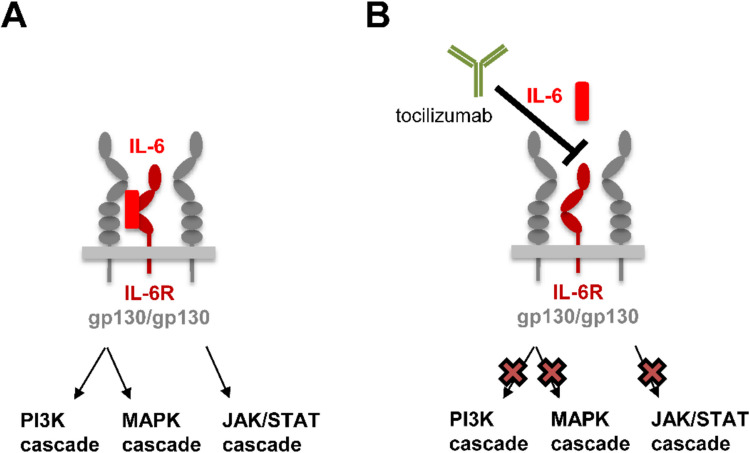 Figure 1
Peer Reviews
No public reviews on file for this paper yet. If you reviewed it on a platform where reviews are public (OpenReview, ICLR, NeurIPS, ICML), you can paste yours below so the community can read it here.
Videos
No videos yet. Explain this paper in a talk, walkthrough, or lecture? Add one.
Taxonomy
TopicsCytokine Signaling Pathways and Interactions · Immune Response and Inflammation · interferon and immune responses