Exploration of neuroprotective strategies in patients with acute promyelocytic leukemia complicated by cerebral hemorrhage
Jing Hu, Wentao Lai

TL;DR
This paper explores how neuroprotective strategies can help patients with a severe type of leukemia who experience brain bleeding.
Contribution
The paper reviews and analyzes neuroprotective strategies for APL patients with cerebral hemorrhage, highlighting their potential clinical benefits.
Findings
Neuroprotective strategies may improve prognosis in APL patients with cerebral hemorrhage.
These strategies can reduce neurological damage and promote recovery.
The paper provides guidance for future clinical practice and research.
Abstract
Acute promyelocytic leukemia (APL) is a highly lethal hematological malignancy associated with various complications, among which cerebral hemorrhage is one of the most severe. Implementing effective neuroprotective strategies for APL patients experiencing cerebral hemorrhage is crucial. This article aims to explore the application of neuroprotective strategies in these patients, analyzing their mechanisms, clinical efficacy, and future research directions. By reviewing existing literature, we reveal the potential of neuroprotective strategies to improve prognosis, reduce neurological damage, and promote recovery, thereby providing guidance for clinical practice.
Genes, proteins, chemicals, diseases, species, mutations and cell lines named across the full text — each resolved to its canonical identifier and authoritative record.
Click any figure to enlarge with its caption.
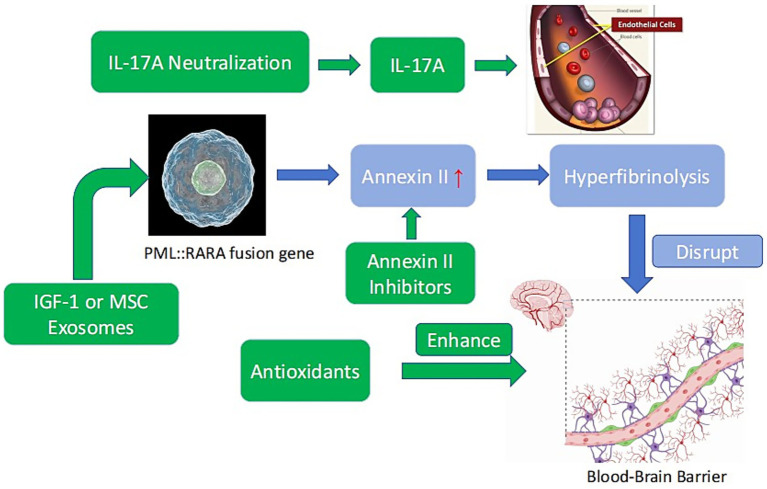 Figure 1
Peer Reviews
No public reviews on file for this paper yet. If you reviewed it on a platform where reviews are public (OpenReview, ICLR, NeurIPS, ICML), you can paste yours below so the community can read it here.
Videos
No videos yet. Explain this paper in a talk, walkthrough, or lecture? Add one.
Taxonomy
TopicsRetinoids in leukemia and cellular processes · Antioxidant Activity and Oxidative Stress · Glioma Diagnosis and Treatment