Impact of thromboplastin reagents on monitoring INR in a patient with triple-positive antiphospholipid syndrome: a case report
Lóránt Varju, Zsuzsa Bagoly, Éva Ajzner, Rita Orbán-Kálmándi, Anna Zsófia Kádár, Judit Nevelős, Péter Ilonczai

TL;DR
A patient with a severe autoimmune condition had inconsistent blood clotting measurements due to antibody interference, and using a specific type of reagent improved monitoring accuracy.
Contribution
Demonstrates that rabbit brain-derived thromboplastin provides more reliable INR monitoring in patients with high antiphospholipid antibody titers.
Findings
Recombinant thromboplastin produced higher and less reliable INR values in high APA-titer conditions.
Chromogenic FXa activity aligned better with INR values from rabbit brain-derived thromboplastin.
Rabbit brain-derived thromboplastin is less sensitive to APA interference and more suitable for monitoring anticoagulation in high-risk APS patients.
Abstract
Antiphospholipid syndrome (APS) is an autoimmune disease characterized by a hypercoagulable state and recurrent thromboembolism (TE). Patients with triple-positive antiphospholipid antibodies (APAs) are at the highest risk of TE. As standard treatment for these patients, oral anticoagulation therapy (OAT) with vitamin K antagonists (VKAs) is widely used, but inaccurate International Normalized Ratio (INR) measurement due to APA interference can complicate monitoring. Here we report the case of a 19-year-old male patient, with a history of submassive pulmonary embolism at the age of 13. Thrombophilia investigations confirmed type II antithrombin deficiency (Budapest 3 heterozygous) combined with triple-positive APS. He received sustained VKA (warfarin) therapy, but his INR values showed strikingly different results when monitored in two different laboratories (INR 3–4 vs. INR >8 on…
Genes, proteins, chemicals, diseases, species, mutations and cell lines named across the full text — each resolved to its canonical identifier and authoritative record.
Click any figure to enlarge with its caption.
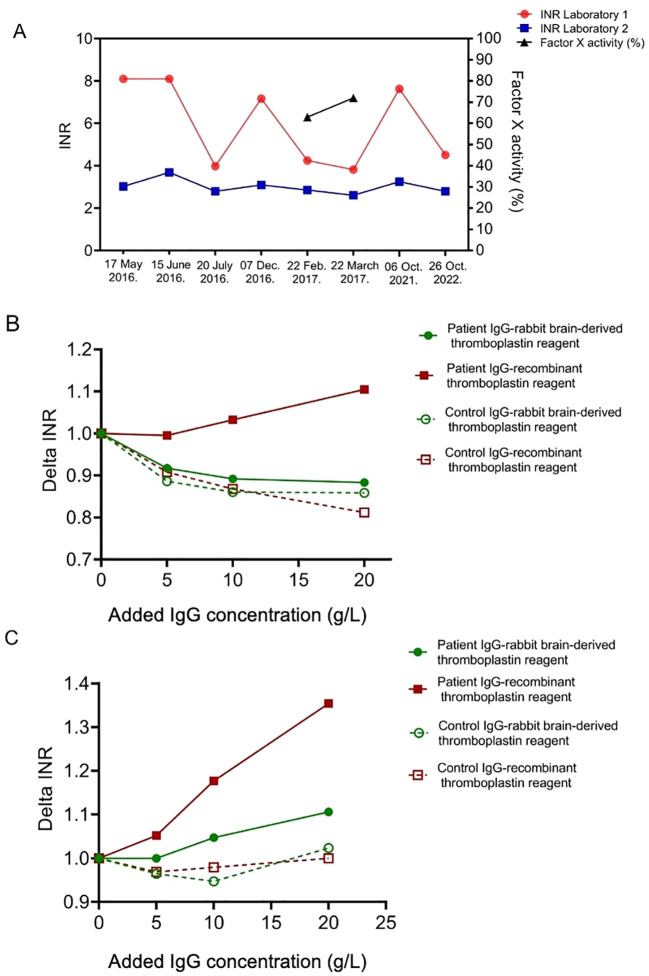 Figure 1
Peer Reviews
No public reviews on file for this paper yet. If you reviewed it on a platform where reviews are public (OpenReview, ICLR, NeurIPS, ICML), you can paste yours below so the community can read it here.
Videos
No videos yet. Explain this paper in a talk, walkthrough, or lecture? Add one.
Taxonomy
TopicsSystemic Lupus Erythematosus Research · Platelet Disorders and Treatments · Blood disorders and treatments