New insights into Wiskott-Aldrich syndrome: ten novel WAS mutations and their clinical impact in a Brazilian cohort
Lucas W. Santos, Samuel S. Medina, Jéssica O. Frade-Guanaes, Lúcia H. Siqueira, Luiz Gustavo R. de Lima, Bruna Chati, Marcos T. Nolasco da Silva, Adriana G. L. Riccetto, Paula Lyra, Ana Carla A. M. Falcão, Pedro P. A. Santos, Regina S. W. Di Gesu, Bianca Stefanello

TL;DR
This study identifies 10 new genetic mutations in Brazilian patients with Wiskott-Aldrich Syndrome and explores how these mutations relate to disease severity and clinical outcomes.
Contribution
The study reports 10 novel WAS gene mutations and highlights the complex genotype-phenotype correlation in a Brazilian cohort.
Findings
Genomic sequencing identified 17 WAS gene variants, 10 of which were previously unknown.
Frameshift indels in exon 10 were the most common mutations, often leading to premature stop codons.
Disease severity varied among patients with similar mutations, emphasizing the complexity of genotype-phenotype relationships.
Abstract
Wiskott-Aldrich Syndrome (WAS) is a rare and severe X-linked immunodeficiency disorder characterized by microthrombocytopenia, eczema, and increased susceptibility to infections, autoimmunity, and malignancies. This study aims to explore molecular changes in the WAS gene in Brazilian patients and assess their correlation with clinical manifestations and disease severity. Thirty-one patients from 27 families with thrombocytopenia suspected to have WAS or X-linked thrombocytopenia (XLT) were analyzed. Clinical evaluation, cell morphology analysis, and flow cytometry (when feasible) were performed. DNA samples underwent direct sequencing to identify WAS gene mutations. Genomic sequencing identified 17 WAS gene variants, 10 of which were novel, expanding the genetic diversity of the disorder. The most frequent WAS gene variants were primarily frameshift indels that introduced premature…
Genes, proteins, chemicals, diseases, species, mutations and cell lines named across the full text — each resolved to its canonical identifier and authoritative record.
Click any figure to enlarge with its caption.
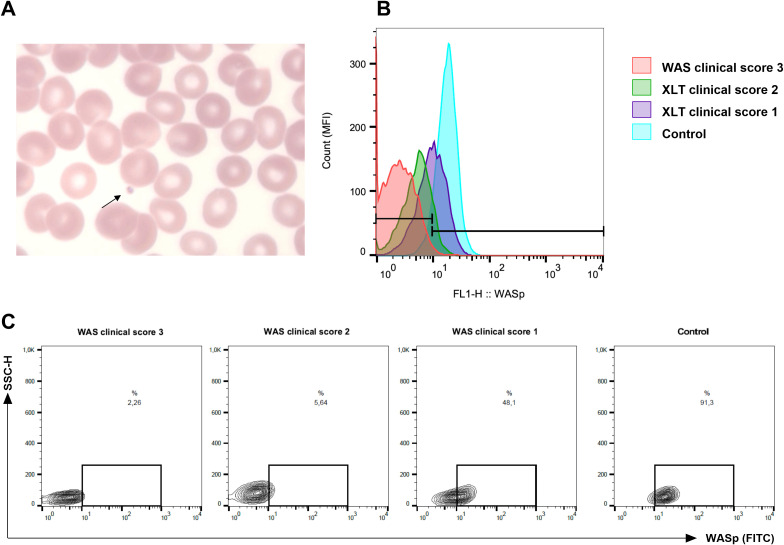 Figure 1
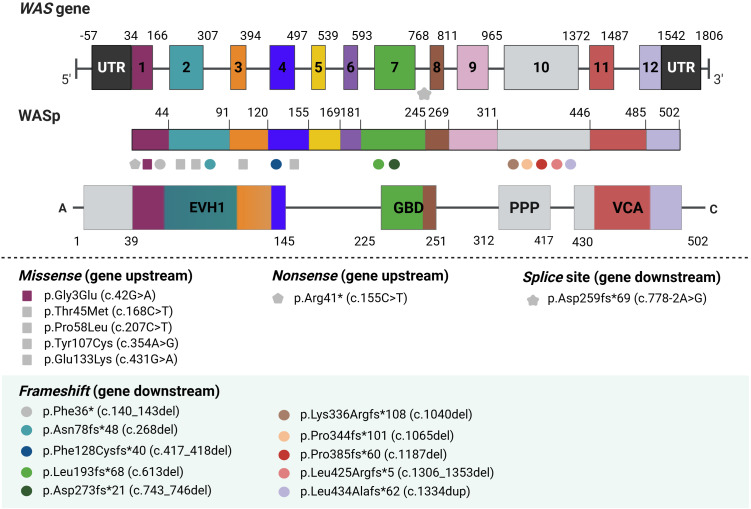 Figure 2
Peer Reviews
No public reviews on file for this paper yet. If you reviewed it on a platform where reviews are public (OpenReview, ICLR, NeurIPS, ICML), you can paste yours below so the community can read it here.
Videos
No videos yet. Explain this paper in a talk, walkthrough, or lecture? Add one.
Taxonomy
TopicsCell Adhesion Molecules Research · Platelet Disorders and Treatments · Immunodeficiency and Autoimmune Disorders