Molecular diagnosis of trypanosomatids in Didelphis marsupialis reveals risk areas for Trypanosoma cruzi transmission and sympatric circulation with T. rangeli in the metropolitan area of Bucaramanga, Santander, Colombia
Jeiczon Elim Jaimes-Dueñez, Vladimir Quintero-Sánchez, Andrea Ardila-Gélvez, Luz H. Patiño, Carlos M. Ospina, Ángela Patricia Jiménez-Leaño, Ian Sebastián Murcia-Cueto, Juan David Ramírez

TL;DR
Wild opossums in Colombia's Bucaramanga area show T. cruzi and T. rangeli infections, highlighting risks for Chagas disease transmission.
Contribution
Identifies sympatric circulation of T. cruzi and T. rangeli in opossums and confirms an enzootic transmission cycle in urban areas.
Findings
14.3% of opossums tested positive for trypanosomatids, including T. cruzi DTU TcI and T. rangeli.
T. cruzi infections were concentrated in peripheral neighborhoods adjacent to forested areas.
Co-infection with T. cruzi and T. rangeli was observed in one opossum.
Abstract
The adaptation of wild animals to urban environments can lead to increased contact with humans and a higher risk of exposure to zoonotic agents. Didelphis marsupialis (common opossum) is an important reservoir of Trypanosoma cruzi and Leishmania spp., which commonly affect human populations in Latin America. Therefore, this study aimed to assess the frequency of trypanosomatid infections and characterize T. cruzi DTUs in common opossums from the Metropolitan Area of Bucaramanga (MAB), Santander, Colombia. A total of 70 individuals from four municipalities (Bucaramanga, Floridablanca, Girón, and Piedecuesta) were analyzed by PCR using blood samples, of which 14.3 % (95 % CI: 7.95–24.3 %) tested positive for trypanosomatids. Next-generation sequencing of 18S and Hsp70 genes in positive samples identified T. cruzi DTU TcI and T. rangeli in nine (12.9 %, 95 % CI: 6.91–22.66 %) and two (2.86…
Genes, proteins, chemicals, diseases, species, mutations and cell lines named across the full text — each resolved to its canonical identifier and authoritative record.
Click any figure to enlarge with its caption.
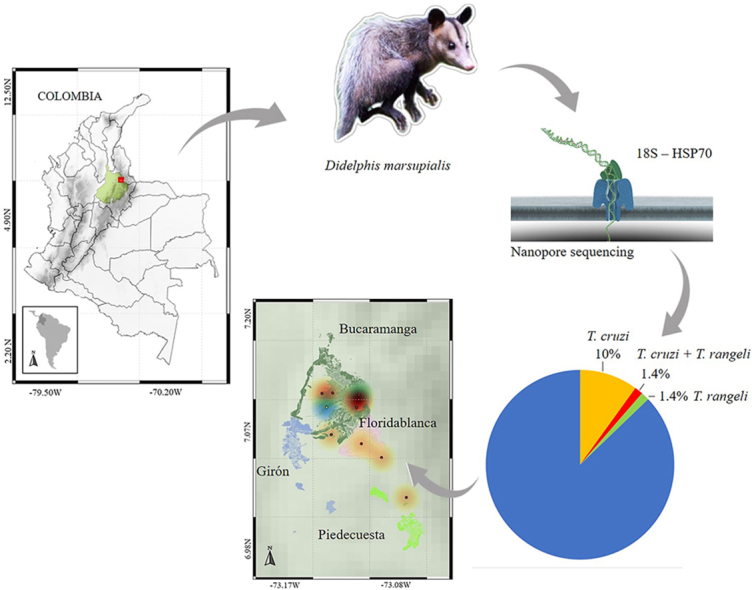 Figure 1
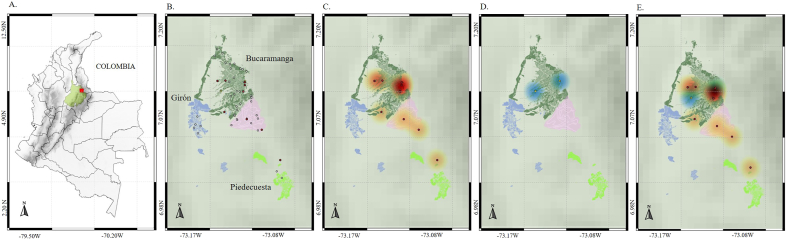 Figure 2
Peer Reviews
No public reviews on file for this paper yet. If you reviewed it on a platform where reviews are public (OpenReview, ICLR, NeurIPS, ICML), you can paste yours below so the community can read it here.
Videos
No videos yet. Explain this paper in a talk, walkthrough, or lecture? Add one.
Taxonomy
TopicsTrypanosoma species research and implications · Research on Leishmaniasis Studies · Insect symbiosis and bacterial influences