Methods Established for EPSPS Gene Mutation Detection in Glyphosate-Resistant Rice (Oryza sativa L.)
Xiuping Chen, Huilin Yu, Chunmeng Huang, Chenhui Hou, Haoyuan Guan, Jiajian Xie

TL;DR
This paper introduces five methods to detect EPSPS gene mutations in glyphosate-resistant rice, enabling accurate mutation identification and large-scale screening.
Contribution
The study establishes a comprehensive set of methods for detecting EPSPS gene mutations with varying sensitivities and applications.
Findings
Five methods (Sanger, NGS, AS-PCR, qPCR, BDA) effectively detect EPSPS mutations with sensitivities ranging from 0.01% to 10%.
Sanger, NGS, and BDA are suitable for precise mutation site characterization, while AS-PCR and qPCR are better for large-scale screening.
The methods provide technical support for safety regulations and intellectual property protection in glyphosate-resistant rice.
Abstract
“Rundao118” is a glyphosate-resistant rice; it contains both endogenous wild and mutated 5-enolpyruvylshikimate-3-phosphate synthase (EPSPS) genes. Conventional qualitative and quantitative detection methods face significant challenges for direct analysis. Here, we describe five detection methods for identifying EPSPS mutations in this rice line: (1) polymerase chain reaction (PCR) amplification-based Sanger sequencing, (2) next-generation sequencing (NGS) based on PCR amplification, (3) allele-specific PCR (AS-PCR), (4) real-time fluorescent quantitative PCR (qPCR), and (5) blocker displacement amplification (BDA). All five methods effectively identified EPSPS mutations, with the following detection sensitivities: Sanger, 10%; NGS, 1%; AS-PCR, 0.05%; qPCR, 0.01%; and BDA, 0.1%. Among these, the Sanger, NGS, and BDA methods excelled at the rapid identification of single-nucleotide…
Genes, proteins, chemicals, diseases, species, mutations and cell lines named across the full text — each resolved to its canonical identifier and authoritative record.
Click any figure to enlarge with its caption.
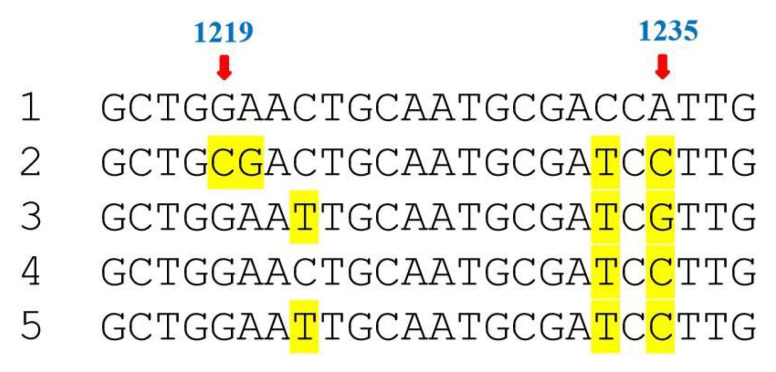 Figure 1
 Figure 2
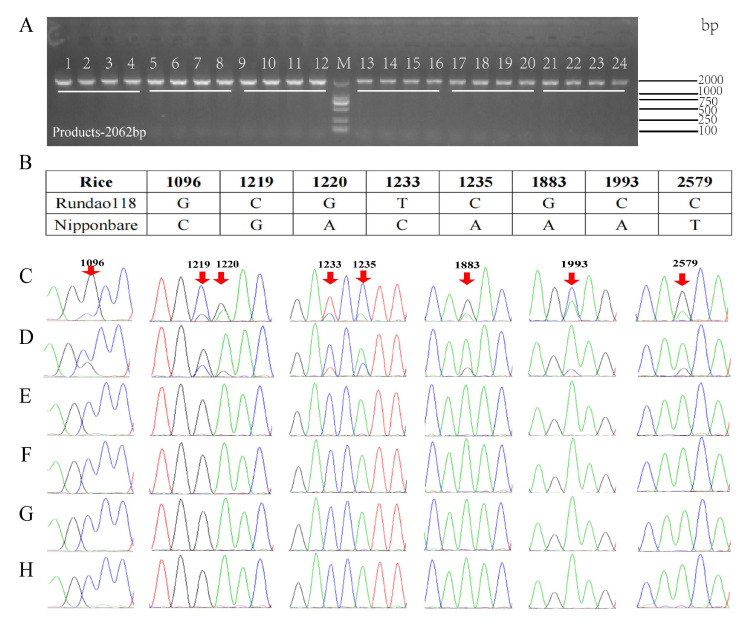 Figure 3
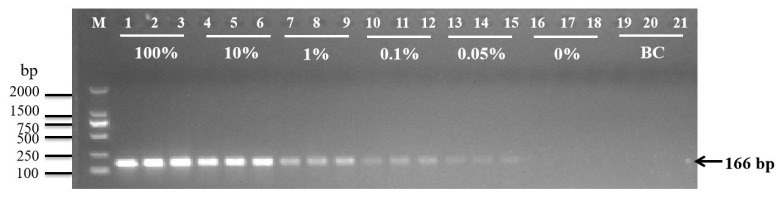 Figure 4
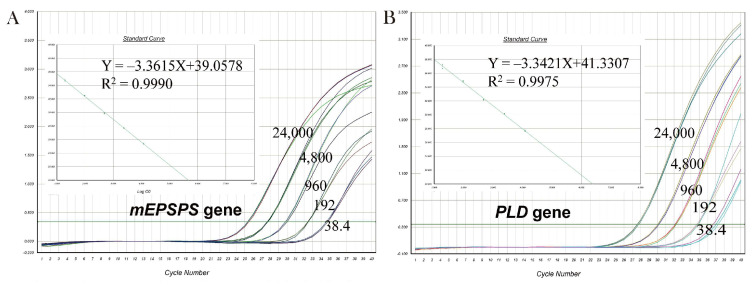 Figure 5
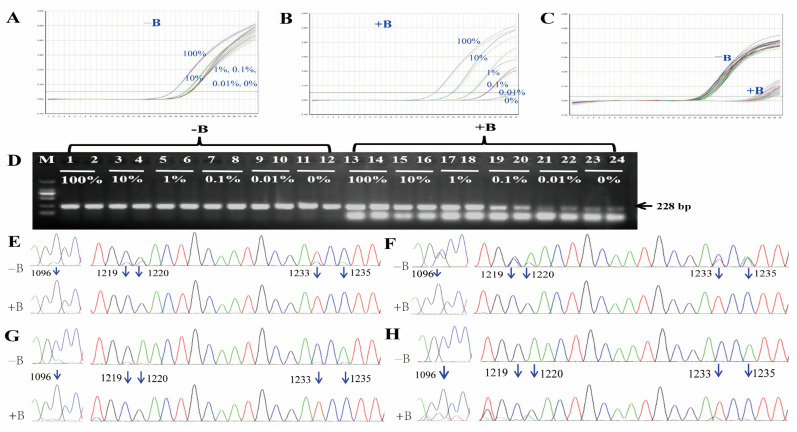 Figure 6
Peer Reviews
No public reviews on file for this paper yet. If you reviewed it on a platform where reviews are public (OpenReview, ICLR, NeurIPS, ICML), you can paste yours below so the community can read it here.
Videos
No videos yet. Explain this paper in a talk, walkthrough, or lecture? Add one.
Taxonomy
TopicsCRISPR and Genetic Engineering · Plant Virus Research Studies · Plant tissue culture and regeneration