RNA-Seq Identification of Peanut Callus-Specific Promoters and Evaluation of Base-Editing Efficiency
Lulu Xue, Han Liu, Huanhuan Zhao, Pengyu Qu, Xiaona Li, Xiaobo Wang, Bingyan Huang, Ziqi Sun, Suoyi Han, Xiaodong Dai, Wenzhao Dong, Lei Shi, Xinyou Zhang

TL;DR
This paper identifies peanut callus-specific promoters that can limit CRISPR gene-editing activity to specific plant stages, improving biosafety and reducing unintended effects.
Contribution
The study discovers and validates new callus-specific promoters in peanut for precise CRISPR base editing.
Findings
Five peanut callus-specific promoters were identified and confirmed to be functional in callus tissue.
These promoters enabled cytosine base editing with comparable or higher efficiency than the cauliflower mosaic virus 35S promoter.
Using these promoters reduces off-target effects and metabolic burden in CRISPR-modified peanut plants.
Abstract
Prolonged expression of gene-editing components in CRISPR-modified plants can interfere with phenotypic analysis of target traits, increase the risk of off-target mutations, and lead to unnecessary metabolic burden. To mitigate these issues in peanut (Arachis hypogaea L.), callus-specific promoters were screened to restrict Cas9 expression to the callus stage, minimizing its activity in regenerated plants. In this study, six callus-specific genes in peanut were identified by mining RNA sequencing datasets and validating their expression profiles using quantitative reverse transcriptase PCR. The promoters of Arahy.H0FE8D, Arahy.WT3AEF, Arahy.I20Q6X, Arahy.ELJ55T, and Arahy.N9CMH4 were cloned and assessed for their expression activity. Beta-glucuronidase (GUS) histochemical staining confirmed that all five promoters were functional in peanut callus. Further investigation revealed their…
Genes, proteins, chemicals, diseases, species, mutations and cell lines named across the full text — each resolved to its canonical identifier and authoritative record.
Click any figure to enlarge with its caption.
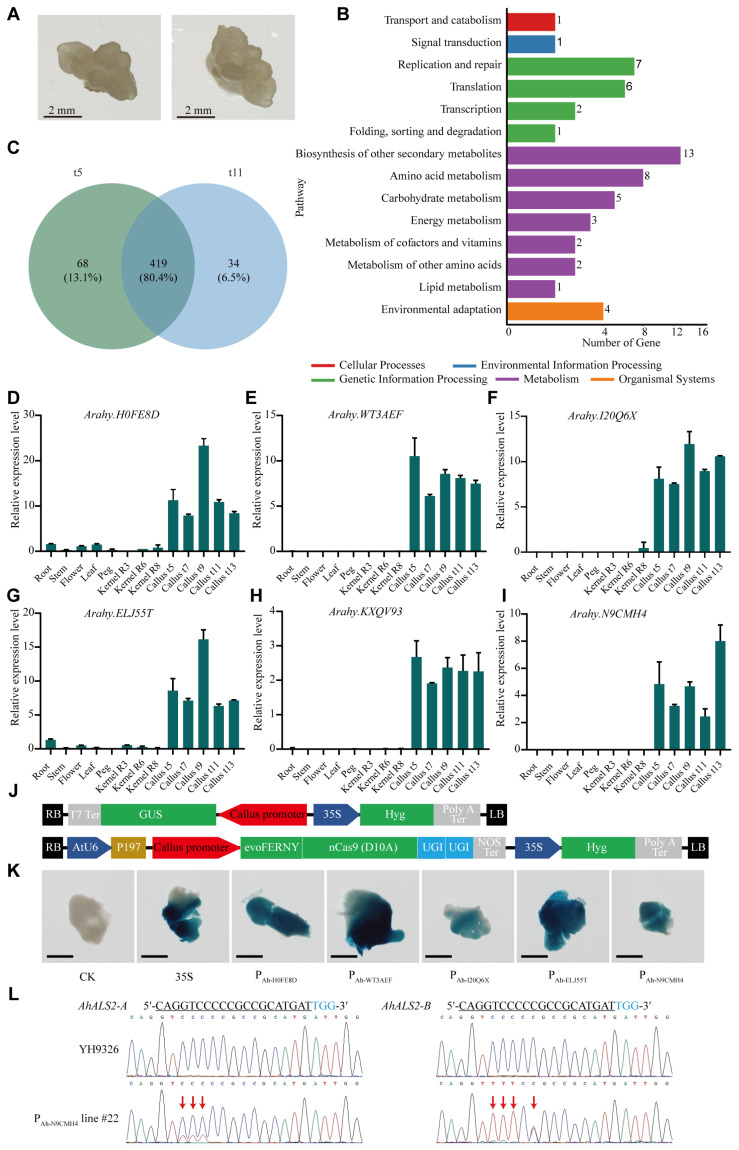 Figure 1
Peer Reviews
No public reviews on file for this paper yet. If you reviewed it on a platform where reviews are public (OpenReview, ICLR, NeurIPS, ICML), you can paste yours below so the community can read it here.
Videos
No videos yet. Explain this paper in a talk, walkthrough, or lecture? Add one.
Taxonomy
TopicsCRISPR and Genetic Engineering · Plant Virus Research Studies · Advanced biosensing and bioanalysis techniques