Bivalent Inhibitors of Mannose-Specific Bacterial Adhesion: A Xylose-Based Conformational Switch to Control Glycoligand Distance
Sven Ole Jaeschke, Ingo vom Sondern, Thisbe K. Lindhorst

TL;DR
This paper presents a new way to study how bacteria recognize sugars by using a molecule that can change shape to control the distance between two sugar-binding units.
Contribution
The novel contribution is the use of a xylose-based conformational switch to modulate glycoligand distance and study its effect on bacterial adhesion inhibition.
Findings
A xylopyranoside scaffold can switch conformations to control the spatial arrangement of mannoside ligands.
Conformational changes affect the biological activity of bivalent glycoclusters in adhesion inhibition assays.
Molecular modeling correlates ligand distance with the structure of the glycocluster–FimH complex.
Abstract
Functional glycomimetics is suited to study the parameters of carbohydrate recognition that forms the basis of glycobiology. It is particularly attractive when a glycoligand allows for the investigation of two different states, such as varying distance between multiple glycoligands. Here, a xylopyranoside was employed as a scaffold for the presentation of two mannoside units which are ligands of the bacterial lectin FimH. The chair conformation of the central xyloside can be switched between a 4C1 and a 1C4 conformation whereby the two conjugated mannoside ligands are flipped from a di-equatorial into a di-axial position. Concomitantly, the distance between the two glycoligands changes and, as a consequence, so does the biological activity of the respective bivalent glycocluster, as shown in adhesion–inhibition assays with live bacteria. Molecular modeling was employed to correlate the…
Genes, proteins, chemicals, diseases, species, mutations and cell lines named across the full text — each resolved to its canonical identifier and authoritative record.
Click any figure to enlarge with its caption.
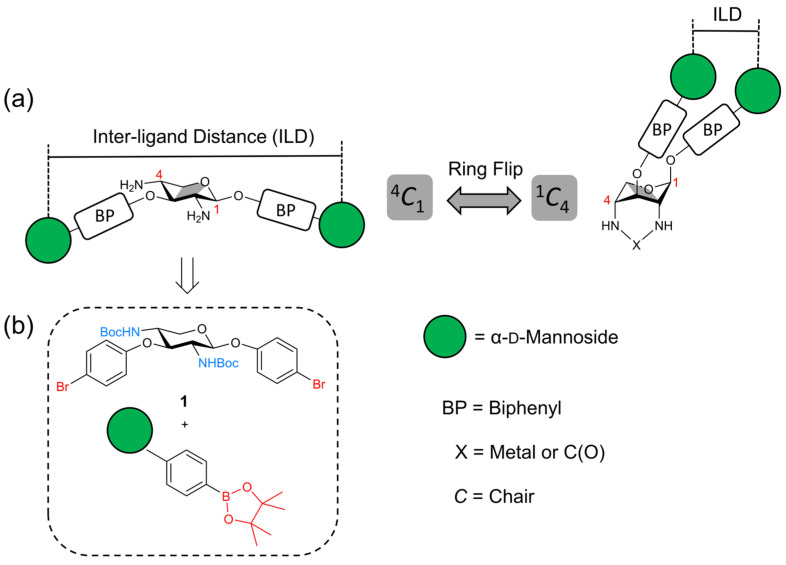 Figure 1
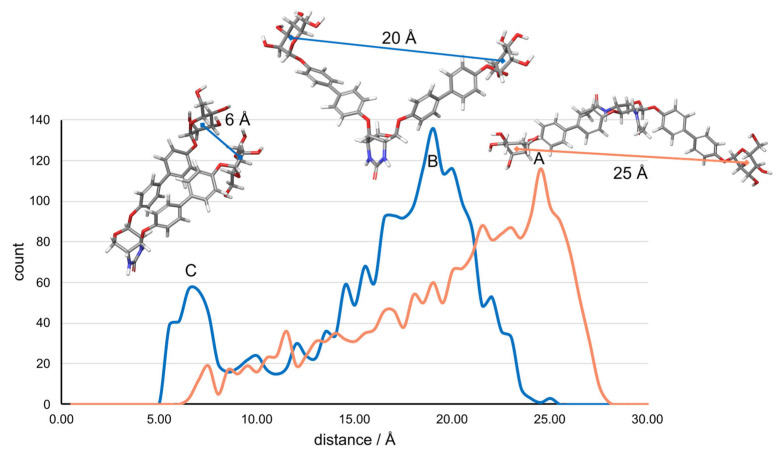 Figure 2
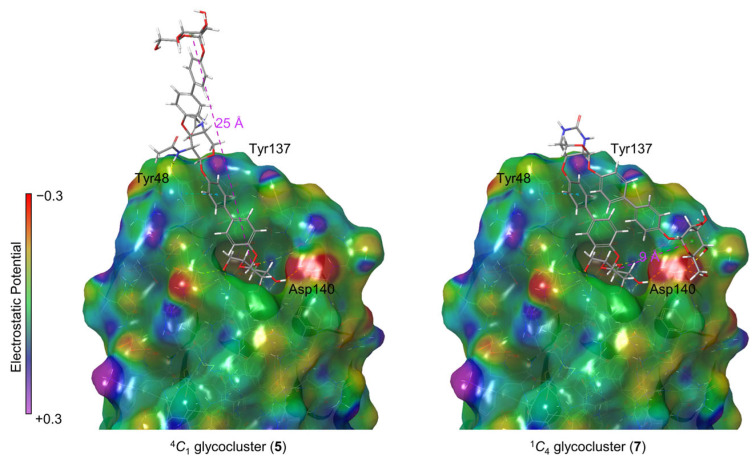 Figure 3
 Figure 4
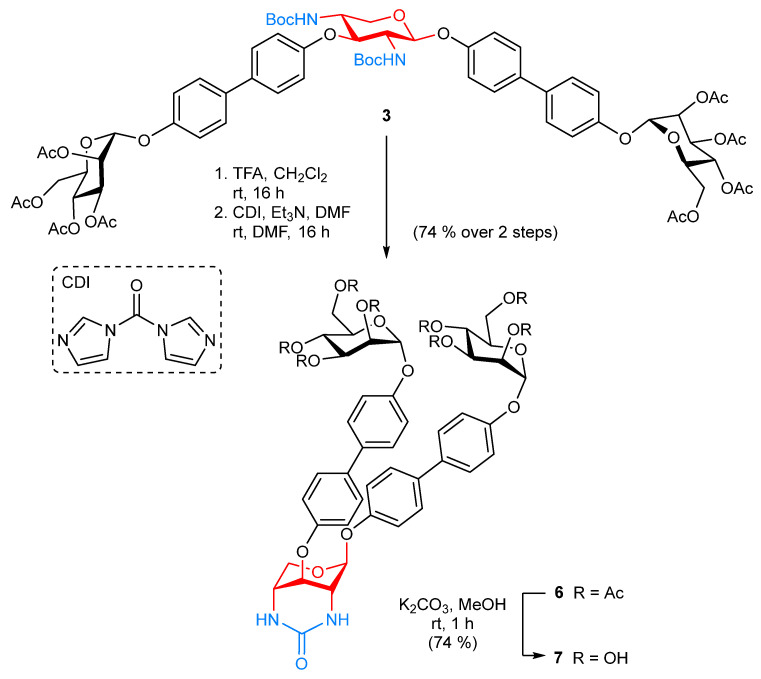 Figure 5
Peer Reviews
No public reviews on file for this paper yet. If you reviewed it on a platform where reviews are public (OpenReview, ICLR, NeurIPS, ICML), you can paste yours below so the community can read it here.
Videos
No videos yet. Explain this paper in a talk, walkthrough, or lecture? Add one.
Taxonomy
TopicsGlycosylation and Glycoproteins Research · Carbohydrate Chemistry and Synthesis · Biochemical and Structural Characterization